

Eltdown Shards
The Eltdown Shards are fictional fragments of inscribed clay associated with the history of intelligent life before humanity. In Lovecraft’s fiction their alleged translations connect the Great Race’s remote past with an alien threat that crosses space through crystal probes. The surviving fragments and the much more expansive interpretations attributed to occult readers are different kinds of evidence within the stories.
4 min read · 756 words
A shared fictional antiquity
Richard F. Searight originated the Eltdown Shards for an epigraph to The Sealed Casket. The epigraph was omitted from that story's first Weird Tales appearance in March 1935. The origin should therefore not be compressed into a claim that the printed magazine text necessarily contained the familiar quotation.
Lovecraft used the name in The Shadow out of Time and in his portion of The Challenge from Beyond. This entry concentrates on those narrative uses. It does not reconstruct the complete writings of Searight's later interpreters or treat every role-playing expansion as a feature of the original literary sources.
Fragments and the problem of reading them
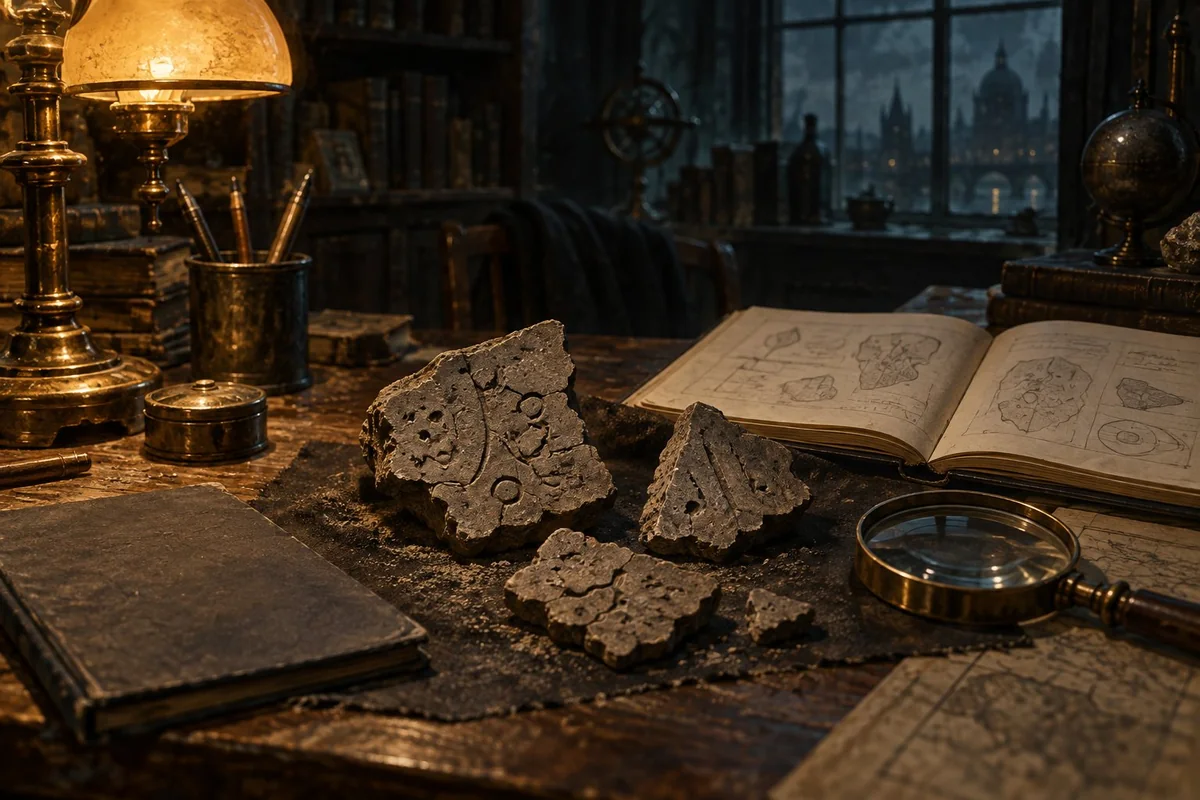
In The Challenge from Beyond, Campbell recalls clay fragments reportedly found in southern England about thirty years earlier. Their claimed geological setting predates human existence, while their shapes and marks suggest purposeful manufacture to some observers.
The text does not present a straightforward scholarly consensus. A small group of fragmentary objects becomes the basis for competing degrees of belief: possible artificial marks, alleged prehuman writing and a remarkably extensive historical narrative.
The difference matters because the artifact alone does not visibly contain the long exposition given to the reader. Access to that exposition depends on an interpreter whose methods and authority are explicitly questionable.
Sources: [2]
Arthur Brooke Winters-Hall’s translation
The Reverend Arthur Brooke Winters-Hall is a Sussex clergyman with occult interests. Around 1912 he claims to connect the shards' markings with hieroglyphs preserved in esoteric traditions and publishes his interpretation at his own expense.
Campbell remembers the resulting pamphlet as disproportionately long for the number of surviving fragments. He initially treats it as the work of an unreliable enthusiast rather than sober geological scholarship.
The cube changes his assessment. Its size, central disc, material and effects correspond so closely with the remembered account that he cannot dismiss the resemblance. Yet the story still presents the historical explanation through his recollection of an alleged translation; he never performs a fresh decipherment of the original clay.
Sources: [2]
The crystal invasion in the translated history
The account describes a distant wormlike civilization that sends crystal probes beyond the range of its physical space travel. A successful probe captures a discoverer's mind and permits an alien investigator to enter the vacated body.
One device reaches ancient Earth under a cone-shaped civilization. Recognizing the invasion, the terrestrial authorities destroy compromised bodies and isolate the artifact. Some displaced minds are consequently abandoned on the remote world.
The defenders preserve the cube for possible research. Unauthorized experiments reveal their actions to the alien civilization, which unsuccessfully tries to reach Earth again. The cube eventually disappears during war and the destruction of its guarded site.
This history gives Campbell a framework for his own capture. Its importance is explanatory and dramatic: a previously dubious publication supplies information that ordinary observation in the forest could not provide.
Sources: [2]
The connection with the Great Race
The Shadow out of Time associates the shards with accounts of the Great Race's origins and mental migrations. Their function is part of a larger web of incomplete testimony: dreams, scattered writings and records that suggest a past radically older than human civilization.
The cone-shaped defenders in The Challenge from Beyond reinforce that connection through their ability to send minds through space and time. The resemblance links the stories without requiring every date or piece of terminology to be flattened into one authoritative chronology.
The documents also make interpretation itself precarious. A seemingly fantastic source can preserve a warning, while the act of recognizing its relevance may come too late to protect the reader. The shards are therefore more than a decorative title in a forbidden library: in Campbell's story they structure the entire explanation of the encounter.
Limits of the surviving literary account
No complete real-world text of the Eltdown Shards exists behind these fictional references. The named translations belong to the narratives and should not be advertised as authentic archaeological publications.
A fixed catalogue of all shards, a universal discovery date, an exact deciphered alphabet and a comprehensive ritual system would require separate attribution to whichever later work provides them. The two Lovecraft narratives do not authorize filling those gaps by invention.
For the same reason, the title's presence is not proof that a book-shaped bound volume appears in every cited scene. The original objects are fragments; a later pamphlet interpreting them is a distinct artifact.
References
- The Shadow out of Time — original text
The fictional narrative is evidence for what the story says, not proof of events in the real world.
- The Challenge from Beyond — original text
The fictional narrative is evidence for what the story says, not proof of events in the real world.
- Eltdown Shards — literary origin and publication note
Used narrowly for Searight’s authorship and the omitted Sealed Casket headnote; primary fiction supports the lore sections.
At a glance
Richard F. Searight
Inscribed clay fragments
Rev. Arthur Brooke Winters-Hall
Uses in The Shadow out of Time and The Challenge from Beyond