

Pnakotic Manuscripts
The Pnakotic Manuscripts are a fictional body of extremely ancient writings used across Lovecraft’s dream and cosmic fiction. They preserve fragmentary lore about divine mountains and prehuman history, yet parts are too old to read. Their appearances connect Lomar and Ulthar with deeper suggestions about the Great Race and the survival of knowledge across immense periods.
6 min read · 1,070 words
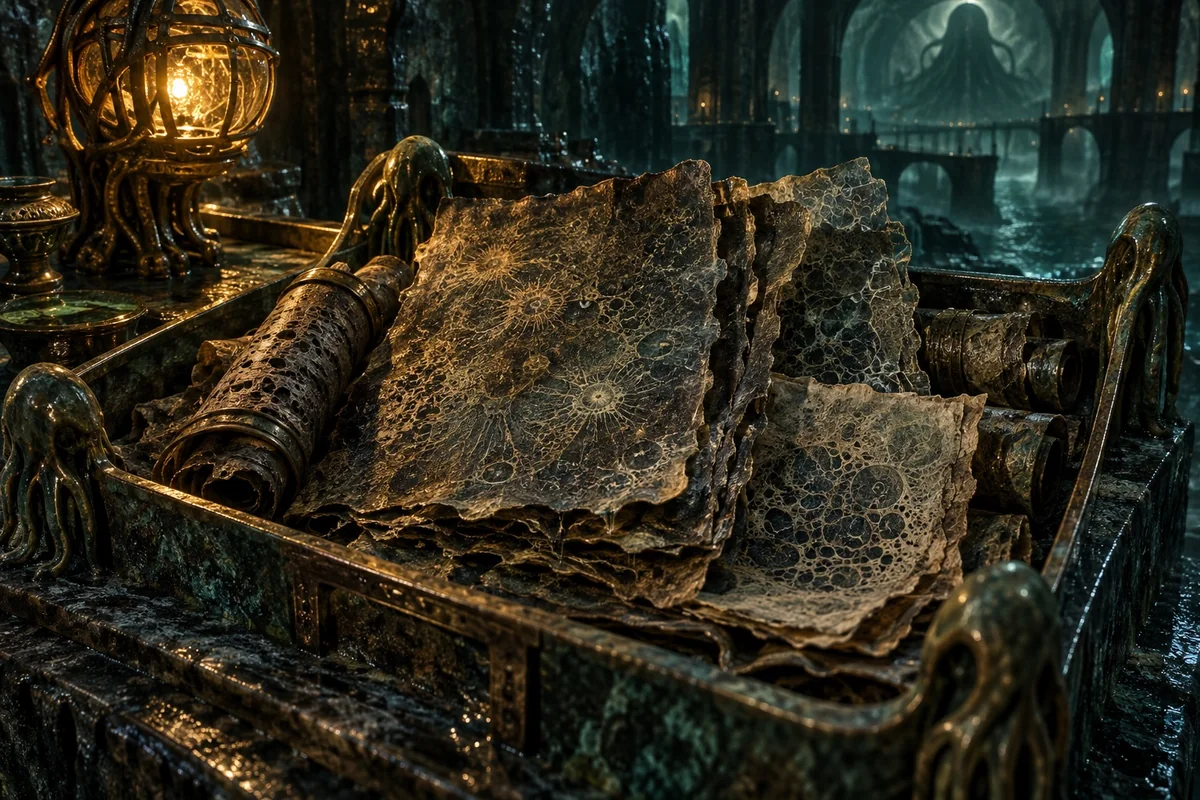
A manuscript tradition rather than a complete book
The plural title suggests a body of writings, and the stories treat its surviving contents as uneven and fragmentary. Some passages communicate recognizable traditions, while others preserve signs without an intelligible text.
Lovecraft does not supply a complete table of contents, one named author responsible for every layer, or a physical description valid for every reference. The manuscripts function as an archive whose antiquity exceeds the ability of later readers to understand it fully.
This uneven survival explains how an image may remain recognizable after its surrounding language has become unreadable. The loss of comprehension is part of the manuscripts' narrative role, not a gap that an encyclopedia should silently fill with invented translations.
Sources: The Other Gods — Unspeakable Tales ebook, The Dream-Quest of Unknown Kadath — original text, The Shadow out of Time — original text
Barzai’s learning in The Other Gods
Barzai the Wise knows the Pnakotic Manuscripts of distant Lomar as well as the seven cryptical books of Hsan. That learning contributes to his confidence that he can approach the gods on Hatheg-Kla.
The manuscripts record an earlier ascent by Sansu, who found only ice and rock. After Barzai disappears, searchers discover an enormous carved sign at the summit. Learned observers recognize its likeness to a symbol in portions of the manuscripts too ancient to read.
The comparison provides evidence of a connection without explaining the sign's complete meaning. Barzai's knowledge also fails to protect him, making the archive a source of dangerous partial understanding rather than a guarantee of mastery.
Transmission from Lomar to the dream region
In The Dream-Quest of Unknown Kadath, an old zoog tells Carter that the manuscripts were made by waking people in forgotten northern kingdoms. According to that account, they were carried into the land of dreams when the Gnophkehs overcame Olathoë and the heroes of Lomar.
The same informant places the last surviving copy in Ulthar. This is a statement within the dream narrative and its particular chain of transmission. It should not automatically erase references in other stories to surviving fragments or different historical layers.
The account links preservation to displacement. A civilization's destruction does not eliminate all of its knowledge, but the surviving material changes location and context. Carter must therefore seek an archive whose route into the dream world is itself part of lost history.
What Carter learns in Ulthar
Carter consults the manuscripts and the books of Hsan while seeking Kadath and his elusive sunset city. They provide less direct assistance than he hopes. Atal's experience and guarded oral knowledge remain necessary.
Atal associates a symbol in the manuscripts with an earlier intervention of the Other Gods and compares it with the mark left on Hatheg-Kla after Barzai's ascent. The recurrence links separate episodes of human approach to divine territory.
The books are thus evidence of prior events and warnings, not a usable set of directions to every forbidden destination. Carter's journey continues through testimony, observation and inference because the archive alone cannot answer his central question.
Prehuman implications in Antarctica
In At the Mountains of Madness, Dyer recalls claims that the fragmentary manuscripts may have an origin earlier than the Pleistocene. The Antarctic discoveries make old references to Leng, Kadath and nonhuman history seem newly disturbing.
As he and Danforth interpret the city's sculptures, the manuscripts become part of a larger body of myths that appear to retain distorted knowledge of prehuman beings. Dyer does not simply translate one passage and obtain the full history of the city.
The direction of interpretation runs both ways: old writings make the discoveries more alarming, while material discoveries make the writings seem less dismissible. Their authority grows through convergence with evidence outside the archive.
The Great Race and surviving text
The Shadow Out of Time identifies parts of the Pnakotic text among the few physical survivals of the Great Race's distant age. This expands the manuscripts' implications beyond the human northern kingdoms emphasized in the dream account.
The story also describes imperfect transmission of knowledge through returned minds and later secret traditions. Physical textual survival and fragmentary mental memory are related means by which an otherwise inaccessible past can leave traces.
The reference does not supply a complete, verified editorial history connecting every manuscript appearance. It establishes another layer of antiquity. A careful account preserves both the dream narrative's human transmission story and the later fiction's prehuman implications.
Relationship with other forbidden writings
The manuscripts appear beside the Necronomicon and the books of Hsan, but they are not alternate titles for those works. Different texts carry different associations, histories and degrees of intelligibility.
The Pnakotic tradition is particularly effective where the story needs a remnant older than the reader's available interpretive tools. A symbol can identify a recurrence, or a fragment can indicate a prehuman past, while the full explanation remains out of reach.
That function distinguishes a fictional archive from a catalogue of spells. Later adaptations may turn it into a defined game resource or add named volumes and powers; those additions require their own attribution.
Sources: The Other Gods — Unspeakable Tales ebook, The Dream-Quest of Unknown Kadath — original text, At the Mountains of Madness — original text, The Shadow out of Time — original text
What remains unspecified
The cited fiction does not establish a single authoritative binding, a complete language sequence, a settled count of sections or a uniform list of supernatural effects. Descriptions of such details should be checked against the writer or game that supplies them.
The most secure core consists of exceptional antiquity, incomplete survival, difficult or lost readability, lore of divine mountains, transmission associated with Lomar and Ulthar, and later connections with prehuman history.
As with the other invented books, the manuscripts are objects inside a literary world. Modern works borrowing the title are separate publications, not recovered copies of an ancient text whose existence Lovecraft documented.
Sources: The Other Gods — Unspeakable Tales ebook, The Dream-Quest of Unknown Kadath — original text, At the Mountains of Madness — original text, The Shadow out of Time — original text
Typer’s first encounter with the text
The Diary of Alonzo Typer records the investigator reading material in the van der Heyl library on 20 April 1908. He says he had not previously seen the Pnakotic Manuscripts or the Eltdown Shards and that their contents change his understanding of the danger surrounding him.
The entry does not reproduce a passage that would allow the reader to identify the precise warning in either work. What it establishes is their role in a recognition: Typer begins to believe he is being held for the approaching Walpurgis observance.
The reference therefore adds an occasion of consultation to the manuscripts' literary history without supplying a new complete account of their language, authorship or organization. Their effect on this reader is more explicit than the exact information he extracts.
References
- The Other Gods — Unspeakable Tales ebook
The fictional narrative is evidence for what the story says, not proof of events in the real world.
- The Dream-Quest of Unknown Kadath — original text
The fictional narrative is evidence for what the story says, not proof of events in the real world.
- The Shadow out of Time — original text
The fictional narrative is evidence for what the story says, not proof of events in the real world.
- At the Mountains of Madness — original text
The fictional narrative is evidence for what the story says, not proof of events in the real world.
- The Diary of Alonzo Typer — original text
The fictional narrative is evidence for what the story says, not proof of events in the real world.
At a glance
Fictional manuscript tradition
Lomar; a surviving copy in Ulthar
Divine mountains, ancient signs and prehuman history
Sansu, in The Other Gods
Surviving text from the Great Race’s age
Fragmentary; some parts too ancient to read
Not supplied in Lovecraft’s fiction