

The Shadow out of Time
An economics professor loses five years of ordinary memory while his body pursues inexplicable studies and journeys. Dreams of an alien archive later draw him to Australia, where the object he most fears to find would make his private past part of a civilization millions of years older than humanity.
12 min read · 2,338 words
Composition, publication and the report to Wingate
Lovecraft wrote The Shadow out of Time between November 1934 and March 1935. Astounding Stories published it in June 1936. Its long investigation of alien culture and deep time makes it a close companion to At the Mountains of Madness, although the mechanism of discovery is different.
Nathaniel Wingate Peaslee narrates a written account intended for his son, Professor Wingate Peaslee of Miskatonic. The immediate occasion is a disturbing exploration in Western Australia during the night of 17–18 July 1935. The narrator hopes his experience might still admit an explanation as dream or delusion, even while arranging the evidence that makes that hope difficult to sustain.
The account begins far earlier, with a disruption in 1908. Its central question is not merely what lies beneath the Australian desert, but what happened to Peaslee himself during the years when another pattern of behavior occupied his familiar body.
Sources: H. P. Lovecraft Archive — fiction in composition order, H. P. Lovecraft Archive — fiction in publication order, The Shadow out of Time — original text
The interruption in 1908
On 14 May 1908, Peaslee is teaching economics at Miskatonic when a sudden disturbance interrupts his ordinary consciousness. When his body resumes activity, it displays unfamiliar habits, interests and ways of using speech and movement. The family and observers confront continuity of appearance combined with a radically altered personality.
The new occupant has to learn aspects of bodily behavior that Peaslee would ordinarily perform without thought. At the same time, it possesses unusual knowledge and an intense program of inquiry. The contrast makes simple explanations of memory loss increasingly inadequate: something seems both ignorant of the body and exceptionally informed about other matters.
The altered Peaslee undertakes extensive reading and travel, including journeys to remote places. He gathers information with a purpose not apparent to the people around him. The body’s life during these years becomes a separate history that the returning narrator must later reconstruct from records and testimony.
His marriage and family relationships suffer. Most relatives cannot accept the changed person, and the estrangement continues after his original consciousness returns. His younger son Wingate is the important exception, preserving a relationship through which the eventual investigation and written warning can proceed.
Return in 1913 and the missing interval
In 1913 the altered personality’s activity changes as if a project is reaching completion. Strange preparations and apparatus precede the return of Peaslee’s familiar consciousness. To the returning man, the economics lecture remains his last ordinary moment; the intervening years have not passed in a continuous remembered life.
The world has nevertheless changed. Peaslee must learn what his body did, confront damaged relationships and attempt to resume work. The discrepancy between his subjective interruption and the public record makes the episode impossible to treat simply as lost time with no consequences.
He develops a particular discomfort with his own body and with the process of looking at himself. Dreams add environments, activities and bodily sensations that do not belong to his remembered life. Their recurrence suggests a displaced experience rather than an empty gap.
His investigation begins as an attempt to understand and recover normality. He studies comparable cases and the literature surrounding unusual memories and personality changes. The research eventually produces an explanation so much larger than the original personal crisis that normality becomes harder, rather than easier, to restore.
Dreams of an unfamiliar body and city
Peaslee’s dreams place him in an immense city inhabited by conical beings. Buildings, ramps, furniture and writing arrangements are organized for bodies unlike a human one. He gradually remembers using such a body himself, with appendages and senses that make ordinary human movement seem strange by comparison.
The city is not presented only as a spectacle. He remembers routines, instruction, communication and work within a sophisticated culture. Familiarity develops through repeated activities rather than a single panoramic vision.
Its architecture and vegetation imply an Earth in a remote geological period. The population has extensive knowledge of the planet and a record of other worlds. Peaslee’s sense of displacement therefore operates in time as well as in anatomy: he is apparently remembering a life in a body and age that should be inaccessible to him.
The detail makes the dream explanation both tempting and increasingly strained. A dream can be vivid, but the accumulation of consistent layouts, technical habits and cultural knowledge begins to resemble a suppressed memory system.
The Great Race and the exchange of minds
The explanation Peaslee reconstructs concerns the Great Race of Yith. Its defining power is the projection of minds through time and the exchange of places with minds in other bodies. The conical organisms are one bodily population occupied by the Great Race, not a sufficient definition of its enduring identity.
During an exchange, the visiting intelligence uses the subject’s body to study its period. The displaced subject inhabits a body in the Great Race’s own setting and supplies knowledge about the world from which it came. The process is therefore reciprocal in location but unequal in power: the subject does not initially choose the displacement or control its duration.
Before return, the captors suppress memories of the interval. Residual dreams and disturbances can survive that treatment. This mechanism accounts both for Peaslee’s missing years and for the later fragments that gradually recover their apparent content.
The account also explains the behavior of his body between 1908 and 1913. Its learning, research and travels belonged to a visitor investigating the human world. What looked like an eccentric personal transformation becomes a research mission conducted through an appropriated person.
Life among the displaced minds
Peaslee remembers communication with other temporarily displaced intelligences. They come from different human periods and from nonhuman civilizations, creating a society whose members are contemporaries only because they have been brought together by the Great Race.
Among the named human examples are the Roman Titus Sempronius Blaesus, the Englishman James Woodville from Cromwell’s period, the Cimmerian Crom-Ya and the future Australian physicist Nevil Kingston-Brown. The range makes a single historical timeline feel like a field that can be visited and compared.
The captives can study and exchange information, and their treatment is not described as constant physical cruelty. Nevertheless, their presence begins with involuntary removal from their own lives. The relative civility of the environment does not erase the coercion on which it depends.
Peaslee contributes a written account of his own period. This apparently routine obligation becomes the central object of the final exploration. If the record survives in a genuinely ancient archive, it would connect the dream life with his ordinary identity in a way no general resemblance of architecture could.
The archive and knowledge across time
The Great Race preserves enormous quantities of information gathered from different ages and worlds. Its archive contains histories and accounts produced by the displaced minds, organized in durable volumes and protective cases. Architecture, materials and cataloging are all designed for survival over extraordinary spans.
The collection changes the meaning of history. For human researchers, the past is partly lost and the future is unknown. For the Great Race, much of both can be investigated through visits and testimony. Knowledge remains a form of power because access and movement are controlled by those who can perform the exchange.
The archive also turns individual lives into resources. Peaslee’s experience matters to the collectors as an account of a period, while the damage to his marriage and personal continuity belongs to the costs imposed on the subject. The story allows admiration for the intellectual achievement to coexist with that unsettling economy of appropriation.
The durable book is a bridge between the narrative’s two halves. In the remembered city it is something Peaslee helps produce; in the desert ruin it becomes something he may be able to find. Writing is both the record of displacement and the possible proof that displacement occurred.
The older enemies and the future escape
The Great Race’s occupation of its terrestrial bodies involves conflict with the beings associated with the black basalt towers. These flying polyps have a different relation to matter, movement and perception from the conical inhabitants. They are driven into underground spaces and kept under control through the Great Race’s superior means.
That control is temporary. The reconstructed history includes a future resurgence that will destroy the conical civilization. Knowing the danger does not mean preventing the physical destruction of its current world. Instead, the Great Race prepares another mass transfer of minds.
Its future refuge lies in a beetle-like population after the human age. The continuity being preserved is mental and cultural, while the present bodies and other inhabitants can be abandoned. This response exposes the distance between survival of the Great Race and protection of every society it occupies.
The black towers and their sealed openings consequently acquire a special significance in Peaslee’s dreams. They mark a threat beneath the ordered city, one the archive’s immense learning has contained without permanently eliminating.
The Australian correspondence
In 1934, Peaslee receives a letter from Robert B. F. Mackenzie in Western Australia. Mackenzie has encountered stones and remains resembling details in Peaslee’s published accounts of his dreams. The correspondence offers a possible connection between private experience and physical archaeology.
Mackenzie’s observations concern an extremely remote area and material that does not fit the expected local record. The report is powerful because it appears to originate outside Peaslee’s immediate environment, yet it also raises the possibility of suggestion through the published descriptions. Verification requires travel and excavation.
Miskatonic supports an expedition. Wingate accompanies his father, and Dyer, already associated with the Antarctic discovery, is among the participants. The party sails in 1935 and begins work in the desert.
The practical expedition changes the investigation’s stakes. Peaslee no longer needs only to explain a dream; he may be approaching an object whose presence would force a choice between his ordinary account of his life and the extraordinary history he has reconstructed.
Excavation and the solitary night journey
The expedition uncovers material that increasingly resembles the remembered city. Fragments and architectural traces strengthen the connection without yet producing the decisive proof Peaslee fears. Familiarity grows as excavation progresses.
During the night of 17–18 July, he wanders away alone and finds access to the buried structures. The solitude matters. Whatever he experiences underground will lack a companion able to confirm the crucial discovery or help recover it.
Inside, recognition guides him through spaces altered by immense age and collapse. Some passages remain astonishingly intact, while others require dangerous climbing and movement through rubble. The ruins are both remembered and transformed: he knows the former organization but must negotiate its present physical condition.
His purpose becomes increasingly specific even before he fully acknowledges it. He is moving toward the archive and the shelf where his own contribution should have been stored. The route is driven by a mixture of remembered habit, fear and a desire for certainty.
The archive in the present
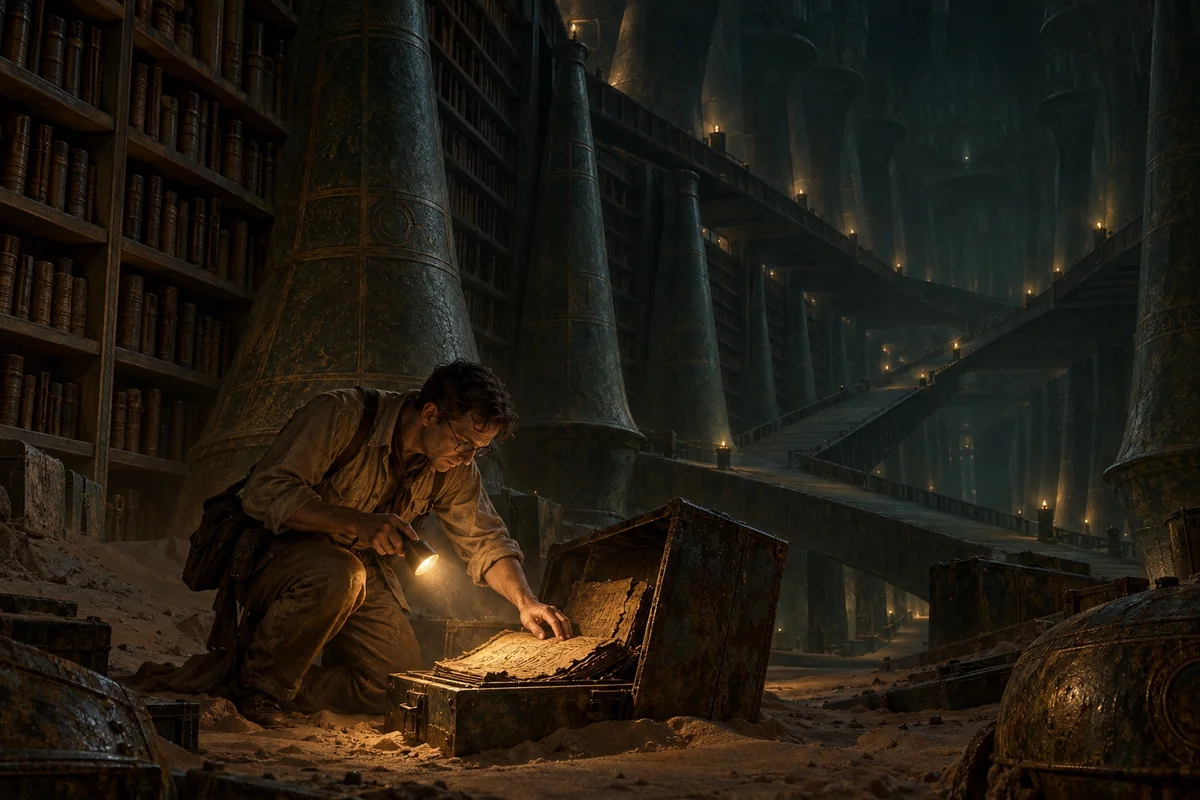
The archival structure has survived better than much of the surrounding city. Protective cases, shelves, symbols and durable pages remain recognizable. Peaslee examines a volume associated with a nonhuman writer he remembers, finding another detailed correspondence between the place and his supposed dreams.
He also encounters openings that had been guarded or sealed in the remembered city. They now stand open, admitting cold damp air from below. Marks in the dust suggest that something may have moved between the depths and the shelves comparatively recently.
The evidence changes the ruins from a passive store of ancient knowledge into an inhabited or accessible danger. The enemies described in the old history may not have disappeared with the civilization whose records Peaslee is searching.
His compulsion nevertheless carries him onward. He recognizes the motions needed to open a particular storage place and considers whether his present human body can reach and manipulate what the conical body once used. Memory becomes physical technique, one of the most disturbing forms of confirmation in the sequence.
The handwriting and the escape
Peaslee finds the record he has been seeking. Its decisive feature is the writing: ordinary English in his own hand appears within the ancient archive. That personal mark joins his modern identity to the remote period more directly than any generic alien object could.
The revelation is held back until the ending of the narrated account, even though the escape follows it in the sequence of events. The structure allows the reader to feel the urgency of flight before learning precisely what made the discovery unbearable.
During his attempt to return, sounds and movement associated with the underground threat intensify his fear. He loses the object that could have supplied public proof and finally reaches the surface in a state of collapse. The survival of the man is purchased at the cost of the evidence he had sought.
He cannot give his son a recoverable book to inspect. Instead he provides a narrative whose strongest proof remains a private perception. The handwriting would settle the question if preserved, but its absence leaves the report suspended between the narrator’s certainty and his desperate wish to have dreamed it.
Identity, deep time and the limits of proof
The story makes identity dependent on more than an outward body. Peaslee’s family sees his body while rejecting its occupant; Peaslee remembers another body while recognizing his own acts of thought and writing. The self can be displaced without the ordinary visible markers of a disappearance.
Deep time is similarly personalized. The remote past is not only a panorama of strange creatures but a period in which the narrator remembers working, learning and recording information. His own handwriting makes geological antiquity intimate.
The Great Race complicates any easy division between civilized investigators and predatory invaders. Its learning and relative restraint coexist with the seizure of bodies and the willingness to abandon a doomed population. Knowledge allows survival, but it does not automatically produce an ethics centered on the lives it uses.
The ending returns to the problem of evidence that structures many Lovecraft tales. Peaslee has enough private confirmation to fear that his worldview is false, yet not enough preserved public proof to make others share that certainty. The linked entries on the Great Race, the flying polyps and Peaslee distinguish the civilization’s history from the narrator’s particular experience of it.
References
- H. P. Lovecraft Archive — fiction in composition order
Composition dates; question marks and ranges retain the source uncertainty.
- H. P. Lovecraft Archive — fiction in publication order
First publication dates and venues; issue dates can differ from actual release dates.
- The Shadow out of Time — original text
The fictional narrative is evidence for what the story says, not proof of events in the real world.
At a glance
H. P. Lovecraft
November 1934–March 1935
1936, June
Astounding Stories, 17, No. 4
Fiction