

Exham Priory
Exham Priory is the English ancestral estate restored by the narrator of The Rats in the Walls. Its layered foundations conceal a vast complex in which successive occupants maintained a cannibal institution, making the building an architectural record of a history its modern owner does not understand.
4 min read · 781 words
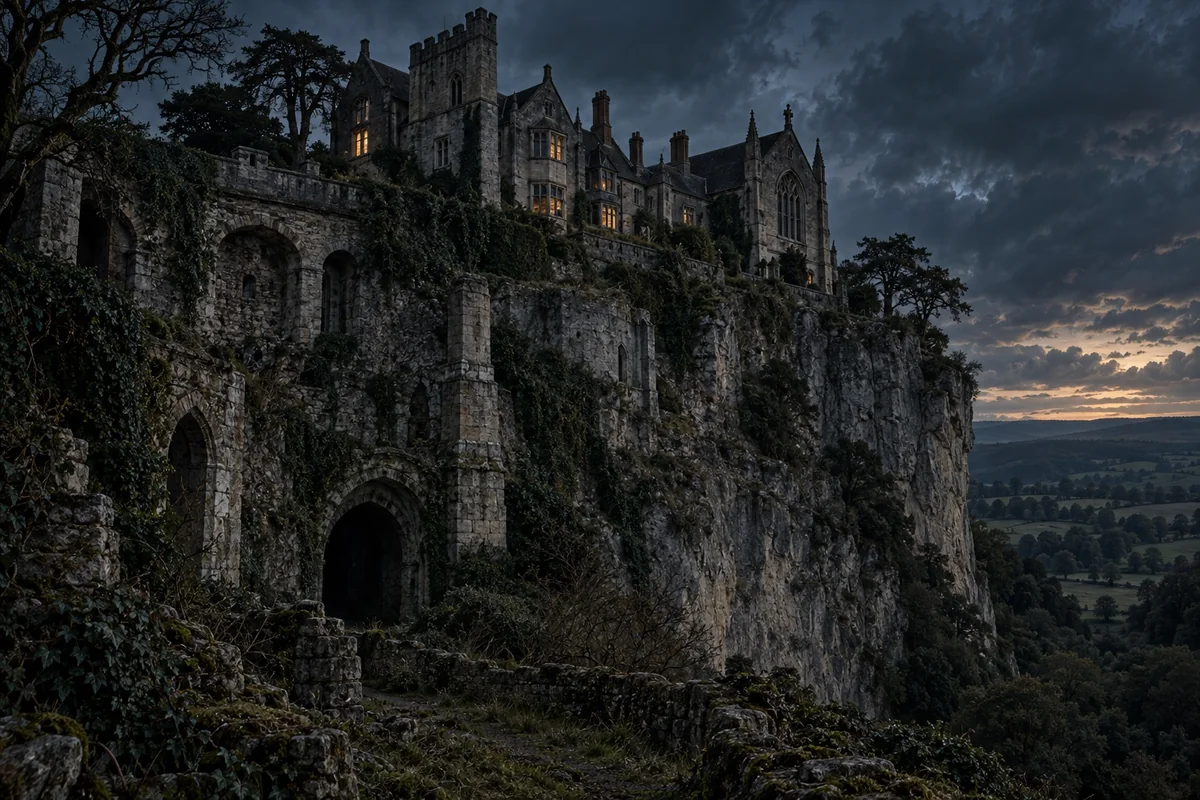
The cliff near Anchester
The priory stands on the edge of a limestone precipice overlooking a desolate valley, about three miles west of the village of Anchester. One side of the foundations merges with the rock.
Sources: [1]
Its position makes the lower cliff difficult to inspect from outside. Unnoticed fissures later account for daylight entering part of the subterranean complex.
Anchester and the estate belong to the story’s fictional geography. The account provides a setting and relative distances rather than identifying a real English monument whose hidden history has been established by excavation.
Successive buildings on one site
The visible ruin combines Gothic upper structures with older masonry. The narrator reconstructs a sequence extending through a prehistoric sacred site, Roman worship associated with Cybele and Atys, Saxon additions and a medieval priory.
A chronicle places a substantial religious establishment there around the year 1000. The estate is granted to Gilbert de la Poer in 1261. Later local accounts associate the family with the practices maintained at the site.
The story’s history is one of continuity beneath changing outward forms. New buildings and affiliations do not necessarily displace the institution operating below them.
Sources: [1]
Walter’s killings and abandonment
During the reign of James I, Walter de la Poer kills members of his household after a disturbing discovery and leaves for Virginia. The estate passes out of family occupation and remains unused for centuries.
Villagers largely regard the killings as the removal of a longstanding curse. A later outbreak of starving rats spreads from the deserted property into the surrounding country.
The underground investigation eventually explains the connection: the cessation of the institution’s food supply leaves its confined population and the rats in a destructive cycle. The visible ruin preserves only the upper part of that aftermath.
Sources: [1]
The twentieth-century restoration
The American descendant buys Exham in 1918 and begins serious restoration after his son’s death. Local labor is difficult to obtain because of the property’s reputation.
The work recreates medieval rooms, stairs, windows and decoration while incorporating modern conveniences. Much of the interior is effectively new, even where old walls and foundations remain.
The owner moves in on 16 July 1923, believing the fresh interior excludes old vermin and allows a new reputation for the family. That confidence depends on treating the restored surface as separate from the site’s concealed lower spaces.
Sources: [1]
The Roman sub-cellar
The documented lower vault contains Roman arches, pillars, inscriptions and several altar-like blocks. Some designs suggest earlier stones incorporated into the later religious setting.
The central altar becomes the focus of the cat’s attention. A draught at its base reveals an opening below, and expert examination eventually identifies the counterweight that lets it tilt.
The mechanism gives the concealed complex a practical entrance. Its discovery follows several kinds of evidence—animal behavior, the narrator’s disputed sounds, moving air and finally physical manipulation—rather than one unquestionable supernatural revelation.
Sources: [1]
The inhabited cavern of earlier centuries
Below the altar, a worn passage descends through accumulated remains into a large cavern. The direction of the cutting suggests construction from beneath.
The lower landscape contains prehistoric, Roman, Saxon and English structures. Pens, vegetable stores, cells and a kitchen reveal the organized keeping and consumption of human beings across a long period. English writing dated as late as 1610 ties the complex to the later household above.
The cellar is therefore not simply a burial crypt. It is the entrance to a former working environment whose functions explain the disproportionate gardens and recurring disappearances described in local tradition.
Sources: [1]
The deeper pits
Beyond the daylight zone, the investigators find disposal pits holding remains from successive ages. Some are filled; others descend beyond the range of the searchlights.
The party never completes a survey of the whole cavern system. The narrative explicitly leaves more distant spaces unexplored.
A map can legitimately show the known sequence from house to sub-cellar, altar, steps, lit cavern and deeper pits. A complete underground city plan with named unvisited chambers would be an invention.
Sources: [1]
Demolition and surviving testimony
After Norrys’s death and the narrator’s breakdown, workmen demolish the priory and erase its foundations. The surviving narrator is confined, and details of the investigation are suppressed.
The destruction ends access to the restored building but does not make the narrator’s account internally reliable in every respect. He acknowledges the discovery while denying the act the others say they witnessed.
In this encyclopedia’s reading, Exham’s importance is its persistence through changes of ownership and appearance. Restoration uncovers a continuity that the owner hoped to control, and demolition becomes the final attempt to prevent that continuity from being encountered again.
Sources: [1]
References
- The Rats in the Walls — Unspeakable Tales ebook
The fictional narrative is evidence for what the story says, not proof of events in the real world.
At a glance
The Rats in the Walls
Limestone cliff about three miles west of fictional Anchester
Gilbert de la Poer, 1261
After Walter de la Poer’s killings in the reign of James I
1918
16 July 1923
8 August 1923
Demolished; foundations being obliterated