

The Rats in the Walls
The Rats in the Walls follows an American descendant of the de la Poer family who restores an English ancestral house and discovers the terrible institution preserved beneath its foundations. Written in August–September 1923 and published in March 1924, it moves from architectural recovery and family research to an archaeological revelation that the narrator cannot keep separate from himself.
8 min read · 1,520 words
Publication and retrospective narration
Lovecraft wrote The Rats in the Walls in August–September 1923. Weird Tales published it in March 1924. The principal investigation occurs in July and August 1923.
The narrator begins by announcing his move into the restored Exham Priory, but quickly reveals that the building has since been destroyed. The account is therefore retrospective from the beginning, even though it postpones the circumstances of his present confinement.
The synopsis includes the discoveries beneath the house and the final account of Captain Norrys’s death.
Sources: H. P. Lovecraft Archive — fiction in composition order, H. P. Lovecraft Archive — fiction in publication order, The Rats in the Walls — Unspeakable Tales ebook
A broken family record
The narrator’s ancestors left England after Walter de la Poer was implicated in killing members of his household during the reign of James I. In Virginia the family name became Delapore, and knowledge of the earlier past was restricted.
A sealed document traditionally passed from one head of the family to his eldest son. The burning of Carfax, the family’s Virginia home, during the American Civil War destroyed that record and killed the narrator’s grandfather. The narrator remembers the fire from childhood.
His later life in Massachusetts brings commercial success but little further knowledge of the English history. The missing document makes the recovery of the ancestral house appear to offer an answer to a genuine gap in the family record.
Alfred and the decision to restore
The narrator’s son Alfred serves as an aviation officer in England during the First World War. Through Captain Edward Norrys, whose family owns Exham Priory, he learns the local stories and writes about them to his father.
The father purchases the property in 1918, but Alfred returns severely wounded. For the next two years his care takes precedence. After the son’s death, the bereaved father turns toward the restoration as a purpose for his remaining life.
That emotional history matters later. The investigation is not simply a wealthy antiquarian’s hobby; it is also an attempt to rebuild continuity after the loss of his child.
Architecture and local hostility
Exham Priory stands on a limestone cliff near the village of Anchester. Gothic remains rest on older structures, with Roman and still earlier foundations below. The site’s successive uses seem to connect prehistoric worship, a Roman religious presence, a medieval priory and the de la Poer estate.
Villagers refuse to work on the restoration and treat the family name with fear. Norrys and visiting antiquarians are more encouraging. The narrator interprets much of the hostility as superstition and hopes his residence will restore the family’s reputation.
He moves in on 16 July 1923 with seven servants and nine cats. The rebuilt interior combines a deliberately medieval appearance with modern conveniences, including electric lights disguised as candles.
The older stories
The traditions associate the family with disappearances, secret rites and an inner group that includes some people who married into the line. They also describe a terrible outbreak of rats three months after Walter’s killings and departure.
The narrator learns that the villagers largely approved of Walter’s violence, believing he had ended a longstanding evil. Walter’s later reputation in Virginia is honorable and humane, making the motive for the massacre more puzzling.
These details prepare a distinction between lineage and participation. The secret institution is not simply something every family member knowingly endorses, and the act that ended it is understood differently inside and outside the estate.
Cats, noises and empty traps
The narrator’s oldest black cat becomes restless and attentive to the old walls. Other cats behave similarly. The narrator begins hearing scurrying behind hangings and panels, though servants hear no corresponding rats.
Traps are found sprung but empty. The apparent movement seems to pass downward through solid old masonry toward the sub-cellar. The cats’ reactions give him some external indication that he is not imagining everything, but no other human confirms the specific sound.
The uncertainty is central: animal behavior, disturbed traps and the narrator’s hearing do not all have the same evidentiary force. The story preserves that imbalance through the later investigation.
Dreams of the herd
The narrator dreams of a filthy underground grotto where a white-bearded keeper drives a herd of repellent creatures. Rats descend and consume both the herd and its keeper.
The dream becomes more detailed on later nights. At one point he recognizes something in a creature’s face and wakes screaming, though the meaning is initially suppressed.
These visions anticipate the underground discovery without supplying an orderly explanation. They also connect the future revelation with the narrator’s emotional life, a connection that becomes explicit only during his final breakdown.
The altar and the draught
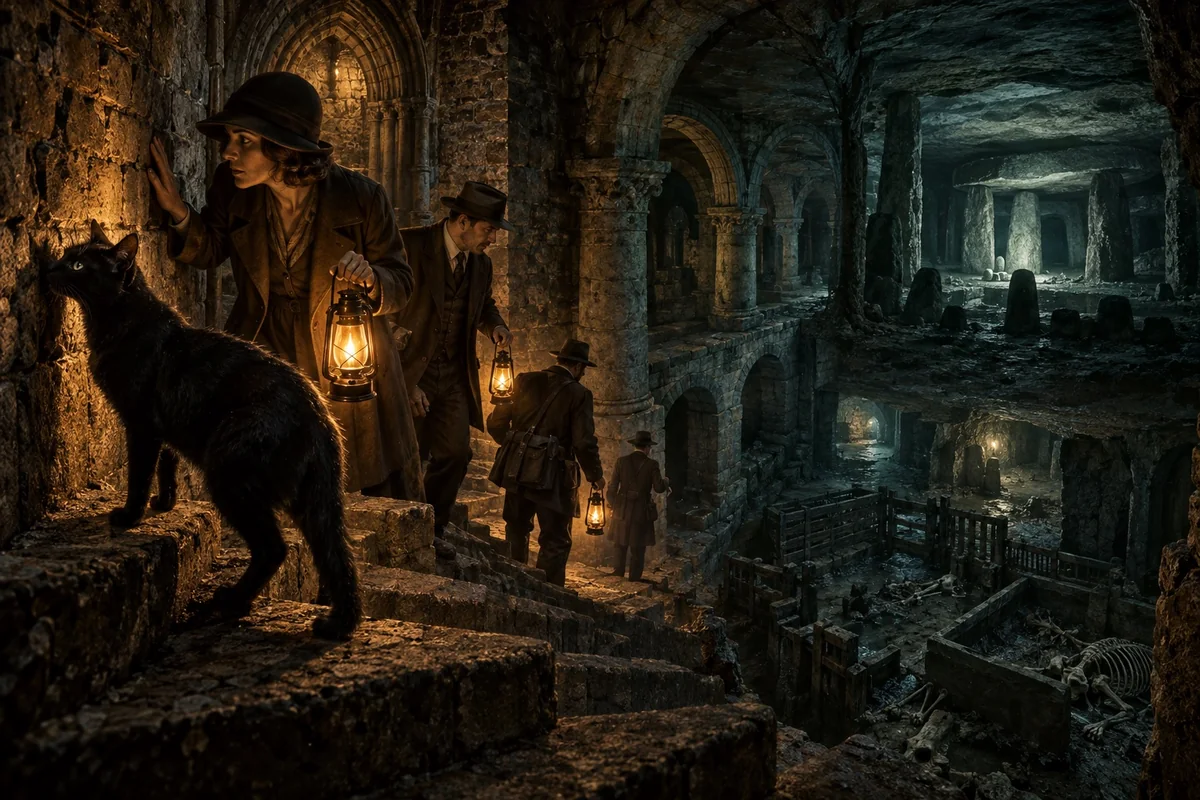
Norrys and the narrator inspect the Roman sub-cellar, then spend a night there with the cat. The narrator again hears rats moving downward, while Norrys hears only the distressed cats outside.
The black cat claws around a large central altar. When Norrys scrapes away material at its base, a lantern flame reveals a current of air rising through the gap.
That physical draught provides a new kind of evidence. Whatever the status of the sounds, an unknown space appears to exist below the documented foundations. The two decide to obtain expert assistance rather than force the entrance alone.
The party from London
They recruit five specialists, including archaeologist Sir William Brinton, anthropologist Dr. Trask and the psychically inclined Thornton. The seven men return to Exham on 7 August and begin the descent the next morning.
Brinton discovers how to tilt the central altar on a counterweight. Beneath it lie worn steps crowded with gnawed human remains. The direction of the marks in the passage suggests it was cut upward from below.
Filtered daylight reaches the cavern through unnoticed openings in the cliff. The investigators are entering a concealed physical complex, not merely following a vision through an immaterial doorway.
The buildings beneath the house
The cavern contains structures from several periods: prehistoric mounds and standing stones, Roman and Saxon remains, and an English building. Human bones cover the ground in enormous numbers.
Further examination reveals pens, storage for coarse vegetable fodder, cells and spaces used for slaughter and cooking. The investigators conclude that people had been kept and bred as livestock for a cannibal institution continuing across successive cultures.
Some of the story’s interpretation uses a hierarchy of supposedly higher and lower human forms voiced by its characters. That language belongs to the tale’s historical construction and prejudices; it should not be adopted as a neutral classification of real human populations.
The family’s place in the institution
The size of the gardens above becomes intelligible as a source of fodder for the concealed population. The English kitchen contains familiar utensils and writing as recent as 1610, linking the older complex with the de la Poers’ occupation.
The narrator finds a skeleton wearing a ring bearing his own family’s arms in one of the barred cells. The evidence complicates any simple division in which all ancestors are masters and all victims are outsiders.
Walter’s killings now appear to have stopped the institution. The subsequent loss of food explains the rats’ attacks underground and their later emergence into the surrounding countryside.
The pits and the loss of control
The party continues toward darker portions of the cavern and finds refuse pits containing the remains of victims from many periods. Some extend beyond the reach of the lights.
The narrator becomes separated from most of the group, with Norrys still nearby. He hears the rats again and follows the cat into darkness. His thoughts begin mixing family history, the burning of Carfax, Alfred’s death and hostility toward the surviving Norrys.
The prose breaks into fragments and shifts of language. The earlier dream’s creature is associated with Norrys’s face, while the narrator struggles against identification with the herd’s keeper. The investigation has become a collapse of his distinction between remembered loss, ancestral crime and present action.
Norrys’s death and the institution at Hanwell
The others find the narrator after three hours, crouched over Norrys’s partly consumed body while the black cat attacks his throat. The narrator reports that this is what they say happened, rather than accepting responsibility.
Exham Priory is demolished and its foundations are being erased. The survivor is confined at Hanwell, with Thornton in a nearby room. Access between them is prevented, and information about the discovery is suppressed.
The narrator insists that rats killed Norrys and continues hearing them behind the padding of his room. The final defense repeats the central auditory experience that no other person has confirmed.
Interpretation: recovery becomes repetition
In this encyclopedia’s reading, the restoration begins as an effort to redeem a family name and compensate for personal loss. The discovered history defeats that intention, while the narrator’s response appears to repeat the appetite he has uncovered.
The rats occupy several roles at once: a remembered outbreak, a possible summons, a private sound and an explanation the narrator uses to deny his own action. Reducing them to a single clearly identified monster would remove the ambiguity on which the ending depends.
The architectural descent gives history a physical form. Each layer preserves evidence that the institution adapted across changes of culture and religion. The narrator’s modern wealth and rebuilt rooms cannot insulate him from what the foundations reveal.
Related music
A Thousand Masks is a dark metal song inspired by Nyarlathotep, the Crawling Chaos who walks among humanity, hiding behind countless faces and whispered lies.
References
- H. P. Lovecraft Archive — fiction in composition order
Composition dates; question marks and ranges retain the source uncertainty.
- H. P. Lovecraft Archive — fiction in publication order
First publication dates and venues; issue dates can differ from actual release dates.
- The Rats in the Walls — Unspeakable Tales ebook
The fictional narrative is evidence for what the story says, not proof of events in the real world.
At a glance
H. P. Lovecraft
August–September 1923
1924, March
Weird Tales, 3, No. 3
Fiction