

Flying polyps
The flying polyps are the partly material alien beings imprisoned beneath the Great Race’s cities in The Shadow out of Time. Their inaccessible minds, control of destructive winds and eventual return establish a threat that even the Great Race’s extraordinary knowledge cannot permanently remove.
4 min read · 818 words
Name and distinction from other ancient beings
The story describes a half-polypous alien population and also calls it by broad terms such as Elder Things or Elder Beings. The conventional name flying polyps helps distinguish these creatures from the winged, star-headed civilization encountered in At the Mountains of Madness.
Sources: [1]
That distinction is supported within The Shadow out of Time itself. Its account separately mentions conflicts with the star-headed Old Ones centered in Antarctica. Shared descriptive labels do not make the two populations biologically identical.
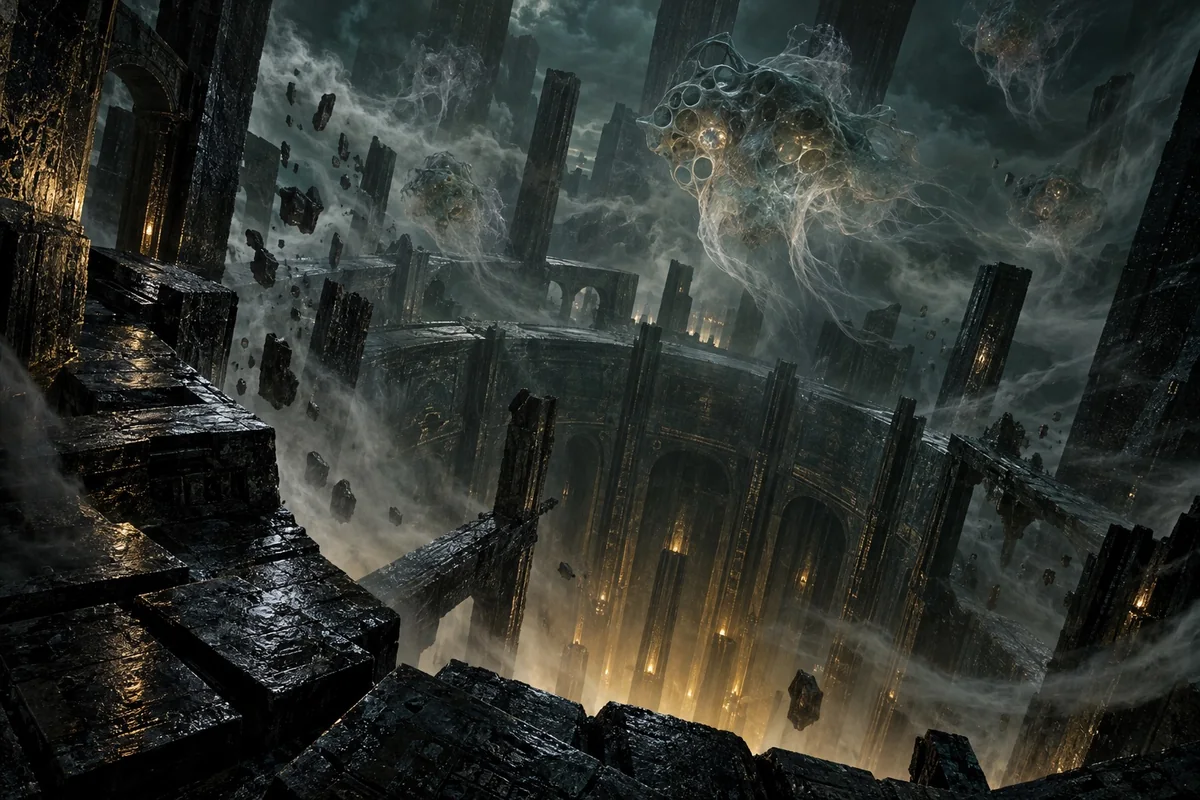
The creatures’ form remains only partially disclosed. Peaslee collects fragments and hints because the Great Race treats the subject with unusual silence. An illustration must therefore interpret a limited description rather than pretend that the story supplies a complete anatomical diagram.
Origin and ancient settlement
The reconstructed history places their arrival from remote regions of space before the Great Race’s terrestrial dominance. They occupied Earth and three other planets in the solar system and built cities characterized by dark basalt towers without windows.
They preyed upon the beings they encountered and extended their dwellings into underground passages. When the minds from Yith arrived and established their own civilization, they developed instruments that could subdue these older occupants. The victors drove them into subterranean spaces and sealed the entrances.
Many of the Great Race’s later cities consequently incorporated an earlier built environment. The windowless towers retain a historical identity within those settlements. Their presence is not simply an architectural fashion invented by the conical inhabitants, but a reminder of the population confined below them.
Sources: [1]
Matter, movement and perception
The creatures are only partly material in the sense familiar to humans. Nevertheless, they can use material implements, require particular kinds of shelter and cannot simply pass bodily through every solid barrier. Their unusual nature should not be expanded into unlimited intangibility.
They can move through the air without wings or another visible means of support. Hints associate them with changes in visibility and an exceptionally plastic form. Their senses do not include sight; their perception can reach through barriers even where their substance cannot.
Reported signs include whistling noises and enormous tracks composed of five circular toe impressions. These traces make the presence of something physically consequential compatible with an uncertain visible outline. The reader receives effects and partial evidence rather than a sustained close view.
Sources: [1]
Weapons and the limits of mind exchange
The Great Race cannot exchange minds with the polyps because their consciousness is organized too differently. This limitation matters in a narrative where mental displacement has otherwise supplied extraordinary power. The mechanism that allows control of other bodies does not solve every encounter.
The polyps use great winds as weapons. Their enemies counter them with devices producing powerful electrical effects, a form of attack the text says can destroy them. A large standing military force remains ready around the danger represented by the older towers and sealed passages.
Neither fact should be generalized beyond the story’s evidence. Their association with wind does not turn them into a complete elemental taxonomy, and the effectiveness of specific fictional electrical weapons does not establish that an ordinary modern electrical device would achieve the same result.
Sources: [1]
Confinement and the foretold breakout
Imprisonment is imperfect. Over long periods the underground population grows stronger, and occasional eruptions occur where entrances have not been adequately secured. Geological changes create further vulnerabilities. The Great Race responds by closing more routes and maintaining guarded access where it may be strategically useful.
Its time investigations reveal a final successful eruption. Knowing this future leads the most capable minds to prepare an escape into a much later civilization. Their response preserves selected intelligences while abandoning the bodies and cities exposed to the disaster.
The later history indicates that the attackers do not permanently repopulate the whole surface world. Peaslee’s account suggests vengeance as a motive and offers possible reasons for their remaining below. Those explanations are conjectures inside the narrative. The text does not provide direct testimony from a polyp explaining its political aims.
Sources: [1]
The Australian ruins
The basalt architecture and sealed depths give Peaslee’s exploration a threat separate from the shock of recognizing the archive. He may be approaching the physical remains of his impossible memories, but those remains also belong to a site with an older and dangerous history.
Air movements, sounds and damaged barriers during the escape evoke the feared presence below. The story does not pause to identify and measure a clearly visible individual for the investigator. The uncertainty keeps the ruined city from becoming a safely abandoned museum.
The polyps thus expose the limit of the Great Race’s apparent supremacy. A civilization can know the history of countless species and still inhabit structures built over an enemy it cannot finally pacify. The old cities preserve both accumulated knowledge and the unresolved conditions of their conquest.
Sources: [1]
References
- The Shadow out of Time — original text
The fictional narrative is evidence for what the story says, not proof of events in the real world.
At a glance
The Shadow out of Time
Windowless basalt towers
Aerial movement without visible wings
Nonvisual; capable of penetrating material barriers
Destructive winds
Certain powerful electrical effects
Incompatible with the Great Race’s method