

Elder Things
The Elder Things are the fivefold, star-headed beings whose fossil-like bodies and Antarctic city reveal an immense prehuman civilization. At the Mountains of Madness reconstructs their biology, engineered life, wars, art and decline, then turns an apparent monster attack into a disturbing encounter between displaced explorers.
9 min read · 1,821 words
Principal source and the problem of naming
At the Mountains of Madness was written in 1931 and serialized in Astounding Stories from February to April 1936. It is the central source for the star-headed Antarctic beings. The explorers call them Elder Things and Old Ones, sometimes interpreting their appearance through material previously encountered in the Necronomicon and related imaginative works.
The phrase Old Ones is not a reliable universal species label across all Mythos fiction. In this narrative it often means the builders whose bodies Lake studies and whose carvings Dyer reads. It should not automatically identify them with Cthulhu’s faction, the invisible presences of the Dunwich Necronomicon passage or the later category of Elder Gods. The conflict with Cthulhu’s spawn depends on distinguishing the populations.
Their entry can be unusually detailed because the source provides both anatomical observation and an extended historical reconstruction. Those forms of evidence should still be identified. Lake’s deductions from the bodies and Dyer’s deductions from carvings are not the same as a complete first-person autobiography of the civilization.
Lake’s discovery and the fourteen specimens
Professor Lake leads a party toward unusual geological formations and finds a deposit containing remains of organisms incompatible with the expedition’s expectations. One extraordinary specimen is followed by thirteen more. Eight appear complete, with their appendages preserved; the others are damaged. Their tissues retain remarkable flexibility despite the age attributed to the surrounding material.
The dogs react with intense hostility, making transport and storage difficult. Lake’s group moves the bodies to the camp and separates the dogs from them. The initial classification remains uncertain because the beings combine a radiate organization, animal-like internal systems and features suggesting plant reproduction. Lake sends detailed descriptions by radio and begins a dissection.
The discovery’s scientific excitement precedes the catastrophe. The researchers believe they are handling preserved material whose living period is unimaginably remote. That assumption becomes central to the later reinterpretation: what appears to one party as a specimen may still be a member of a civilization capable of waking and examining the strangers around it.
Sources: [1]
External anatomy and fivefold organization
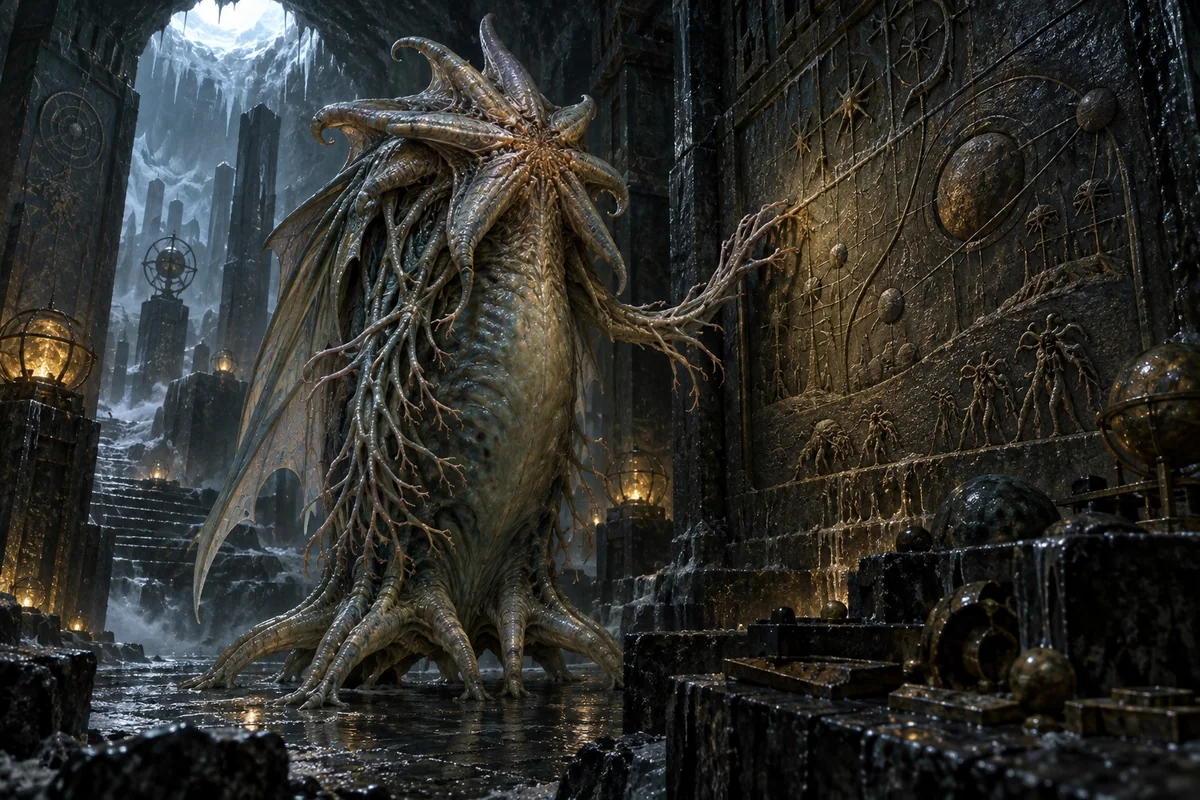
The complete specimens are described as roughly eight feet from end to end. Their central barrel-shaped torso is six feet long and widest near the middle, with five prominent ridges. The body narrows toward both ends. Its dark gray material is exceptionally tough but remains flexible, allowing appendages to fold close against it.
Five systems of arms emerge around the middle. Each branches into smaller subdivisions and then into numerous fine tendrils, producing a manipulative arrangement unlike a pair of human hands. Membranous wings lie in the spaces between the torso’s ridges. They can be folded, and their construction includes tubular features and openings that contribute to Lake’s uncertainty about function.
At the upper end, a swollen neck supports a five-pointed head. Tubes associated with the points terminate in eye-like structures, while other tubes end in openings Lake interprets as mouths. Fine cilia and several colors distinguish parts of the head. At the lower end is another fivefold arrangement, with muscular limbs and membranous extensions suited to movement.
The repetition of five is not decorative coincidence. The explorers later encounter it in architecture, carving and signs. Biological organization becomes a clue to cultural authorship: the same structural preference that shapes the body also helps explain why the city’s forms differ from human conventions. A drawing that gives the being a normal human head or a simple bilateral dragon body loses one of the source’s most sustained details.
Sources: [1]
Internal biology, senses and reproduction
Lake finds organ systems that imply a complex organism rather than an inert plant or a simple marine animal. Respiratory arrangements, digestion and muscular development suggest considerable adaptability. He infers a capacity for musical piping rather than ordinary syllabic human speech, a detail that later becomes important when sounds recur in the city’s lower passages.
The bodies also suggest a sensory range that cannot be reduced to sight alone. Dyer’s historical reconstruction describes forms living at different ocean depths, where light and other modes of perception have different importance. Some use luminous organisms; others supplement vision through unusual sensory structures. The source gives a civilization adapted to several environments rather than one creature confined to a single human-like habitat.
Reproduction proceeds through spores, and the historical account links their longevity with a limited need to produce new generations. Expansion into new regions can make reproduction more necessary. The resulting social history does not begin from the assumed human pattern of paired parents and short generational succession. The beings’ durable bodies, long lives and methods of reproduction shape the civilization’s practical needs.
Sources: [1]
Arrival and the creation of terrestrial life
The carvings suggest an extraterrestrial origin and a period of migration between worlds. After reaching Earth, the beings first establish themselves in the sea. They create simple life for food and other purposes, then develop more elaborate organisms. Dyer interprets the history as placing them near the beginnings of the planet’s biological development.
Shoggoths are a particularly consequential product of this activity. Their plastic bodies can form temporary organs under the creators’ influence, making them useful for heavy labor. Other developing organisms are permitted to continue when useful or harmless, and troublesome forms can be eliminated. Human evolution appears within a history whose initial experiments were not undertaken for humanity’s benefit.
This is the fictional account inferred by the explorers, not a scientific explanation of actual evolution. Within the narrative, its effect is to displace humanity from a privileged position. The beings who once occupied the role of creators are themselves a historical civilization with practical goals, enemies, declining knowledge and eventual vulnerability.
Sources: [1]
Cities, writing and historical art
The Antarctic ruins contain an immense system of buildings, bridges, passages and carved interiors. Their scale initially makes them overwhelming, but their records gradually become legible to the explorers. Representations of organisms and events allow Dyer and Danforth to reconstruct a sequence even when they cannot simply translate every sign into an English sentence.
The source also describes writing on surfaces suited to underwater use and adaptations of visual culture to darker environments. Geometry, the repeated fivefold pattern and narrative carving help make the city an expression of its builders’ bodies and history. Its strangeness is systematic rather than an arbitrary collection of ominous shapes.
The quality and style of the art change over time. Dyer reads these differences as evidence of development and decline, using an art-historical perspective familiar from human archaeology. His admiration becomes part of a growing recognition that the builders possess a culture capable of achievement, memory and loss. The city ceases to be merely a threatening backdrop and becomes the record of another people’s experience.
Sources: [1]
Wars, coexistence and changing environments
The reconstructed history includes conflict with several other nonhuman populations. Cthulhu’s octopoid spawn are associated with a major struggle followed by an accommodation. The Mi-Go also belong to the larger pattern of incursions and competition. These references place the builders within a contested Earth rather than at the top of an uncontested cosmic hierarchy.
Environmental change is equally important. Continents shift, climates alter and the balance between marine and land settlement changes. The capacity to travel through space is eventually lost or no longer exercised as it once was. Knowledge does not simply accumulate forever: techniques once available to the civilization can become inaccessible to later descendants.
The Antarctic setting makes the end of that process visible. A city once linked with richer ecosystems faces increasing cold and the failure of its surrounding life. Its inhabitants develop plans for a lower, more sheltered environment. The transition is an effort to survive material circumstances, not the fulfillment of a prophecy that they were always destined to live beneath ice.
Sources: [1]
Shoggoth labor, rebellion and the lower city
The builders’ dependence on shoggoths contains the source of a continuing danger. Created organisms begin to reproduce and develop capacities that no longer remain entirely within their makers’ control. A rebellion leads to a campaign of reconquest, after which the survivors are again subjected to the builders’ purposes. The records preserve the violence through distinctive images of victims and methods of control.
Later environmental pressures increase dependence on the same labor. Shoggoth tissue is taken into the construction of the lower settlement, and the newly bred organisms become large and capable. Their imitation of the builders’ voices complicates the significance of sounds heard by the human explorers. A familiar signal can be reproduced by something whose relationship to its makers has changed.
The story’s sympathy for the Elder Things does not require ignoring this system of domination. They can be skilled artists, scientists and frightened survivors while also having created and violently controlled other living beings. The historical complexity is one reason their civilization is more compelling than an uncomplicated species of either benevolent teachers or evil invaders.
Sources: [1]
Awakening, the ruined camp and Dyer’s recognition
When the relief party reaches Lake’s camp, the scene appears to show madness, mutilation and inexplicable theft. Gedney is missing, as are the complete specimens and useful supplies. Some bodies have been examined in a manner that resembles dissection. Human investigators initially attempt to fit the evidence into a human crime or breakdown.
The subsequent journey reveals another possibility. The preserved beings have awakened in a world transformed by immense time, found unfamiliar creatures around them and tried to understand the situation. They gather equipment and information, recognize the mountains and seek a route back toward their civilization. What the humans regard as theft and experimentation can be understood as the practical behavior of displaced explorers.
Dyer’s attitude changes most forcefully when he recognizes their shared predicament. His sympathy does not make their actions harmless, but it interrupts the assumption that frightening anatomy entails an absence of motives humans could understand. Both parties have approached the unknown through collecting, examining, moving and trying to survive.
The awakened beings then encounter danger in the lower passages. Their ancient familiarity with the region cannot guarantee safety after so much change. The human explorers discover the traces of that encounter and face the shoggoth that has made the old city its own. The final danger is neither identical with the original specimens nor explained by simply calling everything in Antarctica an Elder Thing.
Sources: [1]
Significance within the Mythos
The Elder Things make the immense past concrete through bodies, architecture and recorded labor. Unlike a remote name invoked only in a ritual, they can be examined as organisms and reconstructed as historical actors. That apparent legibility is what allows the story to turn fear into recognition before exposing a further threat.
Their relation to the rest of the Mythos is consequently historical as well as supernatural. They fight other beings, manufacture life, lose capabilities and adapt to a changing planet. The linked entries on the Antarctic city, shoggoths, Cthulhu and the Mi-Go describe different parts of that network. Keeping their identities separate preserves the source’s account of an Earth that has housed several civilizations with competing interests.
Sources: [1]
Related music
The Dead But Dreaming is a dark folk metal song inspired by The Call of Cthulhu, evoking R’lyeh, forbidden worship and the ancient dream beneath the sea.
References
- At the Mountains of Madness — original text
The fictional narrative is evidence for what the story says, not proof of events in the real world.
- H. P. Lovecraft Archive — fiction in publication order
First publication dates and venues; issue dates can differ from actual release dates.
- H. P. Lovecraft Archive — fiction in composition order
Composition dates; question marks and ranges retain the source uncertainty.
At a glance
H. P. Lovecraft
At the Mountains of Madness
February–April 1936 · Astounding Stories
Old Ones
Fivefold; barrel torso; star-shaped ends; wings and branching arms
Approximately eight feet, as reported by Lake
Fourteen; eight apparently complete
Spores
Shoggoths
Carvings interpreted by Dyer and Danforth