

Glaaki
Glaaki, also spelled Gla’aki, is Ramsey Campbell’s spined, lake-dwelling entity. Its associated writings and later reappearance connect Campbell’s early Severn Valley stories with his mature exploration of cosmic terror.
2 min read · 405 words
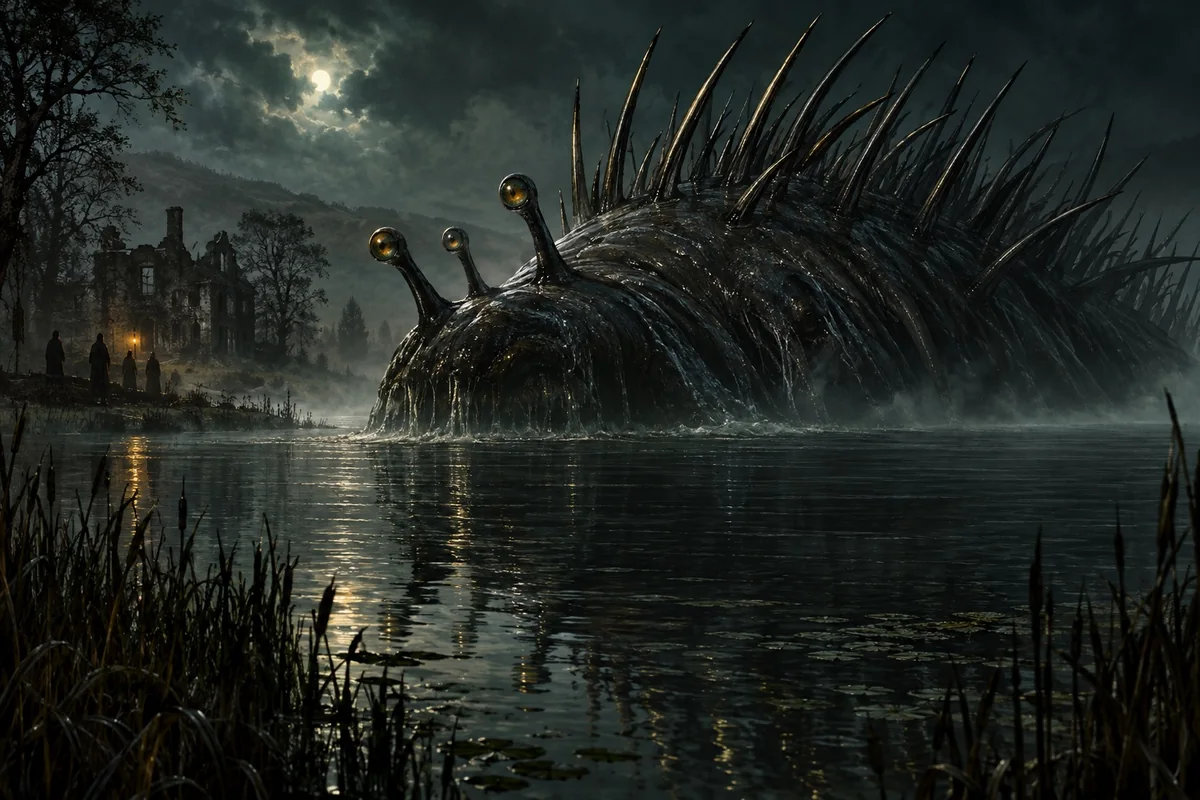
The creature in the early fiction
The description reproduced from The Inhabitant of the Lake gives the creature an oval body, a thick-lipped circular mouth, metallic-looking spines and three stalked yellow eyes. Small pale projections underneath appear to support movement. The familiar slug comparison summarizes its outline without capturing all these features.
Sources: [1]
Another passage makes contact a change in perception: eyes emerge from the water, the witness experiences chest pain and spreading numbness, and terror abruptly disappears. The menace involves the observer's altered response as well as an enormous visible body.
Mention, appearance and collection
Bibliographic distinctions matter here. S. T. Joshi identifies The Room in the Castle as an early citation of Glaaki. The Inhabitant of the Lake supplies the sustained lake-centered encounter. Naming the collection's title story as the creature's only point of introduction obscures those different uses.
The early stories were collected in Campbell's first book in 1964. PS Publishing's anniversary edition places them beside early drafts and Derleth's editorial responses, allowing the development of Campbell's inventions to be followed rather than treated as a single unchanging mythology.
Returning to Gla’aki
In a 2016 interview, Campbell explained that he revived Gla'aki and Daoloth because he felt the earlier treatments had not done their ideas justice. His aim included a stronger sense of cosmic terror. The return is consequently a reconsideration of an old invention, not merely an additional catalogue of powers.
Sources: [4]
The Last Revelation of Gla’aki
The 2013 novella moves the investigation to Gulshaw, a northern seaside town. Brichester University archivist Leonard Fairman follows an offer of rare occult volumes after publishing an essay online. The advertised overnight visit becomes an increasingly elusive search.
The publisher's description associates that search with people gathering at the shore, secretive encounters and dreams of a stone enclosure traveling through space before reaching Earth. These images extend the entity's reach beyond its original lake setting, while withholding a complete explanation of what the visitor is entering.
Sources: [5]
A presence assembled through reading
The later narrative distributes the sought-after books among different holders. Fairman's growing access to them accompanies a loss of ordinary confidence in his surroundings. The sequence makes revelation a process in which a reader becomes implicated, rather than a detached delivery of background information.
The distinction between Gla'aki and the Revelations remains useful: a book can structure an investigation long before any direct encounter settles what its deity is.
Sources: [6]
References
- The Inhabitant of the Lake — descriptive excerpts reproduced by Michael Bukowski
- S. T. Joshi — Ramsey Campbell: Before and after Lovecraft (1993)
- PS Publishing — The Inhabitant of the Lake, 60th Anniversary Edition
- Ramsey Campbell interviewed by Simon Bestwick (2016)
- The Last Revelation of Gla’aki — publisher description reproduced by Risingshadow
- Skulls in the Stars — The Last Revelation of Gla’aki (2014)
At a glance
Ramsey Campbell
Glaaki; Gla’aki
The Inhabitant of the Lake and Less Welcome Tenants (1964)
The Last Revelation of Gla’aki (2013)
Literary development; game statistics are separate