

The Inhabitant of the Lake and Less Welcome Tenants
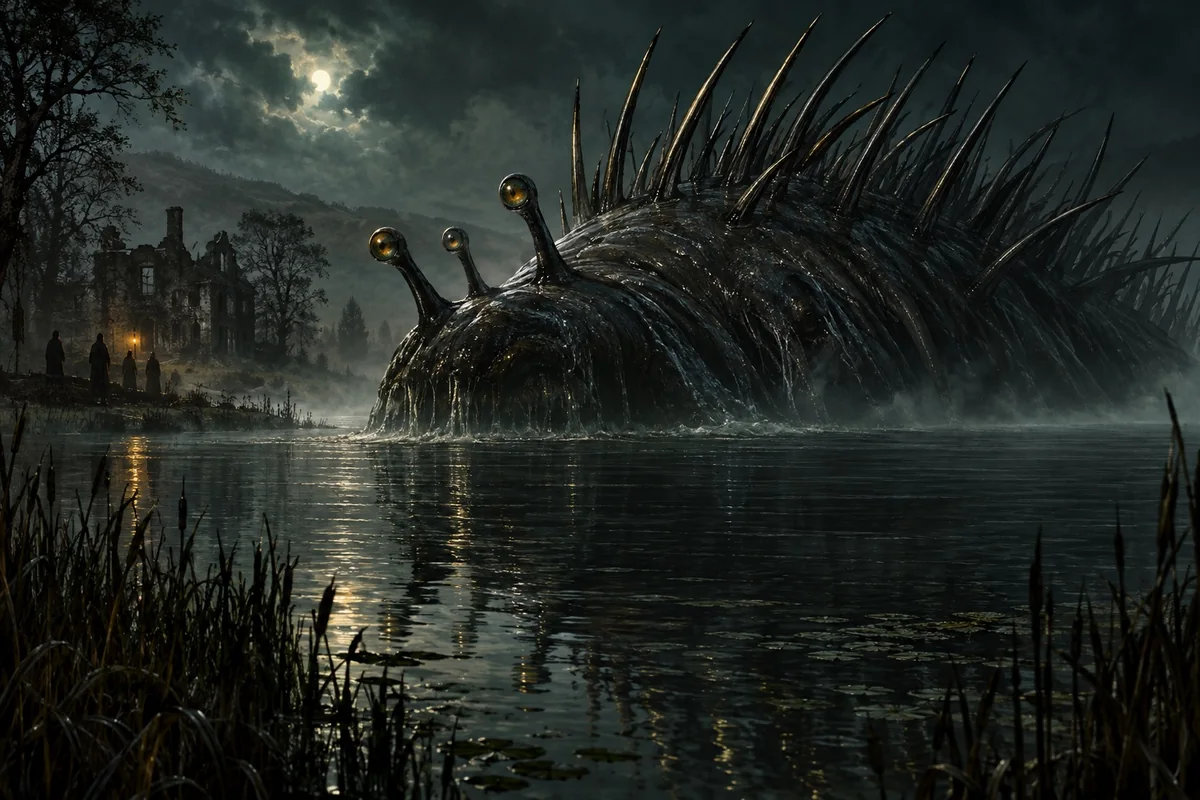
The Inhabitant of the Lake and Less Welcome Tenants is Ramsey Campbell’s first collection, published by Arkham House in 1964. Its early Mythos fiction records an apprenticeship shaped by August Derleth’s editorial advice, followed by Campbell’s development toward a more personal and less explicitly systematized horror.
4 min read · 679 words
The original collection
The 1964 book appeared under the name J. Ramsey Campbell. Its ten stories are The Room in the Castle, The Horror from the Bridge, The Insects from Shaggai, The Render of the Veils, The Inhabitant of the Lake, The Plain of Sound, The Return of the Witch, The Mine on Yuggoth, The Will of Stanley Brooke and The Moon-Lens.
This is a collection, not a single novel with ten chapters. Its title story supplies the book's principal name, but the remaining tales retain separate plots. References to a creature or location elsewhere in Campbell's writing should not be assumed to occur in every story here.
Sources: The Inhabitant of the Lake and Less Welcome Tenants — source and publication reference
An apprenticeship in correspondence
PS Publishing's account traces the collection to stories Campbell began sending Derleth as a teenager in 1961. The correspondence became an extended professional relationship, and the resulting book appeared three years later.
The later expanded edition includes original drafts and Derleth's responses. That material permits readers to examine revision rather than treating the published stories as the unchanged products of a single early burst of inspiration. The editorial history is part of the collection's importance alongside its additions to fictional lore.
Sources: PS Publishing — The Inhabitant of the Lake, expanded edition
From imitation toward suggestiveness
In Paul Tomlinson's interview, Campbell recalls beginning with conspicuous imitation of Lovecraft, including unconvincing attempts at New England speech. Derleth urged him to reduce the repeated assertions that things were indescribable and to study M. R. James's handling of suggestion.
Campbell describes imitation as a possible stage of learning rather than a sufficient destination. What first attracted him was the sense of a horror greater than the words directly disclosed. His later dissatisfaction emerged when explanatory habits began filling the very gaps that made the influence powerful.
This testimony complicates an account of Derleth as merely encouraging more names and monsters. At least part of the remembered advice concerned restraint, atmosphere and the practical craft of making a scene frightening.
Restored title and expanded editions
The 2011 reissue used The Inhabitant of the Lake and Other Unwelcome Tenants, restoring the intended title. Campbell's account attributes the earlier wording to a mismatch introduced while the original cover was being arranged.
Later PS editions contain drafts, correspondence, the author's afterword and illustrations by Randy Broecker. Their supplementary material should be distinguished from the contents of the ten-story 1964 edition. An anniversary label on a reissue also does not alter the original publication year.
Sources: The Inhabitant of the Lake and Less Welcome Tenants — source and publication reference, PS Publishing — The Inhabitant of the Lake, expanded edition
Campbell’s retrospective criticism
Speaking to David McWilliam in 2012, Campbell characterized the early tales as close imitations influenced by later codification of the Mythos. He argued that excessive explanation could reduce the mystery he valued in Lovecraft.
He pointed to subsequent experiments that sought cosmic terror without the familiar named apparatus, or located Lovecraftian effects within contemporary urban life. He also described a continuing debt to Lovecraft's accumulation of detail and narrative structure.
The resulting distinction is between abandoning an obvious vocabulary and abandoning an influence. Campbell's later account supports the former much more clearly than the latter. His criticism of his youthful work is valuable testimony about artistic development, not a requirement that readers dismiss the collection.
Sources: David McWilliam — Interview with Ramsey Campbell, 23 January 2012
After the collection
In the interview with Stefan Dziemianowicz, Campbell recalled attempting stories less overtly modeled on Lovecraft almost immediately after completing the Inhabitant group. He described an early effort to put a psychological relationship at the center of a supernatural story, rather than relying mainly on a borrowed mythology.
That recollection makes the book a turning point as well as a beginning. The development toward the kind of work later collected in Demons by Daylight was already underway before his first collection had acquired its retrospective status as a landmark of British Mythos fiction.
For readers following this encyclopedia's connections, Glaaki, Brichester and the Revelations of Glaaki offer routes into Campbell's invented world. The author profile provides the broader career context; the collection's contents and editorial documents show one early phase of that career, not its permanent limits.
Sources: Ramsey Campbell with Stefan Dziemianowicz — The Count of Thirty interview, David McWilliam — Interview with Ramsey Campbell, 23 January 2012
References
- The Inhabitant of the Lake and Less Welcome Tenants — source and publication reference
- PS Publishing — The Inhabitant of the Lake, expanded edition
- Paul Tomlinson — Interview with Ramsey Campbell
- David McWilliam — Interview with Ramsey Campbell, 23 January 2012
- Ramsey Campbell with Stefan Dziemianowicz — The Count of Thirty interview
At a glance
Ramsey Campbell
1964
Collection
Arkham House