

The Haunter of the Dark
The Haunter of the Dark is the presence awakened through the Shining Trapezohedron in Lovecraft’s story of the same name. It occupies the darkness of a deserted Providence church, develops an intimate connection with Robert Blake and is identified in his final diary as an avatar of Nyarlathotep.
5 min read · 893 words
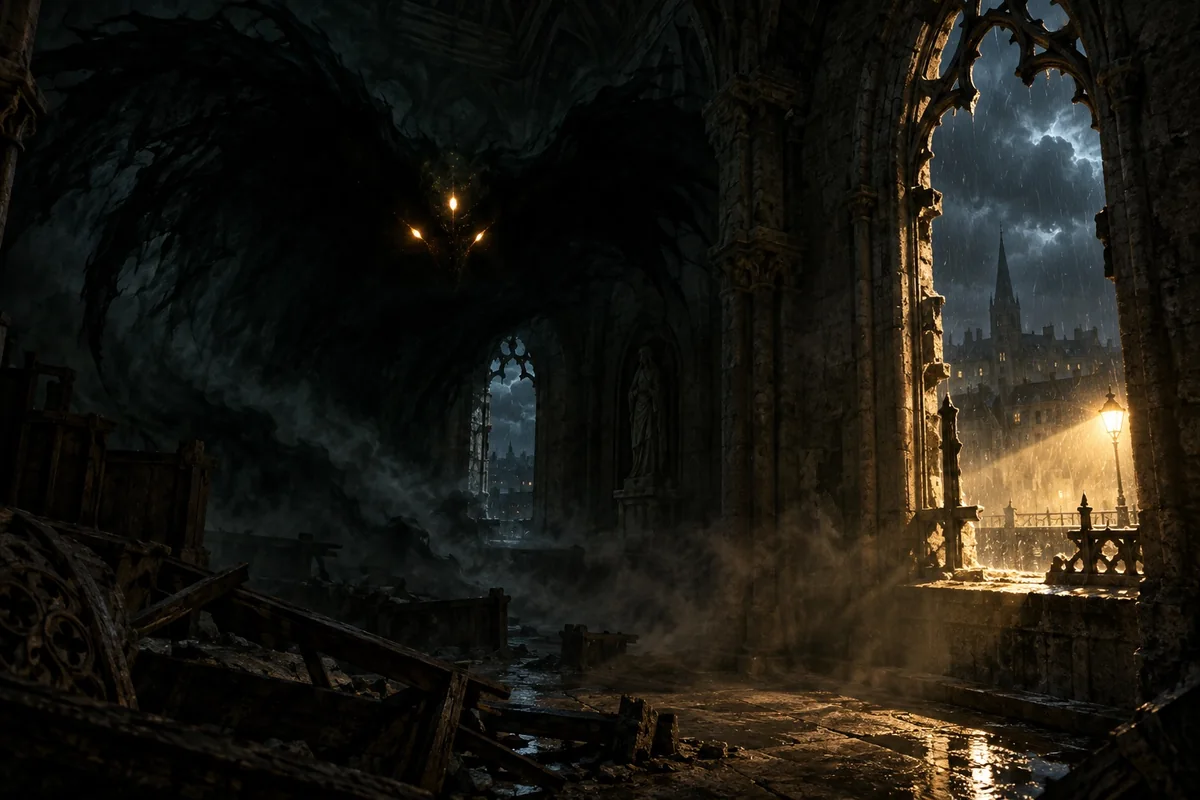
Knowledge offered through a forbidden contact
The Starry Wisdom records describe the Haunter as a source of extraordinary knowledge requiring terrible sacrifices. Looking into the Trapezohedron establishes access to it. Blake’s research supplies this account after his first encounter with the stone.
The story does not present the Haunter giving a calm public lecture or answering a complete series of questions. Its reputation for knowledge reaches the reader through cult testimony, while its actual narrative presence develops through visions, sounds, fear and altered consciousness.
This distinction preserves both dimensions of the entity: what worshippers believed they could obtain from it and what contact does to the story’s investigator.
The relation to Nyarlathotep
Blake explicitly calls the presence an avatar of Nyarlathotep in his final diary. He associates that name with an earlier human manifestation in Egypt. The identification is thus present in Lovecraft’s text, rather than being entirely a later bestiary classification.
It appears, however, during a breakdown of Blake’s ordinary perception and identity. The narrative gives the reader his recognition without explaining a complete hierarchy of Nyarlathotep’s forms or the mechanism by which one manifestation becomes another.
The Haunter’s specific limitation concerning light should therefore be applied to this portrayal. It does not automatically establish a weakness shared by every appearance of Nyarlathotep in every author’s work.
Darkness as a condition of movement
The records state that weak light drives the Haunter back and strong light can banish it, after which another summons is required. The church’s windowless steeple provides a refuge, while city street lamps divide it from the surrounding neighborhood.
During a temporary blackout, witnesses report movement through lower parts of the building. Reporters later find broken windows and materials apparently arranged to obstruct incoming light. The evidence suggests an effort to extend or preserve usable darkness.
The final storm removes the city’s electric protection, and wind defeats many of the lamps and candles carried by residents. The entity’s opportunity depends on these changing physical conditions rather than on an arbitrary ability to appear anywhere at any time.
An incompletely seen body
Much of the presence is conveyed through odor, weight, sound and motion. People hear scraping, bumping and winglike vibration; investigators find unusual stains, damaged material and traces of burning.
During the final departure, some witnesses think they see a spreading darkness or smoke-like mass moving east. Blake’s final words add black wings and a three-lobed burning eye. These observations come from different positions and degrees of visibility.
A single rigid anatomical description would conceal that presentation. The burning eye is a strong textual image, but the tale does not give a complete measured body plan or establish that every spectator clearly sees a winged creature.
The connection with Blake
After looking into the Trapezohedron, Blake feels perceived by something beyond it. That connection continues across the distance between Federal Hill and his rooms near Brown University.
It develops through dreams, compulsive attention, sleepwalking and a final collapse of ordinary perception. Blake seems to experience the dark church from within while remaining physically at his desk. His diary struggles to distinguish his own identity from the presence’s.
The relationship is more intimate than a monster simply tracking a person through the streets. The threatened boundary is the investigator’s sense of where and who he is. His effort to repeat his name and address reflects that loss of stability.
Lillibridge and the evidence of earlier contact
The damaged skeleton of reporter Edwin Lillibridge is found in the tower beside the route to the steeple. His notes document the cult and the light-sensitive presence. Staining, charring and unusual damage make Blake suspect an extraordinary death.
No surviving witness narrates the precise event that killed Lillibridge. The association is strong within the story’s pattern, but an article should not invent a detailed attack sequence or dialogue for the missing reporter.
The earlier remains serve as a warning Blake understands only after he has already examined the stone. They also connect his experience with a previous investigation that failed to return a public account.
The final flight and electrical event
During the August blackout, the church’s east-facing boarding breaks and an indistinct presence moves toward College Hill. Witnesses in that direction report an extraordinary gust, odor and later burst of light and sound.
Blake dies at his desk during the same crisis. The story allows an official explanation through electrical or nervous shock while placing it beside his diary and the observations from both hills.
The lightning is central to the event, but the account does not conclude with an independently examined corpse of the Haunter or a comprehensive statement that Nyarlathotep has been destroyed. The ending concerns this manifestation and this fatal contact.
The artifact after the encounter
Dr. Dexter disposes of the Trapezohedron and its box in Narragansett Bay. He believes the act removes something too dangerous to preserve. Because looking through the artifact is the means of contact, its removal has an evident protective purpose.
Disposal is nevertheless different from demonstrated destruction. Lovecraft’s story leaves the object submerged, and later continuations must be read under their own authorship.
The Haunter’s lasting narrative role is to make an apparently one-way investigation reciprocal. The person who studies a hidden world becomes visible to it, and the knowledge obtained cannot be neatly separated from the connection established.
Related music
A Thousand Masks is a dark metal song inspired by Nyarlathotep, the Crawling Chaos who walks among humanity, hiding behind countless faces and whispered lies.
References
- The Haunter of the Dark — Unspeakable Tales ebook
The fictional narrative is evidence for what the story says, not proof of events in the real world.
At a glance
The Haunter of the Dark
Avatar of Nyarlathotep in Blake’s final diary
Gazing into the Shining Trapezohedron
Dark steeple of the Starry Wisdom church
Retreats from light; strong light can banish it
Smoke-like or shadowy mass; black wings; three-lobed burning eye
Robert Blake