

Nyarlathotep
Nyarlathotep is the intelligent messenger and soul associated with the Other Gods, encountered as a performer, a royal guide, a figure of witchcraft and a manifestation in darkness. His distinctive terror is personal: he understands human curiosity and desire well enough to exploit them.
10 min read · 1,919 words
Origins and publication history
The first prose work named Nyarlathotep appeared in The United Amateur in an issue dated November 1920. The Archive dates its composition to early December, a reminder that a periodical’s cover date need not indicate when readers actually received it. This short piece already combines an apparently human visitor, scientific exhibition, disturbed sleep and a final vision of mindless cosmic powers whose soul is Nyarlathotep.
The Dream-Quest of Unknown Kadath, composed in 1926–1927 but first published in 1943, gives him a much more sustained speaking role. Publication order can therefore obscure the order in which Lovecraft developed the character. Readers encountered The Dreams in the Witch House in 1933 and The Haunter of the Dark in 1936 before the long Dream-Quest reached print. These works do not merely repeat the original scene: they connect the name to different encounters, places and narrative forms.
Sources: H. P. Lovecraft Archive — fiction in publication order, H. P. Lovecraft Archive — fiction in composition order, Nyarlathotep — Unspeakable Tales ebook, The Dream-Quest of Unknown Kadath — original text, The Dreams in the Witch House — original text, The Haunter of the Dark — Unspeakable Tales ebook
The Egyptian showman
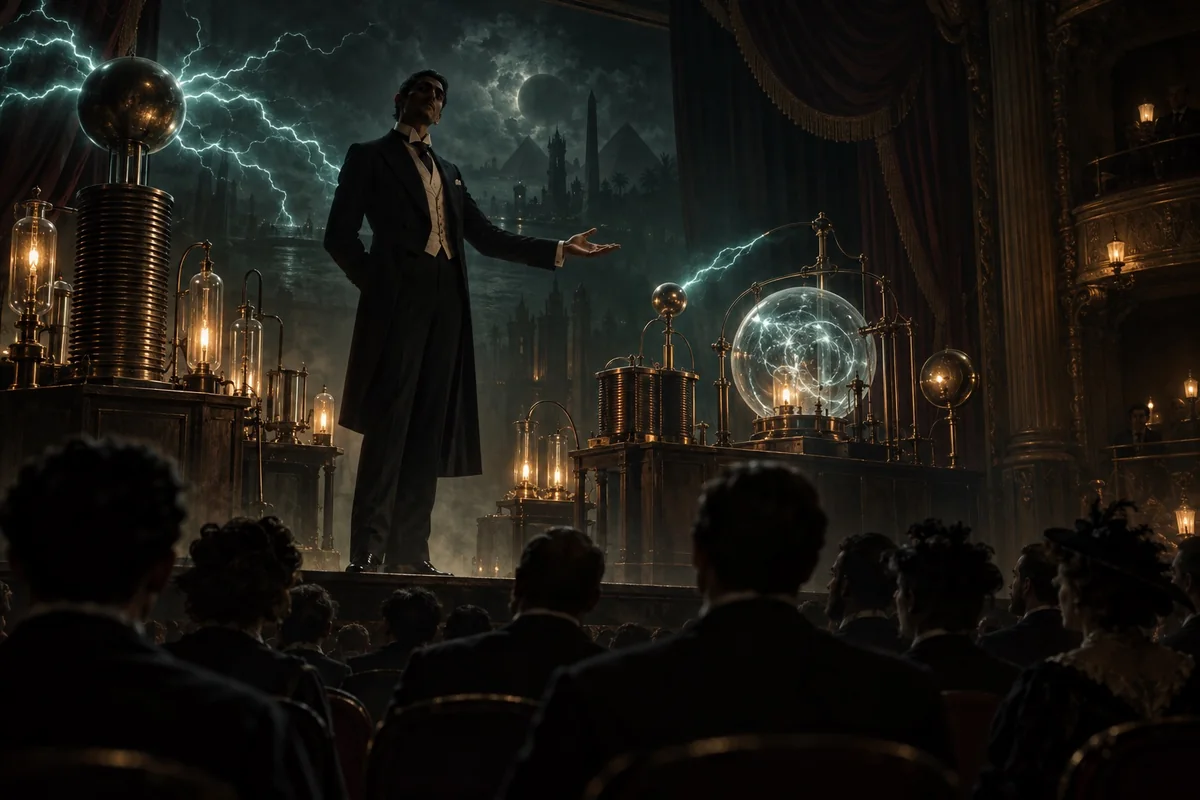
In the early prose piece, Nyarlathotep arrives from Egypt during a period of political tension, abnormal weather and generalized dread. He appears slender, dark and suggestive of a pharaoh. He claims an antiquity of twenty-seven centuries and knowledge of messages from beyond Earth. The account supplies this as his presentation to an audience; it does not open with an independently narrated birth or a verified dynastic biography.
His public activity belongs partly to the modern world. He buys components of glass and metal, constructs instruments, discusses electricity and psychology, and becomes famous for exhibitions that leave spectators frightened and fascinated. The combination matters. Ancient authority is not confined to an archaeological object: it occupies a contemporary performance space and uses the language of technological progress.
The narrator attends a demonstration in a crowded, oppressive room. Images on a screen show ruins and cosmic destruction; electrical effects play around the spectators. When he tries to dismiss the experience as a trick of static electricity, Nyarlathotep expels the audience. Their attempt to reassure one another fails as the city outside appears damaged, deserted or impossibly transformed. The performance has not stayed safely within the room where it began.
The procession out of the familiar world
After the exhibition, the crowd breaks into columns that seem drawn toward separate destinations. One vanishes into an alley, another into an abandoned underground entrance. The narrator’s group reaches a landscape of snow that contradicts the lingering autumn heat. They move toward a black opening between enormous drifts and pass into a vision of dead worlds and ruined cosmic structures.
At the end, the images of drums, flutes and awkwardly moving ultimate gods displace the human city entirely. Nyarlathotep is associated with the mindless beings as their soul. The performer who can address an audience connects intelligible human behavior with powers beyond ordinary intention or speech. The movement from a science demonstration to the exterior of the universe makes the scale of that connection apparent.
The piece never settles into a conventional travel itinerary. Its broken transitions resemble the logic of a nightmare, and the narrator speaks as a devastated survivor trying to communicate to an empty listener. Those formal features prevent a simple literal map from accounting for every scene. An encyclopedia can describe the events in order while preserving the uncertainty of the frame.
Messenger, soul and relation to the Other Gods
Dream-Quest identifies Nyarlathotep as the soul and messenger of the Other Gods. Those powers are distinct from the comparatively accessible gods of Earth whom Randolph Carter originally seeks. The difference becomes central to the journey: a human dreamer may imagine petitioning the Great Ones, but their protection by powers beyond Earth makes interference dangerous.
Nyarlathotep’s office supplies an interface between those levels. He understands Carter’s language, knows his history and can offer detailed instructions. The Other Gods, by contrast, are repeatedly described through mindlessness, movement and sound. Calling him their messenger does not require that they conduct conversations or maintain a bureaucracy resembling a human court. The title describes a relationship within the story’s imaginative order.
His association with Azathoth places him near the most remote region of that order, yet he is not simply another name for Azathoth. Carter can argue with or escape a deception by Nyarlathotep; the threatened destination is the domain of a different power. Their linked names should remain distinct in a character index, an illustration caption and a description of what a particular protagonist actually encounters.
Sources: The Dream-Quest of Unknown Kadath — original text, Nyarlathotep — Unspeakable Tales ebook
The meeting at Kadath
Carter reaches the immense onyx castle of Kadath with the help of ghouls and night-gaunts, expecting to confront Earth’s gods. The throne room is empty. The gods have left their proper place, and the vacancy changes the meaning of his arrival. Rather than standing before the beings he intended to petition, he faces their far more dangerous intermediary.
Nyarlathotep appears in a ceremonial procession as a regal figure with an Egyptian double crown. He addresses Carter by name and presents himself as someone capable of explaining the whole quest. His speech combines knowledge, reproach, apparent generosity and a warning about powers Carter has disturbed. Unlike a creature whose danger consists entirely in physical attack, he can make an explanation itself into a trap.
The revelation about Carter’s desired city is substantially true. Its beauty has been formed from the dreamer’s remembered New England, especially impressions accumulated in childhood. The Great Ones have been drawn away to that city. Carter’s own memory thus supplies both the object of his search and the cause of the gods’ absence. Nyarlathotep can use the truth because he understands how deeply Carter wants to recover what it describes.
The shantak journey and Carter’s escape
Nyarlathotep promises Carter a route to his city and sends him away on a shantak. His elaborate directions give the appearance of a navigable solution. The creature instead carries the dreamer toward the outer gulfs and the region of Azathoth. The apparent guide has converted a longing for home into a movement toward the destruction of any recognizable home or self.
Carter eventually recognizes the deception. Recalling the waking world and his ability to awaken, he abandons the prescribed journey rather than trying to master it on the messenger’s terms. He leaps from the shantak and falls through changing immensities toward consciousness. The escape ends in his Boston room. Nodens is associated with guidance and triumph during the passage, while Nyarlathotep returns to Kadath in frustration.
This outcome establishes an important limit within the particular narrative. Nyarlathotep is exceptionally knowledgeable and dangerous, but his design does not succeed simply because he has announced it. Carter’s remembered attachment to his own world supplies something the manipulation fails to extinguish. Turning the episode into a claim of unlimited omnipotence would remove the actual contest on which its ending depends.
The Black Man in The Dreams in the Witch House
Walter Gilman’s investigation of unusual geometry and folklore becomes entangled with Keziah Mason, her familiar Brown Jenkin and the Black Man of the witch tradition. Keziah’s historical testimony includes an oath, a new name and a means of crossing the walls of space. In Gilman’s experiences, initiation involves a book, blood and an intended journey toward Azathoth’s throne.
The narrative connects this intermediary with the name Nyarlathotep in the Necronomicon. Brown Jenkin repeats the relevant names, and Gilman and his fellow student Frank Elwood discuss the recurring figure of a deputy serving powers outside the ordinary world. This context gives the identification more substance than a modern artist’s decision to draw a dark silhouette and label it an avatar.
The story combines witchcraft imagery with mathematical passage through dimensions. Nyarlathotep’s function is to mediate access and obligation: knowledge acquired by study leads into a network that demands participation. The relationship is different from the public exhibition of the early prose piece, but both exploit a person’s desire to know more than the familiar world permits.
The epithet belongs to a fictional use of older witch-lore terminology. It should not be treated as evidence that a real ethnic group has an association with supernatural evil. As elsewhere in Lovecraft, describing the imagery accurately requires attention to the historical prejudices through which human appearance and danger become connected.
The Haunter of the Dark and the Shining Trapezohedron
Robert Blake discovers a strange many-faced stone in an abandoned Providence church associated with the Starry Wisdom sect. Looking into it opens a connection with a presence that can operate in darkness. The surrounding neighborhood’s lights become a practical barrier, and the possibility of an electrical failure turns ordinary urban infrastructure into part of the struggle to contain the threat.
Blake’s final notes identify the Haunter as an avatar of Nyarlathotep and recall a human form in ancient Egypt. This is a particularly explicit link between a named manifestation and the larger figure. Even here the evidence reaches the reader through Blake’s fragmentary record, written while his own perceptions and the entity’s awareness seem to converge. The account’s form is part of what makes the identification frightening.
The Haunter’s vulnerability to light belongs to this manifestation and its circumstances. It should not be transferred without explanation to the showman, the royal figure at Kadath or every later avatar invented by other writers. Otherwise a local mechanism in one carefully constructed story becomes a universal rule that the other stories never state.
The Shining Trapezohedron likewise deserves its own entry. It is the object through which this encounter becomes possible, with an invented transmission history and a role in the sect’s practices. Nyarlathotep is the larger identity invoked by the last notes; the object, the sect and the manifestation are related parts of the narrative rather than interchangeable names.
Forms, servants and misleading identifications
Dream-Quest speaks of Nyarlathotep’s many forms, so multiplicity is present in Lovecraft’s own writing. It does not follow that every subsequent list of named avatars was supplied there. A useful catalog records the source of an individual manifestation, the author who uses it and the evidence connecting it to Nyarlathotep. That method preserves a documented concept of many forms without pretending the original fiction contains a complete illustrated bestiary of them.
The same care applies to allegiance. Dream-Quest associates the moon-beasts with Nyarlathotep, while the night-gaunts acknowledge Nodens. The latter can assist Carter against threats linked with the messenger. Their dark, frightening appearance does not automatically place them in his service. Actions and explicit relationships in the narrative are more useful than sorting every creature by whether its illustration looks sinister.
The Crawling Chaos, a collaboration with Winifred V. Jackson, is a separate visionary story. Its title overlaps with an epithet of Nyarlathotep, but the text does not thereby become a physical appearance of the character. Titles, invocations, avatars and firsthand encounters require different descriptions. Conflating them produces a longer list at the expense of accuracy.
Sources: The Dream-Quest of Unknown Kadath — original text, The Crawling Chaos — original text
Interpretation: the danger of an intelligible voice
Nyarlathotep’s recurring advantage is intelligibility. He can resemble a performer, speak as an authority, promise an explanation or act as an intermediary. People can approach him through recognizable desires: curiosity about an exhibition, longing for a vanished city or ambition to cross a forbidden boundary. The terrifying part is not that these motives make no sense, but that he can understand them so precisely.
Across the principal stories, communication fails in different ways. The exhibition overwhelms the conditions under which its spectators interpret the world. The speech at Kadath mixes revelation with deliberate misdirection. The witchcraft encounter joins access to submission. Blake’s final knowledge erodes the separation between observer and observed. These are distinct narrative uses of a shared figure, and preserving the distinctions reveals more than a single label such as trickster or messenger can convey.
Sources: Nyarlathotep — Unspeakable Tales ebook, The Dream-Quest of Unknown Kadath — original text, The Dreams in the Witch House — original text, The Haunter of the Dark — Unspeakable Tales ebook
Related music
A Thousand Masks is a dark metal song inspired by Nyarlathotep, the Crawling Chaos who walks among humanity, hiding behind countless faces and whispered lies.
References
- H. P. Lovecraft Archive — fiction in publication order
First publication dates and venues; issue dates can differ from actual release dates.
- H. P. Lovecraft Archive — fiction in composition order
Composition dates; question marks and ranges retain the source uncertainty.
- Nyarlathotep — Unspeakable Tales ebook
The fictional narrative is evidence for what the story says, not proof of events in the real world.
- The Dream-Quest of Unknown Kadath — original text
The fictional narrative is evidence for what the story says, not proof of events in the real world.
- The Dreams in the Witch House — original text
The fictional narrative is evidence for what the story says, not proof of events in the real world.
- The Haunter of the Dark — Unspeakable Tales ebook
The fictional narrative is evidence for what the story says, not proof of events in the real world.
- The Crawling Chaos — original text
The fictional narrative is evidence for what the story says, not proof of events in the real world.
At a glance
H. P. Lovecraft
The United Amateur · November 1920 issue; composed early December
Soul and messenger of the Other Gods
Egyptian-associated scientific showman
The onyx castle of Kadath
Human presentations; the Black Man connection; the Haunter of the Dark
Shining Trapezohedron