

The jade amulet
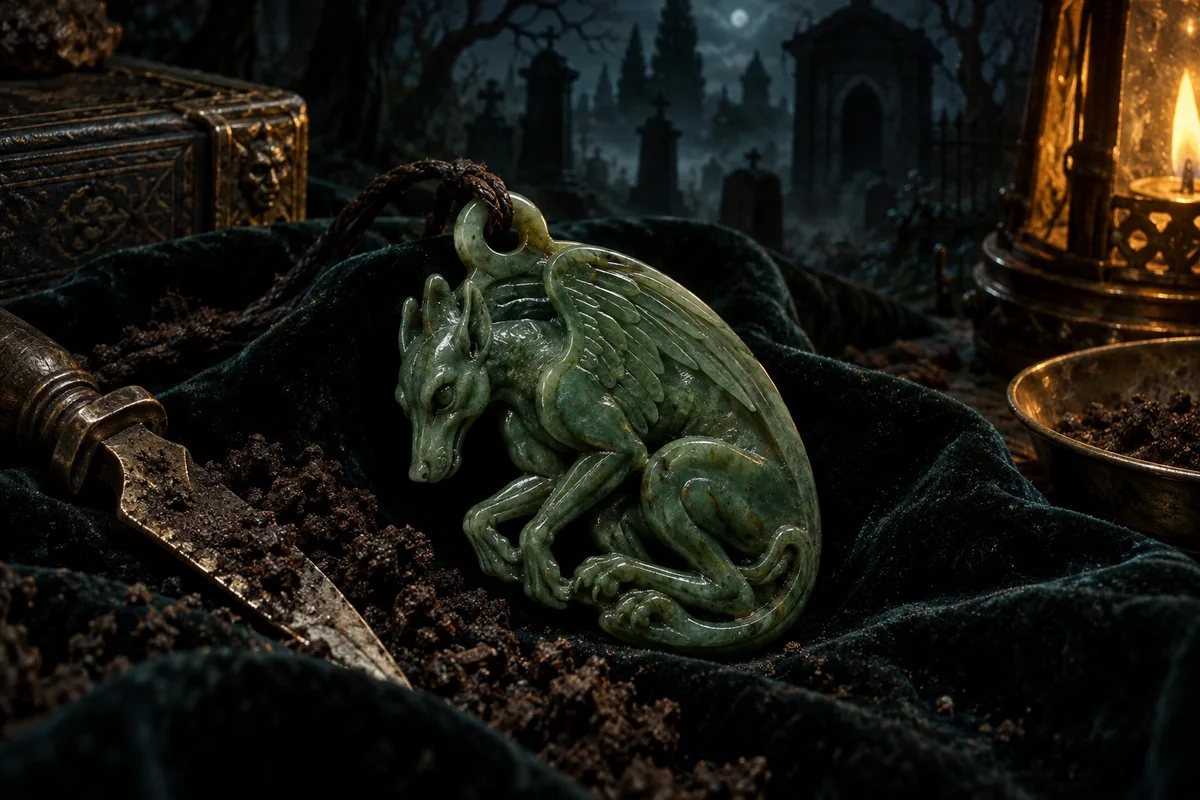
The jade amulet is the stolen grave-object at the center of The Hound. Carved as a crouching winged, partly canine figure, it is recognized by the narrators through a passage in the Necronomicon. Its removal, display, theft and eventual return to the coffin organize the story’s chain of supernatural pursuit. The text supplies a precise visual description while leaving the exact mechanics of its power uncertain.
4 min read · 690 words
Material and shape
The object is a small piece of green jade carved into a crouching winged figure. The narrator compares it both to a hound and to a sphinx with a partly canine face.
Sources: [1]
An inscription runs around its base in characters neither collector can identify. A grotesque skull is engraved underneath in a position compared with a maker’s mark.
These details are more specific than a generic green pendant. A source-conscious illustration can preserve the crouching posture, wings, canine qualities and distinct underside marking without inventing a translation for the unknown inscription.
The first known owner in the story
The amulet is found in the coffin of a man buried in Holland for five centuries. Local tradition says that he had himself robbed a powerful tomb and was later killed by an unknown beast.
The narrative does not give a complete chain of ownership before that theft. Its ancient style and association with Leng suggest a longer history, but the particular craftsmen, original temple and route to Europe remain unspecified.
The collectors’ removal therefore repeats a reported act of theft rather than beginning the object’s dangerous history.
Sources: [1]
The Necronomicon connection
The two men recognize the figure from the Necronomicon, where it is associated with a corpse-eating cult in Leng. The text connects its form with a supernatural manifestation involving those who disturb and consume the dead.
This recognition is initially part of the object’s attraction. Possessing something known from a forbidden text promises a stronger sensation than acquiring another anonymous funerary ornament.
Later reading becomes an attempt to understand the danger. The same textual knowledge that heightened desire begins to provide a language for fear.
Sources: [1]
An exhibit in the private museum
Back in England, the collectors place the amulet in a niche in their hidden museum and sometimes burn scented candles before it. The gesture brings the object close to the role of a shrine within their deliberately constructed environment.
They are not described as members of an established local cult with a complete ritual manual. Their behavior belongs to their private search for extreme aesthetic experience.
The distinction matters because the subsequent pursuit cannot be attributed to a fully narrated initiation ceremony. The clearest triggering action is the removal of the object from the grave.
Sources: [1]
The pattern of pursuit
Disturbances follow the return from Holland: movement around windows, sounds of wings, strange voices, tracks and persistent baying. St. John’s dying reference to the amulet reinforces the narrator’s belief in a causal connection.
The story does not show the object visibly radiating a beam or independently moving around the house. Its significance emerges through the pattern of events and the final discovery.
Descriptions of a precisely measured magical radius, a fixed activation phrase or a complete list of powers would therefore go beyond the evidence.
Sources: [1]
The failed attempt to give it back
After destroying the rest of the collection and discovering that flight to London does not help, the narrator carries the amulet toward Holland. He hopes that replacing it may bring mercy.
Thieves take it from him in Rotterdam. Soon afterward, a report of horrific deaths in the thieves’ quarter connects the new possession with the same threatening sound.
The narrator’s plan is an attempted remedy, not a rule that the story confirms. He never personally completes the act of returning the object to the coffin.
Sources: [1]
The final location
When the grave is reopened, the undead occupant holds the amulet. Its return is accompanied by evidence of recent violence and the same baying that has haunted the survivor.
The object’s presence closes the material circuit from grave to museum to stolen luggage and back to grave. It does not release the narrator from fear, since the occupant now confronts him as an active presence.
The ending makes ownership inseparable from violation. The collectors treated the amulet as transferable property, while the supernatural consequences insist on a relationship they could neither understand nor safely interrupt.
Sources: [1]
References
- The Hound — Unspeakable Tales ebook
The fictional narrative is evidence for what the story says, not proof of events in the real world.
At a glance
The Hound
Green jade
Crouching winged hound or partly canine sphinx
Unknown characters around the base; skull underneath
A five-century-old grave in Holland
The Necronomicon and a corpse-eating cult of Leng
Held by the active occupant of the reopened coffin