

Abdul Alhazred
Abdul Alhazred is Lovecraft’s fictional poet and author of the Al Azif, the Arabic work later known as the Necronomicon. Stories quote or invoke his account of powers older than humanity, while History of the Necronomicon supplies an invented biography and a history of the book’s transmission. He belongs to the mythology’s imagined past; neither his book nor its supernatural claims should be confused with documented Arabic literary history.
6 min read · 1,143 words

The character and the book
Alhazred serves principally as an absent authority. Most readers within the stories encounter his words, a translation of them or another character's description of his work. He does not ordinarily appear as a living participant explaining the events around them.
That distance helps the mythology acquire depth. Different investigators can consult what appears to be a much older account, and frightening discoveries can seem to confirm material dismissed as madness or fable.
The relationship nevertheless remains textual. A statement attributed to Alhazred is evidence of what a fictional source claims, not an automatic guarantee that every narrator interprets it correctly or possesses a complete copy.
Sources: History of the Necronomicon — original text, The Dunwich Horror — Unspeakable Tales ebook, The Nameless City — original text
Sanaá, travels and the Arabian desert
History of the Necronomicon places Alhazred's origin in Sanaá, Yemen, and his life around the period of the Umayyad caliphs. It describes journeys to the ruins of Babylon and to subterranean places at Memphis, followed by ten years alone in the great southern Arabian desert.
The geography combines real places with invented discoveries and the language of fantastic travel. The sketch identifies the desert through several historical-sounding names and associations, but it is not a reliable geographical or ethnographic guide.
Alhazred's isolation becomes an explanation for knowledge inaccessible to ordinary scholars. Ruins, underground spaces and desert remoteness connect his biography to the recurring Mythos premise that human history occupies only the latest layer of a much older world.
Irem and the unnamed city
The biographical sketch reports that Alhazred claimed to have seen Irem, the City of Pillars. It also credits him with finding records of a prehuman race beneath an unnamed desert town.
The wording matters: these are claims included in the invented biography. The sketch does not supply a measured route, a surviving excavation report or evidence that a reader can independently locate the site.
The Nameless City connects Alhazred with the same atmosphere of desert antiquity. Its narrator recalls the poet and his unsettling verse while investigating a civilization whose architecture and preserved bodies overturn human expectations.
The connection places Alhazred within the story's network of earlier knowledge. It does not make him the narrator of that expedition or establish that every detail discovered there has already been explained in the Necronomicon.
Sources: History of the Necronomicon — original text, The Nameless City — original text
Composition in Damascus
The fictional history says that Alhazred spent his final years in Damascus, where he composed the Al Azif. Its appended chronology places that composition around 730 CE.
The original title is associated in the sketch with nocturnal sounds interpreted as demonic howling. Necronomicon is the later Greek title; it is not presented as the Arabic title chosen by Alhazred himself.
This sequence separates the imagined author's work from the later translators and editions through which Lovecraft's investigators encounter it. A Latin copy in an American university library represents several stages of fictional transmission, rather than Alhazred's original manuscript.
The tradition of his disappearance
The sketch dates Alhazred's death or disappearance to 738 CE while explicitly admitting conflicting accounts. Its best-known version describes an invisible creature attacking him in daylight before terrified witnesses.
Lovecraft attributes that report to a historical-sounding biographical authority. The attribution is part of the fictional apparatus and should not be repeated as though a genuine medieval source documents the event.
The uncertainty over death and disappearance helps preserve the character's legendary status. Even this apparently compact biography does not establish a single witnessed ending beyond dispute, and the account supplies no named attacker or verified motive.
Cthulhu, Yog-Sothoth and religious attribution
History of the Necronomicon associates Alhazred with worship of Cthulhu and Yog-Sothoth. Its presentation contrasts those imagined allegiances with the religious identity assigned to him by the sketch.
These details belong to Lovecraft's construction of a fictional occult author. They do not describe Islamic belief, establish the real worship of Mythos beings or provide evidence about actual people in medieval Yemen or Syria.
The distinction is especially necessary because the sketch adopts a bibliographical tone. Real cities, real religious institutions and invented supernatural events are placed together to create plausibility, not to supply a historical reference work.
Transmission after Alhazred
The history traces a Greek translation by Theodorus Philetas, a later Latin version attributed to Olaus Wormius and an English translation associated with John Dee. It also describes suppression, lost texts, uncertain printing places and copies held in named libraries.
These episodes explain why later characters may know different forms of Alhazred's work. Survival is uneven; fragments, translations and restricted collections replace the possibility of consulting a universally accessible original.
The detailed dates and library names remain fictional bibliography. The article on the Necronomicon treats that transmission more fully, while keeping real publications that later adopted the title separate from the book imagined by Lovecraft.
Alhazred in The Dunwich Horror
The Dunwich Horror gives the Necronomicon a practical role in an investigation. Wilbur Whateley's interest in a particular passage and the scholars' later study make the book more than an atmospheric title on a shelf.
The account associated with Alhazred describes beings outside ordinary human categories and introduces a relation among Yog-Sothoth, gates and passage between conditions of existence. The investigators connect that textual material with the local Whateley events.
This is an interpretation made within a specific crisis. The passage should not be turned into an exhaustive biological manual, nor should every being called an Old One in other stories automatically be assigned the same characteristics.
A voice assembled from quotations
Alhazred's importance comes from how much narrative authority can be suggested through incomplete access. A remembered couplet, a translated passage and a fictional publication history together imply an extensive body of writing that the reader never receives in full.
The absence creates room for individual stories to use the book differently. One investigator may find a warning, another a clue to a dangerous procedure, and another only a parallel that makes an inexplicable event harder to dismiss.
An encyclopedia should explain those uses without manufacturing missing chapters and presenting them as recovered Lovecraft material. New imitations can be identified as modern fiction, but they cannot fill the gaps in the primary evidence retrospectively.
Sources: The Nameless City — original text, The Dunwich Horror — Unspeakable Tales ebook, History of the Necronomicon — original text
Related identities and common confusions
Alhazred is distinct from the historical author H. P. Lovecraft and from the fictional translators assigned to the Necronomicon. He is also distinct from the investigators who quote him in later narratives.
The term madness in his familiar epithet belongs to the stories' characterization and rhetoric. It does not establish a specific clinical diagnosis or explain the truth-value of each statement attributed to him.
His central role is that of an invented predecessor: a figure whose supposed encounters allow later discoveries to arrive already shadowed by warning. Preserving the difference between that literary role and actual history is essential to a reliable account.
Sources: History of the Necronomicon — original text, The Nameless City — original text, The Dunwich Horror — Unspeakable Tales ebook
Related music
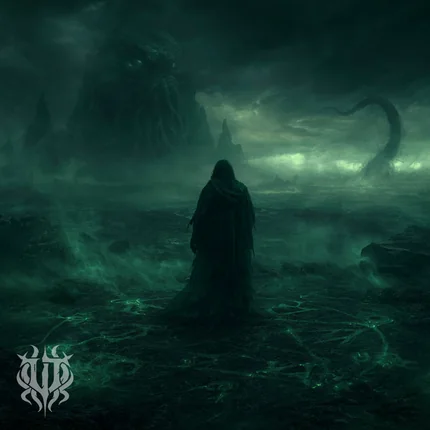
The Dead But Dreaming is a dark folk metal song inspired by The Call of Cthulhu, evoking R’lyeh, forbidden worship and the ancient dream beneath the sea.
References
- History of the Necronomicon — original text
The fictional narrative is evidence for what the story says, not proof of events in the real world.
- The Dunwich Horror — Unspeakable Tales ebook
The fictional narrative is evidence for what the story says, not proof of events in the real world.
- The Nameless City — original text
The fictional narrative is evidence for what the story says, not proof of events in the real world.
At a glance
Fictional poet and occult author
Al Azif, later translated as the Necronomicon
Sanaá, Yemen
Damascus
Circa 730 CE
738 CE; conflicting accounts
Cthulhu and Yog-Sothoth