

Kilderry and the moon-bog
Kilderry is the fictional Irish locality in The Moon-Bog, centered on Denys Barry’s ancestral castle, a nearby village and a marsh with an island ruin. Barry’s plan to drain the bog empties the village of its original inhabitants and leads to the disappearance of his replacement household. The story locates it in County Meath but supplies no reliable real-world site to visit.
3 min read · 591 words
Castle, village and marsh
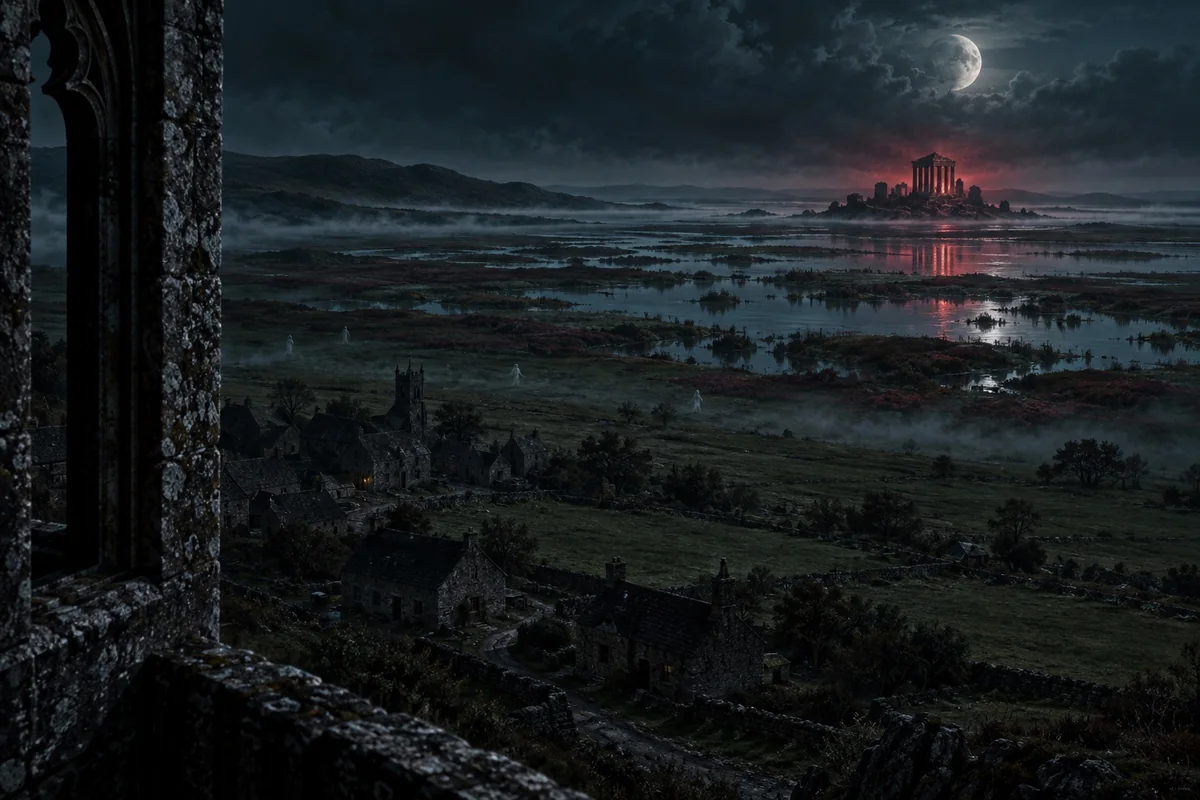
The castle stands close enough to the village and bog for a visitor in a tower room to observe both. A plain separates the settlement from the water, and a distant islet holds an ancient pale ruin.
Sources: [1]
Barry restores the castle after acquiring it with wealth made in America. Its towers and ivy become signs of returning family prestige. The narrator's room, however, turns those same elevated views into a position from which he witnesses events he cannot stop.
Access through Ballylough
Kilderry lies away from the railway. The narrator reaches Ballylough by train, where Barry's motor car meets him. Local people avoid the vehicle and warn the traveler about his destination.
Ballylough also receives the residents who leave Kilderry rather than participate in the drainage project. It serves as a place of withdrawal and, eventually, the vicinity where the surviving narrator is found at dawn.
The account establishes these functional relationships without supplying distances or a complete road map. They are part of the story's geography, not sufficient directions to an actual castle.
Sources: [1]
What the bog conceals
The marsh contains moss, heather, pools and small streams. Its beauty attracts the narrator even while Barry considers its surface wasted space that could yield peat and usable ground.
Legends place a buried stone city below it. A guardian presence and pale figures are associated with the island ruin, and local warnings forbid disturbance of the area.
The narrator's dreams develop the concealed city through Greek architectural and religious imagery. This remains a fictional reconstruction experienced in sleep rather than an excavation that confirms the entire plan beneath the peat.
Sources: [1]
The island ruin and the restored vision
Barry has visited the ruin but finds it too deteriorated to determine its original date and purpose. Its form appears unlike most familiar Irish ruins.
On the final night, the narrator sees the structure apparently complete again, with marble columns and a radiance that floods the bog and tower room. The transformation is observed at a distance and through an account that repeatedly questions its own perception.
The dream's temple of Artemis provides a connection, but the story does not offer a measured reconstruction or a separate archaeologist's confirmation of the identification.
Sources: [1]
The abandoned and replacement populations
The original residents leave because of Barry's intended drainage. Workers and servants from the north replace them, occupying the houses and castle.
These newcomers experience disturbed sleep and eventually join the nocturnal procession into the marsh. The narrative associates the later frogs with the disappearance, but does not directly show each person changing form.
The distinction matters for the fate of the village. It is the replacement population that disappears in the witnessed event; the residents who had already withdrawn to Ballylough are not described as joining it.
Sources: [1]
After the final night
Searches fail to recover Barry or his household. The narrator survives but cannot establish every part of the supernatural explanation. His last view suggests Barry's shadow being drawn from the ruin toward the moon.
The planned drainage does not proceed within the narrated events. The story supplies no later development project, repopulation or renewed expedition.
Illustrations can show the castle, village, plain, bog and distant island as a coherent interpretive landscape. Adding precise boundaries, a complete buried-city plan or a documented historical identity would go beyond the source.
Sources: [1]
References
- The Moon-Bog — Unspeakable Tales ebook
The fictional narrative is evidence for what the story says, not proof of events in the real world.
At a glance
Fictional locality
The Moon-Bog
County Meath, Ireland
Denys Barry
Motor journey from Ballylough railway station
The bog beside the castle
Withdraw to Ballylough
Barry and the replacement household disappear