

Neil Gaiman
Neil Gaiman is a British writer whose Lovecraft-related fiction includes comic monologue, literary crossover and transformed visits to Innsmouth. I, Cthulhu, Shoggoth’s Old Peculiar and A Study in Emerald approach inherited material through different voices and genres. This profile concentrates on those literary connections and their illustrated adaptations within his wider career in prose and comics.
5 min read · 977 words
A wider career in imaginative fiction
Born in Hampshire in 1960, Gaiman began with journalism and nonfiction before becoming widely known as a comics writer and novelist. His collaborations with Dave McKean include Violent Cases and Black Orchid; The Sandman developed a sustained narrative around Dream and the other Endless.
His prose bibliography includes Good Omens with Terry Pratchett, Neverwhere, American Gods, Coraline and The Graveyard Book. These works draw upon several traditions and should not be grouped indiscriminately as Cthulhu Mythos fiction.
The Lovecraft connection is clearest in specific shorter works that name, adapt or deliberately juxtapose recognizable elements. Reading those individual stories gives a more precise account of his contribution than assuming that every dream, ancient being or supernatural world in his bibliography comes from Lovecraft.
Sources: Neil Gaiman — biographical reference
I, Cthulhu: the monster speaks
I, Cthulhu presents the great being dictating an account of his life to Whateley. The voice is boastful, digressive and irritable. Cosmic migration, conquest and conflict become the recollections of a speaker preoccupied with his own importance and the incompetence of others.
The joke depends partly on reversing perspective. Human beings become disturbing little creatures; other ancient powers become acquaintances and rivals. A recurring instruction about feeding a shoggoth eventually threatens the listener himself. Familiar names remain menacing even when the manner of telling is absurdly conversational.
This is an alternative comic version, not evidence for Cthulhu's biography in Lovecraft's original fiction. The authorized webpage also reproduces a humorous follow-up about supposed Lovecraft–P. G. Wodehouse collaborations. Those titles belong to Gaiman's literary joke, not to a recovered historical bibliography.
A Study in Emerald: crossing two reading traditions
A Study in Emerald brings a consulting detective and his companion into an investigation involving a murdered German noble and the Old Ones. The combination asks readers to recognize both the conventions of Sherlock Holmes and the vocabulary of cosmic horror.
The resulting mystery is more than a familiar detective with an unusual monster to identify. A crossover can unsettle assumptions carried from either source: which figures deserve trust, what counts as normal government and how much the narrator understands about the world around him.
Gaiman's author page describes the story in terms of this double inheritance. Its effectiveness depends on the reader's expectations about literary roles as well as on the investigation itself. Recognizing a familiar address or narrative manner does not guarantee that every relationship will follow the pattern of Conan Doyle's stories.
Publication and recognition
A Study in Emerald appeared in Shadows Over Baker Street, edited by Michael Reaves and John Pelan and published by Del Rey in 2003. It won the Hugo Award for best short story in 2004. The official award record identifies the original anthology as well as the winning work.
Those dates separate first publication from subsequent recognition. They also identify the anthology as an organized setting for the encounter between two literary traditions, rather than treating the story as an isolated discovery of that combination.
An award records a particular act of reception. It does not place Gaiman's fictional events inside Lovecraft's own continuity or establish a definitive interpretation of the Mythos. Here its historical value is to show that this form of literary recombination reached an audience beyond a narrowly specialized Lovecraft publication.
Sources: 2004 Hugo Awards — official results
A Study in Emerald in comics
Dark Horse published a graphic adaptation in 2018. Its credits distinguish Gaiman's underlying story and words from Rafael Albuquerque's art and adaptation work, Rafael Scavone's adaptation script, Dave Stewart's colors and Todd Klein's lettering.
The investigation moves between impoverished London streets and royal surroundings. Drawing gives architecture, clothing, bodies and the abnormal world an immediate visible form, where prose can depend on delayed description or a reader's provisional assumptions.
The adaptation therefore has several creative participants whose work should remain visible in its bibliography. A reader comparing editions is comparing more than two containers for identical words: page composition, color and lettering contribute to the pace and presentation of revelation. The 2018 volume belongs in both Gaiman's adaptation history and the history of comics derived from later Mythos fiction.
Sources: Neil Gaiman’s A Study in Emerald — Dark Horse / Penguin Random House, Dark Horse Neil Gaiman Library — publisher sampler and copyright credits
Shoggoth’s Old Peculiar: travel, humor and illustration
Shoggoth's Old Peculiar follows a young American visitor into an encounter with Innsmouth. The publisher's announcement emphasizes the combination of humor and horror rather than presenting the story as a sober extension of the town's history. It appeared in the collection Smoke and Mirrors in 1998.
DreamHaven's 2004 chapbook added a cover and twelve interior illustrations by Jouni Koponen. According to the contemporary announcement, the project began with illustrations Koponen made for his own enjoyment and sent to Gaiman, who brought them to publisher Greg Ketter's attention.
Gaiman's diary records signing the resulting book with Koponen at Fiddler's Green in November 2004. This provides a small but concrete example of how a prose story can acquire a separate illustrated life through an artist's initiative and a specialist publisher.
Sources: DreamHaven announcement of Shoggoth’s Old Peculiar, reproduced on the author’s forum, Neil Gaiman — At Fiddler’s Green, 13 November 2004
Only the End of the World Again
Only the End of the World Again places the adjustor Lawrence Talbot in Innsmouth, where a threatened apocalypse is connected with a werewolf. The publisher explicitly describes its mixture of Lovecraft and Roger Zelazny. Innsmouth consequently becomes a meeting place for traditions beyond its original fish-human ancestry narrative.
The Dark Horse edition published in 2018 credits Gaiman, P. Craig Russell, Troy Nixey and Matthew Hollingsworth, and includes material showing inks and layouts. Such production material helps distinguish the finished comic from the stages through which it was constructed.
Together with A Study in Emerald and the Shoggoth chapbook, the work shows three routes from a later author's prose into illustrated publication. These are adaptations of Gaiman's transformations of inherited material, not interchangeable illustrated editions of Lovecraft. Their continuities, collaborators and publication histories remain separate even when they revisit the same names and places.
Sources: Only the End of the World Again — Dark Horse / Penguin Random House
Related music
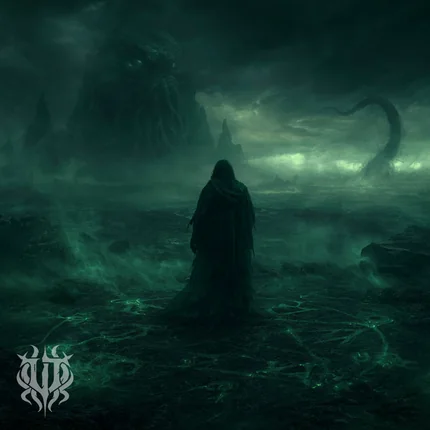
The Dead But Dreaming is a dark folk metal song inspired by The Call of Cthulhu, evoking R’lyeh, forbidden worship and the ancient dream beneath the sea.
References
- Neil Gaiman — biographical reference
- Neil Gaiman — I, Cthulhu, authorized text
The appended Wodehouse correspondence claim is part of the joke, not documentary evidence.
- A Study in Emerald — author’s audio page
- 2004 Hugo Awards — official results
- Neil Gaiman’s A Study in Emerald — Dark Horse / Penguin Random House
- Dark Horse Neil Gaiman Library — publisher sampler and copyright credits
- DreamHaven announcement of Shoggoth’s Old Peculiar, reproduced on the author’s forum
The quoted press announcement is used, not the surrounding forum discussion.
- Neil Gaiman — At Fiddler’s Green, 13 November 2004
- Only the End of the World Again — Dark Horse / Penguin Random House
At a glance
Born 1960
Later Mythos
Selected literary connections to Lovecraft and their adaptations
A Study in Emerald: Shadows Over Baker Street (2003); Hugo Award (2004)
Shoggoth’s Old Peculiar (DreamHaven, 2004); A Study in Emerald (Dark Horse, 2018)