

Cthulhu
Cthulhu is the immense, dreaming being at the center of a worldwide cult and the submerged Pacific city R’lyeh. Lovecraft reveals it through art, anthropology, inherited papers and a disastrous sea voyage; later writers and game designers turn that concentrated story into a much larger mythology.
16 min read · 3,180 words
Creation, first publication and the central sources
H. P. Lovecraft wrote The Call of Cthulhu in 1926, and Weird Tales published it in its February 1928 issue. That story supplies the principal direct encounter with Cthulhu: an emergence from R’lyeh, the killing of members of a ship’s party, and a pursuit interrupted by a collision with a steam yacht. It also establishes the cult, the dream disturbance, the strange idols and the long-awaited return. These elements belong together, but the reader learns about them from different witnesses.
Sources: [1], [2], [3], [4], [5], [6], [7]
Cthulhu subsequently becomes a recurring point of reference in Lovecraft’s fiction and revisions. The Dunwich Horror places the name within a larger account of beings outside ordinary human knowledge. The Whisperer in Darkness includes it in a network of forbidden names and ritual testimony. At the Mountains of Madness connects its spawn with a prehistoric conflict reconstructed from alien carvings. The Mound, a revision for Zealia Bishop, uses the form Tulu in an underground religious tradition. The direct encounter, an invocation and an archaeological reference are different kinds of appearance.
The entity and its introductory story should therefore have separate entries. The story article addresses how a narrator assembles a document; this article follows the being, its representations, its cult and its relations across the fiction. A date in this opening section is a real publication date. Dates attached to Johansen’s voyage or the police investigation below belong to the invented events inside the narrative.
Name, pronunciation and epithets
Cthulhu is an invented name intended to suggest a sound outside familiar human speech. Lovecraft offered more than one indication of its pronunciation. One recorded approximation is Khlûl′-hloo; the familiar kuh-THOOL-hoo convention was popularized through the roleplaying tradition. A spoken approximation is more appropriate than a claim that one easy English pronunciation reproduces an alien language exactly. Related spellings in the fiction are useful evidence of transmission and revision, rather than automatic proof of separate beings.
The Call of Cthulhu’s worshippers identify their subject as a great priest. Their translated chant describes a condition in which death, waiting and dreaming coexist in a house at R’lyeh. These descriptions give the being a religious office, a location and a suspended state. They do not amount to a complete system of divine ranks. In particular, being the best-known name in the modern Mythos does not establish that Cthulhu commands every other god or alien civilization mentioned by Lovecraft.
Appearance: sculpture, dream image and living presence
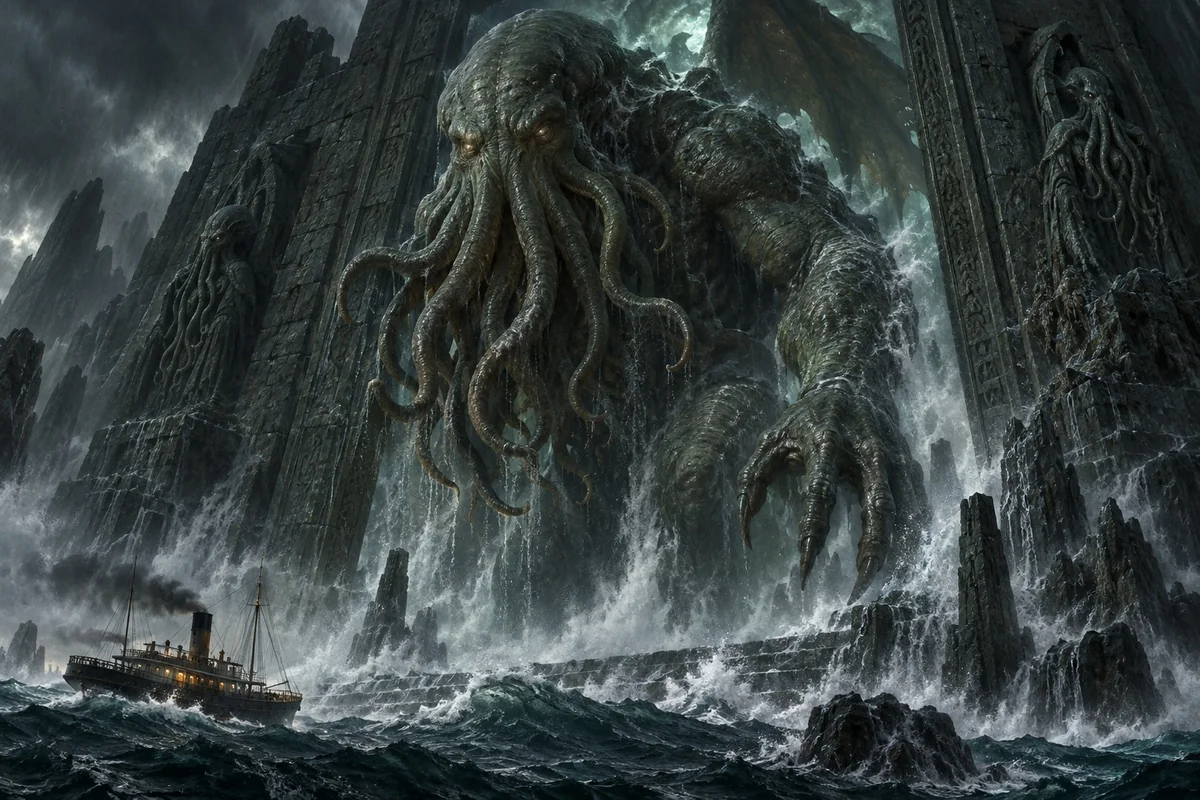
The reader first encounters Cthulhu as a representation on a fresh clay bas-relief made by Henry Anthony Wilcox. The artist has dreamed of an enormous stone city and a presence whose form he tries to preserve in his work. The relief combines a roughly human arrangement with a pulpy, tentacled head, a scaled body and small wings. Its surrounding signs and architecture are part of the problem: the artifact seems to communicate a whole culture that nobody present can identify.
Inspector John Raymond Legrasse’s older idol provides a second representation. It is a small carving in a greenish-black substance with unusual flecks and markings. The figure has a cephalopod head, claws, a rubbery-looking scaled surface and wings. Specialists cannot place either its iconography or its material within the categories available to them. The resemblance to Wilcox’s work becomes evidence that the artist’s experience may have a source beyond his private invention.
The figure that Johansen encounters at R’lyeh is vastly larger than either object. The account emphasizes overwhelming mass, unstable-seeming substance, movement and the inability of the witness’s language to contain what he has seen. The being can emerge through a monumental opening, seize people and move into the sea. Its body is not simply an enlarged human skeleton with an octopus attached: the later impact with the yacht shows a plasticity incompatible with an ordinary vertebrate animal.
No exact height, weight, wing loading or number of facial tendrils is measured in the story. Sculptures can consistently depict certain recognizable features without functioning as technical diagrams. Likewise, wings on the images do not provide an observed flight sequence during Johansen’s encounter. The illustration accompanying this entry follows the textual features while treating lighting, surface details and composition as artistic choices.
Sources: [3]
R’lyeh: city, tomb and unstable geometry
R’lyeh lies beneath the Pacific in the story’s present. Its significance extends beyond providing an underwater lair: it preserves a remnant of an inhabited Earth older than human history. Castro’s account describes stone houses containing beings who remain capable of thought while physically unable to begin their own liberation. Cthulhu’s chamber is part of that suspended civilization. The archaeological scale is therefore collective, even though a single occupant dominates the encounter.
When Johansen’s party reaches the newly exposed land, the sailors find an expanse of monumental stone covered with marine residue. They struggle to judge surfaces, angles and the orientation of the great door. An opening that seems vertical can also be interpreted as lying at a slope; architectural relationships fail to remain intuitively stable. During the escape, a sailor disappears into an angle that should not have been capable of swallowing a person. The account makes navigation itself unreliable.
The narrator interprets the exposed structure as only a high part of a much larger drowned city. That is an inference from the surviving record, not a surveyed plan of R’lyeh. The story does not give a complete list of districts, temples or inhabitants. Later maps can be useful imaginative reconstructions, but their invented streets should not be presented as information Johansen brought home.
The city’s emergence and subsequent disappearance are connected with earthquakes and storms. Their timing also corresponds to the period of disturbed dreams. This coordination ties geology, psychology and ancient architecture into one event without reducing it to a fully explained physical mechanism. A submerged city is a material obstacle to the witnesses; it is also a barrier between modern humanity and a history it has failed to remember.
Sources: [3]
Dream contact and the 1925 disturbance
Wilcox brings his relief to Professor George Gammell Angell on 1 March 1925, following the previous night’s tremor and dream. Angell initially treats the object as a possible clue to an existing cult. As he questions the artist, however, Wilcox appears to lack the historical knowledge that would explain its resemblance to the older material. The professor begins collecting dreams and experiences from a wider group of people.
The resulting record distinguishes ordinary respondents from people with especially receptive imaginations. Artists and poets appear more likely to report the strange city, oppressive masonry, unfamiliar sounds and a sense of impending terror. Wilcox’s condition intensifies into a fever during the later part of March and abruptly clears on 2 April. The dates subsequently become crucial when the narrator discovers the independent account of the Pacific voyage.
Castro’s doctrine explains such communication as transmitted thought. The ancient beings do not ordinarily use mammalian speech; human minds receive their influence as dreams. He also says that the sea’s covering of R’lyeh once interrupted the exchange. The 1925 episode suggests a renewed opening during the city’s temporary exposure. It does not establish that every nightmare in human history is caused by Cthulhu or that the entity can issue precise commands to anyone at will.
The form of contact has a practical narrative consequence. Wilcox never needs to travel to the island, join the cult or read Angell’s files to produce relevant evidence. An isolated experience in Providence can belong to the same event as a disturbance on the other side of the world. Cthulhu’s reach is first apparent as a pattern of simultaneous effects, long before the narrator can attach those effects to a visible body.
Sources: [3]
The cult: Louisiana, Greenland and a claimed worldwide network
Legrasse brings his confiscated idol to an archaeological meeting in 1908 after a police operation in the Louisiana swamps the previous year. The officers have investigated disappearances and discovered a nocturnal ceremony centered on a carved image. The arrests make a fragment of a concealed tradition available to outsiders. The later scholarly meeting tries to identify what police methods alone have been unable to explain.
William Channing Webb recognizes similarities with a rite he encountered in Greenland during an earlier expedition. The match involves both a representation and a phonetically recorded chant. Its importance lies in the separation of the witnesses: neither the Louisiana police nor Webb begins with the other’s information. Their comparison suggests a shared tradition operating across a geographical distance that the investigators did not expect.
The prisoners say that their worship preserves the memory of beings who arrived before humanity, withdrew beneath the earth and sea, and will return when conditions permit. Castro, an elderly participant, claims access to wider traditions through voyages and conversations with exceptionally old leaders in China. He also identifies an Arabian center near the legendary Irem. The narrative presents these last locations as parts of his testimony, not places visited and independently checked by Angell or the narrator.
The cult’s promised liberation includes the destruction of existing restraints and a violent transformation of human conduct. That prophecy explains the adherents’ expectations, but it should not be confused with a neutral account of what Cthulhu would actually provide them. The story never follows a successful global restoration to its conclusion. Its human worshippers can be certain about a future that the reader is not shown.
Lovecraft’s portrayal uses overt racial prejudice and treats cultural difference as evidence of menace. A factual encyclopedia must identify that feature of the writing rather than adopt its judgments. The Greenland and Louisiana episodes are fictional constructions, not reliable descriptions of Inuit religion, Haitian religion or actual communities in Louisiana. Their role within the invented cult can be explained without repeating the narrative’s slurs.
Sources: [3]
Death, preservation and the conditions of awakening
The cult’s terminology makes Cthulhu simultaneously dead, sleeping and mentally active. Castro describes the ancient beings as having shapes without being composed like familiar flesh and blood. Their existence depends on recurring cosmic conditions represented by the positions of the stars. When those conditions are unfavorable they cannot live in the ordinary sense, yet their withdrawal is not final extinction.
Cthulhu’s spells preserve the sleepers in their stone houses. Preservation also constrains them: an outside agency must initiate release when the appropriate time arrives. This detail gives the cult a prospective task and makes the opening of the door by unsuspecting sailors especially consequential. The story does not require those sailors to understand or deliberately perform the cult’s expected mission.
The phrase about the stars being right supplies no numerical timetable. No orbital period, conjunction chart or countdown to the next emergence is given. Nor does the text identify the water as an elemental weakness that burns or damages Cthulhu; the being actively enters the sea and pursues the yacht. Water conceals the city and, in Castro’s explanation, interrupts mental contact. Those particular functions should be kept distinct from a general claim that a sea-associated being is unable to tolerate water.
At the close, the narrator believes Cthulhu remains alive and that the chance of liberation may recur. The immediate danger has receded, but the long-term condition remains. This is one source of the story’s unsettling scale: the entire drama of investigation and escape occupies a brief interval within a process that has already outlasted human civilizations.
Sources: [3]
The encounter with Johansen and the Alert
Gustaf Johansen is second mate of the schooner Emma when its crew encounters the armed yacht Alert. After a violent confrontation, surviving members of the Emma’s company take control of the yacht and continue into the strange region. They reach the exposed island on 23 March 1925. The eventual appearance of their experience in an Australian newspaper gives the narrator the missing connection between the dreams and an independently recorded physical event.
Exploration of the architecture leads the sailors to the immense door. When it opens, Cthulhu emerges into the world they understand. Members of the party are killed, overwhelmed or lost in their attempted flight. Johansen and Briden reach a boat and regain the Alert, but the creature follows them into the water before the yacht can develop enough speed to escape normally.
Johansen turns toward the pursuer and drives the vessel into its body. The collision ruptures the head and produces a cloud of foul green material. Behind the accelerating ship, the scattered substance begins to recombine. The crucial result is a temporary interruption of pursuit. The account supports resilience and reformation; it does not report a corpse, a permanent killing or the destruction of R’lyeh.
Briden does not survive the aftermath, and Johansen returns with a private written account whose full significance he cannot know. By the time the narrator seeks him in Norway, he too has died. The narrator interprets that death, like Angell’s, as possibly connected with the cult. Suspicion intensifies the ending, but the narrative does not supply a courtroom demonstration that cult agents murdered both men.
The storm on 2 April marks the end of the extraordinary episode and corresponds to Wilcox’s recovery. Subsequent observation no longer finds the island. The surviving evidence is therefore indirect again: documents, an idol and the effects on witnesses. A brief confrontation with a tangible being returns to the same documentary uncertainty through which the reader first approached it.
Sources: [3]
Prehuman history and Cthulhu’s spawn
At the Mountains of Madness adds a second historical framework. William Dyer and Danforth reconstruct the history of the Antarctic builders from their extensive carvings. Among the events they infer is a conflict with octopoid beings identified as Cthulhu’s spawn. The war belongs to an Earth occupied by nonhuman societies, long before the Antarctic expedition or the formation of human cultural memory.
The conflict is followed by accommodation rather than the simple destruction of one side. The account associates the newcomers with lands and cities that later disappear beneath the Pacific. This gives R’lyeh a place in a longer sequence of settlement, warfare and geological change. The Antarctic builders have their own interests and their own perspective on those events; their records are not a disinterested divine history.
The relationship between Cthulhu, the spawn and every sleeper mentioned in the earlier story is not laid out as a complete biological taxonomy. The term spawn suggests association or descent, but the texts do not provide individual genealogies, developmental stages or a census. The useful documented distinction is between the star-headed Antarctic builders and the octopoid faction with which they fought. The two are not interchangeable simply because both are ancient and sometimes discussed under overlapping language about old beings.
Sources: [6]
Cthulhu as a museum representation
The Horror in the Museum also includes a representation of Cthulhu among George Rogers’s unsettling exhibits. During Stephen Jones’s night in the building, the figure’s flexible facial tentacles seem to move, and he tries to explain the effect through the air disturbed by his own advance. This is an important distinction in an occurrence list: the story presents an image of Cthulhu within a scene of increasingly unreliable perception, while its central creature is Rhan-Tegoth.
The episode extends the original story’s interest in images that exceed their status as inert objects. A relief in Providence, a confiscated idol and a museum exhibit all offer ways to encounter a recognizable form before establishing what relation it has to a living original. They should be cross-linked as representations without claiming that Cthulhu physically emerges in every room where its likeness appears.
Sources: [10]
Other appearances and the limits of a single pantheon
The Dunwich Horror includes Cthulhu within a Necronomicon passage concerned with access between the ordinary world and other powers. The passage places it in relation to beings beyond the familiar boundaries of space. This reference extends the cosmological setting while making no new physical appearance occur at Dunwich. The enormous invisible child in that story is associated with Yog-Sothoth, not identified as Cthulhu in disguise.
In The Whisperer in Darkness, Cthulhu occurs among names and religious references that Albert Wilmarth encounters during his correspondence with Henry Akeley. The Mi-Go’s presence brings astronomy, extraterrestrial travel and cultic communication into the same investigation. A name included in ritual language does not, by itself, establish that every Mi-Go everywhere serves one universally organized church.
The Mound places Tulu in the religious and historical imagination of K’n-yan. Because the work is a revision credited to Zealia Bishop and its first publication involved a shortened text, attribution and version matter. Its subterranean civilization expands the range of settings in which a related name functions, but the story should not be silently substituted for The Call of Cthulhu as though both described the same human witnesses and the same event.
Taken together, these references produce a network rather than a fully legislated pantheon. A being can be the central object of one cult, a distant relative in a cosmological passage, an ancient enemy in another civilization’s history and a name in a forbidden litany. Each relationship adds a particular fact. None supplies a license to fill all remaining gaps with a modern family tree.
Later frameworks, games and adaptation
The Call of Cthulhu roleplaying tradition gives Cthulhu an explicit place among the Great Old Ones and distinguishes that grouping from Outer Gods, Elder Gods and various alien races. Chaosium’s description presents Cthulhu as especially important on Earth, with worshippers hoping to release an ancient power. These categories help a game organize encounters and information. They are useful when the entry is describing that game’s world; they should be labeled when carried back into discussion of Lovecraft’s individual stories.
The difference also affects powers and scale. A game may need values, procedures and limits so that players can resolve an encounter. A story may depend on the absence of those measurements. Comparing the two forms is more informative than treating a stat block as a scientific discovery about the original prose.
This encyclopedia connects the entity with the 2005 film The Call of Cthulhu, which adapts its source story, and with the broader screen and game indexes. A film or game that uses the name in its title does not necessarily dramatize Johansen’s encounter. The work’s own article identifies whether the relationship is direct adaptation, looser reuse or thematic association.
Why the figure matters: a reading of the evidence
Cthulhu unites several kinds of distance. The being is distant in space beneath the Pacific, in time beyond human history, in matter beyond familiar anatomy and in communication beyond normal language. The investigation gradually reduces those distances without making them disappear. Every apparent explanation opens onto a scale larger than the explanation can contain.
The story also makes research active. Angell’s professional knowledge allows him to recognize an important resemblance; the narrator’s persistence connects archives, museums and travel; Johansen’s practical seamanship creates a brief opportunity for survival. These human abilities accomplish something real. What they fail to provide is the comforting conclusion that understanding one event makes the whole universe manageable.
Cthulhu’s final significance therefore exceeds the familiar tentacled silhouette. The silhouette condenses the problem into a memorable image, but the horror develops through the documents surrounding it: a sculpture made without conscious knowledge, witnesses separated by decades, a translated chant and a survivor’s record that arrives too late. The reader ends with enough evidence to recognize a threat and too little power to secure the future.
Sources: [3]
Related music
The Dead But Dreaming is a dark folk metal song inspired by The Call of Cthulhu, evoking R’lyeh, forbidden worship and the ancient dream beneath the sea.
References
- H. P. Lovecraft Archive — fiction in publication order
First publication dates and venues; issue dates can differ from actual release dates.
- H. P. Lovecraft Archive — fiction in composition order
Composition dates; question marks and ranges retain the source uncertainty.
- The Call of Cthulhu — Unspeakable Tales ebook
The fictional narrative is evidence for what the story says, not proof of events in the real world.
- The Dunwich Horror — Unspeakable Tales ebook
The fictional narrative is evidence for what the story says, not proof of events in the real world.
- The Whisperer in Darkness — original text
The fictional narrative is evidence for what the story says, not proof of events in the real world.
- At the Mountains of Madness — original text
The fictional narrative is evidence for what the story says, not proof of events in the real world.
- The Mound — original text
The fictional narrative is evidence for what the story says, not proof of events in the real world.
- Cthulhu — pronunciation and reception references
Used for a short account of pronunciation; primary fiction supports the separate lore sections.
- Chaosium — the Mythos in the Call of Cthulhu game
A later roleplaying framework, not a retrospective definition of every original story.
- The Horror in the Museum — original text
The fictional narrative is evidence for what the story says, not proof of events in the real world.
- The Call of Cthulhu (2005) — credits, synopsis and release history
At a glance
H. P. Lovecraft
The Call of Cthulhu
1926
February 1928 · Weird Tales
R’lyeh · Pacific Ocean
Great priest; associated with the Great Old Ones
Johansen’s account of the 1925 emergence
Enormous; no measured height in the source
Believed to persist after the island sinks again