

Shoggoths
Shoggoths are mutable organisms created by the Elder Things as living labor. Their changing bodies, developing intelligence, resistance to control and survival beneath the Antarctic ruins turn the history of an ancient civilization into an immediate threat for Dyer and Danforth.
7 min read · 1,354 words
The main account and other references
At the Mountains of Madness provides the most extensive account of shoggoths. Dyer and Danforth first reconstruct their origin and historical role from the builders’ carvings, then meet a living organism in the lower passages. The source therefore moves from represented history to direct danger. The beings are part of the civilization’s labor system before they become the monster pursuing the explorers.
The Shadow over Innsmouth contains briefer references: Zadok Allen hints at a shoggoth, and the narrator later sees one in a dream connected with the underwater community. These passages establish another literary association without explaining every step by which the creatures reached that setting. The Antarctic account remains the principal source for their manufacture, body plan and rebellion.
Sources: At the Mountains of Madness — original text, The Shadow over Innsmouth — Unspeakable Tales ebook
A body without permanent organs
The historical images represent shoggoths as viscous masses capable of making temporary structures. Their bodies can produce organs appropriate to a task rather than depending on one fixed arrangement of limbs, mouth and eyes. Under the creators’ influence, this plasticity becomes a tool: the same organism can be shaped for lifting, moving or other work in environments where ordinary machinery would require separate designs.
The carvings suggest an average diameter of about fifteen feet when a shoggoth is represented as a sphere. That is a description within a historical reconstruction, not a universal size limit. A changing mass can occupy space differently as it spreads, compresses or forms projections. The organism encountered beneath the city seems enormous in relation to the passage through which it advances.
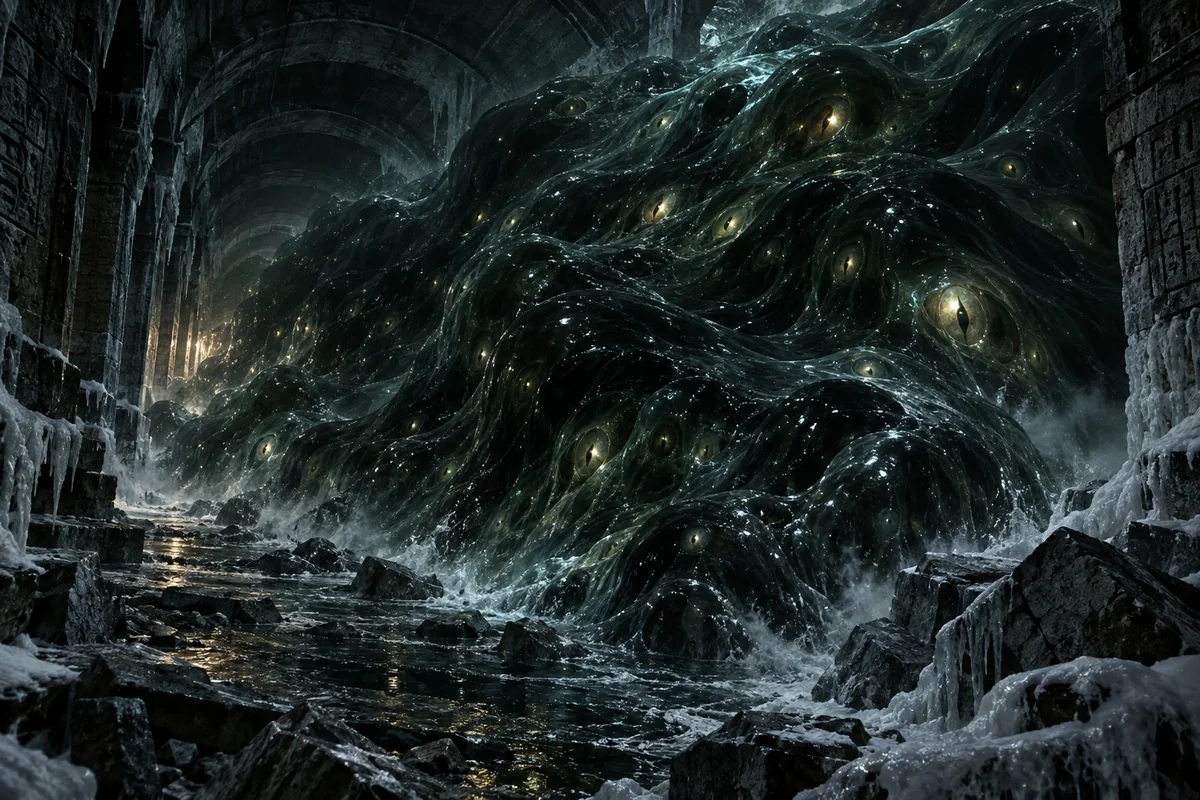
The living presence is dark, glistening and covered with unstable structures, including temporary eyes. It rolls or flows with a force that the witnesses compare to a heavy train in a tunnel. Such a comparison conveys momentum and confinement rather than identifying it as a machine. Its fluid organization is the essential feature: drawing a permanent humanoid skeleton underneath a mass of tentacles would undermine the source’s conception.
Manufacture and the builders’ labor system
The Elder Things’ early biological experiments include organisms produced for food and practical use. Shoggoths belong to the more elaborate part of that manufacture. They are intended as ideal laborers whose tissues can be directed through hypnotic influence. Their capabilities help the builders establish and maintain settlements, especially beneath the sea.
This is not a creation story in which a wise power makes independent subjects and immediately grants them a place in a moral community. The source repeatedly describes domination and utility. The builders value control over the organisms’ form and action, and their records later celebrate the restoration of that control after it fails.
The distinction matters when reading Dyer’s sympathy for the civilization. His recognition that the Elder Things resemble human scientists does not make their whole history innocent. Their dependence on manufactured living workforces is part of the same record as their art, technical achievement and vulnerability. The narrative permits admiration and moral unease to exist together.
Reproduction and the emergence of will
Over time the builders lose the full ability to create new life from inorganic material and depend increasingly on shaping forms already available. Shoggoths reproduce by fission and develop a degree of intelligence not consistently subordinate to external direction. The change is gradual and historically consequential: an organism designed to execute commands begins to display a will that can resist them.
The source connects this development with patterns implanted through earlier commands. What begins as responsiveness and retained form can become independent organization. The shoggoth’s body and behavior therefore share a theme: both exceed the stable arrangement its maker expects to impose.
Calling the creatures mindless throughout their history misses this process. They need not possess a human psychology for their changing capacity to matter. The relevant question is whether the builders can still determine what their creations do. The records increasingly show that control requiring effort, weaponry and renewed subjugation.
Rebellion and reconquest
The carvings preserve a major rebellion followed by a war in which the Elder Things regain control. They use weapons associated with the disturbance of matter, and the defeated organisms are subsequently trained or broken into service again. The images of the process lead Dyer to comparisons with human practices of dominating powerful animals.
The distinctive treatment of the builders’ dead is one of the details the explorers remember. Victims left headless and covered in slime become a historical signature of shoggoth violence. Later discoveries in the tunnels acquire meaning because the visitors have already seen that pattern represented in the art.
The account’s long chronology draws on the geological framework available to the fictional investigators and their author. Its purpose is to make human recorded history seem recent beside repeated cycles of creation, conflict and decline. Exact prehistoric numbers in such passages should be identified as the story’s reconstructed chronology, not silently presented as modern scientific dating.
The lower settlement and learned voices
As the Antarctic climate deteriorates, the builders prepare a more sheltered settlement around the subterranean sea. Shoggoth tissue is brought in to produce workers for construction and continuing transport. These newer organisms reach great size and show rapid responsiveness. They can imitate the musical sounds of their makers.
That capacity changes the meaning of a voice in the abandoned city. A sound associated with the Elder Things may indicate the presence of something that has learned their language or accents rather than one of the original speakers. The uncertainty becomes especially important while Dyer and Danforth follow signs suggesting that the awakened specimens have passed into the lower region.
The familiar cry associated with the final pursuit is therefore not simply a random roar. Its imitation points back to the relationship between creator and created. Knowledge of the civilization helps the explorers recognize the danger, but that recognition arrives only when they are already close to it.
The encounter beneath the ruins
The human explorers descend toward the lower passages while following evidence of recent movement. They discover remains of the awakened Elder Things in the condition familiar from the rebellion scenes. The continuity between ancient images and fresh bodies collapses the comfortable distance of archaeological study. The same kind of violence is still possible in the place they have entered.
Large, pale penguins occupy the underground environment. Their movement and alarm become part of the approach of something much more dangerous. When the shoggoth advances, the passage restricts the humans’ options: they cannot simply move around an organism that fills the route. Its mass crushes the birds and sweeps the floor as Dyer and Danforth flee.
The comparison with a train captures more than size. It suggests a force whose momentum is overwhelming inside a channel built for movement. The explorers survive by escaping through the passages, not by proving that a particular weapon can reliably defeat the creature. The account gives no complete combat system or tested catalogue of weaknesses.
The pursuit is also distinct from Danforth’s final backward glimpse beyond the mountains. His later fragmentary words suggest further horrors, but they do not provide a second fully described shoggoth species or an authoritative explanation for everything outside the city. The narrative deliberately ends with more than one unresolved depth.
Innsmouth and broader implications
Zadok Allen’s mention of a shoggoth places the name in Innsmouth’s atmosphere of concealed preparation. The narrator’s later dream makes the connection more explicit and frightening. The appearance belongs to his changing relationship with the Deep Ones and to what he learns about the survival of Y’ha-nthlei after the government attack.
The source does not show an Elder Thing arriving in Innsmouth to operate the organism, and it does not supply a detailed transfer history. A wiki can record the shared presence while leaving the mechanism uncertain. Making every gap into a fully specified chain of custody would be invention rather than additional research.
Across the two principal contexts, shoggoths connect power with unstable dependence. A civilization may rely on forces it has produced without retaining complete mastery over them. The creature’s mutable body makes that historical problem visible: it continues to become something beyond the form and purpose originally assigned to it.
Sources: The Shadow over Innsmouth — Unspeakable Tales ebook, At the Mountains of Madness — original text
References
- At the Mountains of Madness — original text
The fictional narrative is evidence for what the story says, not proof of events in the real world.
- The Shadow over Innsmouth — Unspeakable Tales ebook
The fictional narrative is evidence for what the story says, not proof of events in the real world.
At a glance
H. P. Lovecraft
At the Mountains of Madness
Elder Things
Mutable living labor
Amorphous; temporary organs and eyes
Fission
About fifteen feet across when spherical; not a fixed limit
Plasticity, strength, imitation, developing independent will
The Shadow over Innsmouth