

Ruthanna Emrys
Ruthanna Emrys is a speculative-fiction author whose Innsmouth Legacy stories place Aphra Marsh and the aftermath of the Innsmouth raid at the center of a new narrative. Her work combines engagement with Lovecraft, an interest in community and religious meaning, and a wider practice of science fiction and weird-fiction criticism.
6 min read · 1,102 words
Finding a story inside an omission
Emrys described her route to Lovecraft in a 2018 interview with the Los Angeles Public Library. She knew the Mythos through friends, role-playing and other derivative works before reading the original stories closely. Listening to The Shadow over Innsmouth prompted a particularly strong response to the roundup and imprisonment of the town's inhabitants.
Her first Aphra Marsh story grew from that response. The catastrophe that could function as background to an outsider's investigation became the central experience of people who had to survive it.
The account explains a creative decision, rather than establishing that every detail of the later series is implicit in Lovecraft. Emrys takes a point of departure from the earlier story and develops her own characters, institutions and understanding of its consequences.
Sources: Los Angeles Public Library — Interview with Ruthanna Emrys
The Litany of Earth and Aphra’s voice
The Litany of Earth appeared on 14 May 2014. Its opening places Aphra in San Francisco, recovering physical strength after imprisonment and working in a bookstore. Her relationship with a Japanese American family situates the rebuilding of her life among other people returning from confinement.
The bookstore also gives inherited knowledge an everyday setting. Aphra can recognize a fraudulent occult volume because the material is part of a culture she knows, rather than merely an exotic object for a collector. A government agent's arrival threatens the fragile separation between her present life and the state that destroyed her family.
The narrative thus changes the status of familiar Mythos objects. A book may be a surviving piece of childhood; a supposedly strange body belongs to the person telling the story. These observations describe the opening's perspective, not a claim that its events are historical.
Sources: Ruthanna Emrys — The Litany of Earth
Winter Tide and the recovery of a community
Winter Tide is the first Innsmouth Legacy novel, published in 2017 after the earlier Aphra story. The government's request for assistance connects an investigation of possible Communist access to dangerous knowledge with Miskatonic University and the materials taken from Innsmouth.
Aphra and Caleb's survival does not restore their destroyed community by itself. The premise links an outward investigation to the harder tasks of recovering records, making relationships and deciding whether cooperation with an agent of the state can be justified.
That structure gives the series a distinctive relationship to the investigative tradition. Finding a secret is not the only objective. Questions about the possession of knowledge, the right to return and the possibility of trusting an institution remain part of the stakes. The dedicated novel entry supplies its chronology and a fuller discussion.
Deep Roots and belonging beyond Innsmouth
Deep Roots, published in 2018, continues Aphra's search for people who might help rebuild Innsmouth. Its opening in June 1949 brings her and her companions into New York. The city offers possible relatives and new connections, while the loss of people and threats to the community's future complicate the search.
The publisher's description places the recovery of a home beside the pressure of developers and the disappearance of those Aphra seeks. Kinship is therefore not simply a list of names discovered in a family tree. It has to become a living relationship under difficult circumstances.
The urban setting also widens the social space of the series. Innsmouth remains a focus, but survival depends on movement, negotiation and encounters beyond the destroyed town. Deep Roots is a sequel in Emrys's continuity, not an additional Lovecraft story.
Sources: Tor — Deep Roots
Cosmic scale without a single emotional response
In her 2017 interview with Petra Mayer, Emrys explained that she did not experience the immensity and indifference of the universe solely as a source of terror. The persistence of life and meaning beyond an individual's limited place could also be reassuring.
This is a significant difference of emphasis within cosmic fiction. Accepting that humanity is not the center does not logically require every character to feel the same emotion. A person already denied power may respond differently from someone whose sense of authority has just collapsed.
The interview also describes readers with different relationships to Lovecraft helping her assess the novel. That matters for accessibility: a story can converse with an earlier author while still needing to make sense to readers who arrive without an established knowledge of the Mythos.
Sources: Petra Mayer / NPR — Remastering the Mythos: Questions for Ruthanna Emrys
Aeonism as an authored religion
In a 2020 question-and-answer discussion, Emrys described Aeonism, the religion she created for her version of the Deep Ones. It finds significance in a universe populated by forms of life that precede and will outlast familiar human arrangements. Different species and communities can interpret the same divine figures differently.
Aeonism should therefore be attributed to Emrys. It is not a recovered name for a fully described religion in Lovecraft's original fiction. Its elaboration belongs to a later writer's worldbuilding.
That attribution also protects the interesting part of the invention. The religion is practiced by imperfect beings with competing understandings; it is not simply a neutral encyclopedia of the universe. The same interview places Emrys's fiction in conversation with other writers who question inherited assumptions about the monstrous.
Sources: Reactor — Ruthanna Emrys on Weird Fiction, Cryptids, and Sympathizing With Cthulhu
A Half-Built Garden and first contact
A Half-Built Garden was published in 2022. In its 2083 setting, Judy Wallach-Stevens investigates an environmental warning in the Chesapeake Bay area and encounters extraterrestrial visitors. The visitors want humanity to leave a damaged Earth, while communities working to repair the planet are unwilling to abandon it.
The conflict concerns how different societies recognize a livable future and who has authority to speak for humanity. Ecological restoration, collective decisions and the possibility of coercion complicate the aliens' proposal.
This novel broadens the author profile beyond the Innsmouth Legacy. It is science fiction about first contact, not another episode in Aphra Marsh's story. Its relevance here lies in a recurring interest in understanding unfamiliar minds and negotiating across unequal relationships, with a separate fictional setting and narrative problem.
Sources: Macmillan — A Half-Built Garden, Macmillan Audio — A Half-Built Garden
Criticism and the larger field of the weird
Emrys and Anne M. Pillsworth co-write Reactor's Reading the Weird column. The publication archive shows a practice that extends from Lovecraft-related work into a much wider field, including earlier supernatural fiction and contemporary stories. The earlier Lovecraft Reread name remains relevant when following older references to the project.
This critical activity makes Emrys part of the reception of weird fiction as well as one of its practitioners. An author can help readers interpret earlier work while creating stories that disagree with it.
For navigation, the strongest direct route runs through The Shadow over Innsmouth, the Deep Ones and Winter Tide. Connections to LaValle and discussions of racism concern approaches to literary inheritance. They should not erase the differences between individual authors or imply that all contemporary responses share one fictional canon.
Sources: Reactor — Ruthanna Emrys, author and column archive, Reactor — Ruthanna Emrys on Weird Fiction, Cryptids, and Sympathizing With Cthulhu
Related music
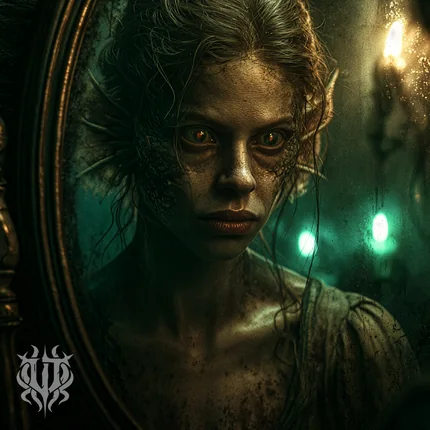
The Esoteric Order of Dagon is a dark metal descent into the world of Innsmouth, where ancient bloodlines, forgotten covenants and the call of the sea endure through countless generations.
References
- Los Angeles Public Library — Interview with Ruthanna Emrys
Used for creative recollections; the interview’s 1936 composition date for Innsmouth confuses publication with composition and is not adopted.
- Ruthanna Emrys — The Litany of Earth
Published 14 May 2014; bounded synopsis of the opening, not a replacement for the story.
- Maryland’s Digital Library / Tor — Winter Tide
The catalog’s 2024 release field is not the novel’s original 2017 publication date.
- Tor — Deep Roots
This page describes a later paperback edition of the 2018 novel.
- Petra Mayer / NPR — Remastering the Mythos: Questions for Ruthanna Emrys
- Reactor — Ruthanna Emrys on Weird Fiction, Cryptids, and Sympathizing With Cthulhu
2020 edited extracts of an author AMA; Aeonism belongs to Emrys’s fiction.
- Macmillan — A Half-Built Garden
Original 2022 digital edition; later paperback records do not establish first publication.
- Macmillan Audio — A Half-Built Garden
- Reactor — Ruthanna Emrys, author and column archive
Used for column attribution and scope; conflicting residence details in contributor biographies are omitted.
At a glance
Modern reinterpretation
Contemporary author and Mythos reinterpretation
Innsmouth Legacy
The Litany of Earth (2014); Winter Tide (2017); Deep Roots (2018); A Half-Built Garden (2022)
Lovecraft Reread / Reading the Weird, with Anne M. Pillsworth