

The Shunned House
The Shunned House is the fictional Benefit Street property whose cellar conceals the life-draining presence in Lovecraft’s story of the same name. Built for the Harris family in 1763 on older occupied and burial ground, it remains dangerous through successive owners and tenants until the narrator’s intervention in 1919. Its architecture closely connects the hidden threat with the ordinary streets of Providence.
5 min read · 867 words
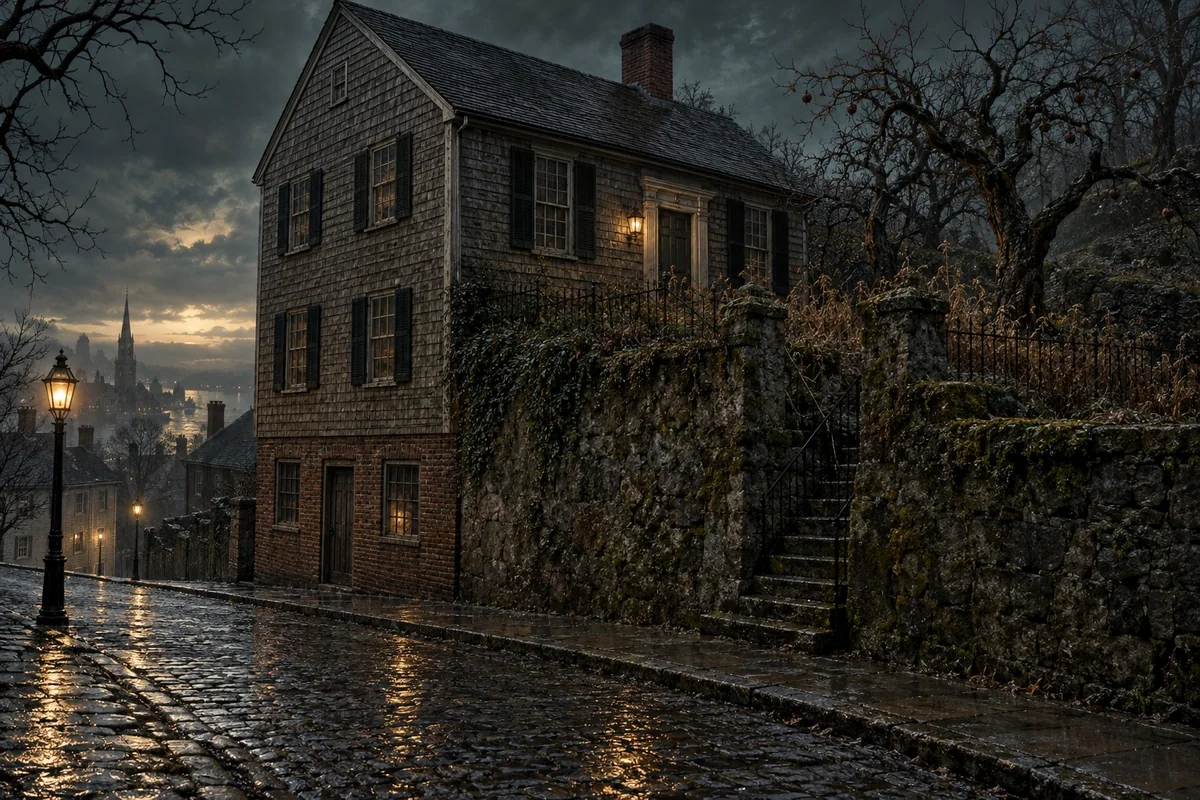
A house embedded in the hillside
The building follows the colonial form of a prosperous mid-eighteenth-century New England house: two principal stories, a peaked roof and an attic without dormers. Its main front faces south. One end rises from the slope toward the street, while the opposite end is partly buried in the higher ground.
Changes to the road alter its relationship with the city. Widening removes the lawn that once separated the western end from the street, exposing the foundations. A brick basement frontage with a door and two windows eventually stands directly beside the sidewalk.
The raised southern garden is reached by steep steps through a retaining wall. The old doorway, damaged decorative features and neglected terraces make the property visibly decayed, but the narrator never treats architectural age itself as the source of evil.
The 1763 household and its departure
William Harris builds the house in 1763 for his growing family. Stillbirths, childhood deaths, servants' illness and the decline of successive adults begin almost immediately. His widow Rhoby and her sister Mercy Dexter become central figures in the record of suffering.
The surviving son, also William, improves during periods away. After returning from military service, he again experiences family loss in the house and eventually relocates. That contrast helps the later investigators identify a danger attached to the site.
Subsequent management treats the property as an income-producing asset. Repeated illness among tenants does not immediately prevent further rentals. The building becomes wholly deserted only after the final series of cases in 1860–61.
The cellar kitchen
The principal room of investigation is an old cellar kitchen with an earthen floor and a large brick fireplace. Remains of cooking fittings establish its earlier domestic use. Stairs connect it to the house above, while the exposed street door provides independent access.
Dampness, a persistent odor and pale fungi distinguish it from an ordinary disused room. The fungi sometimes emit a weak light as they deteriorate. A variable pale patch near the fireplace can suggest a doubled-up body.
The relationship between this floor pattern and the concealed being becomes clear only retrospectively. The story does not establish that every fungus is a separate creature or that the patch itself contains the complete entity.
The garden as evidence
The terraced garden initially contains malformed weeds, unusually pale grass and barren, twisted trees. Birds avoid it. These details extend the house's unhealthy influence beyond its enclosed rooms.
After the narrator attacks the buried source, the following spring brings normal growth. The trees eventually bear small apples, and birds nest in their branches. The garden supplies a continuing sign of recovery that does not depend solely on the narrator's interpretation of the cellar encounter.
Its changing condition also complicates the building's appearance. The old house can remain visually strange while ceasing to be dangerous. Decay, beauty and supernatural harm are related during the plot but are not interchangeable categories.
The Roulet burial ground
Research places an earlier Roulet cottage and family burial ground beneath the later property. A 1697 lease supplies the French connection that the narrator has been seeking. Unlike other graves moved during the street's development, these burials have no recorded transfer in the material he finds.
The narrator links that history to the house's French-speaking victims and to traditions about Etienne and Paul Roulet. His reconstruction proposes a surviving hostile influence, but the records do not supply a complete biography of the buried being.
The source's narrative of unpopular immigrants, religious suspicion and mob violence must be read critically. These fictional connections do not establish supernatural wrongdoing by any actual family or community.
The 1919 investigation
Dr. Elihu Whipple and his nephew begin their joint cellar vigil on June 25, 1919. They bring equipment suited to different guesses about the presence's nature, cover the windows and keep the street door unlocked.
Whipple dies during the manifestation. The nephew's first attack fails, but his later excavation identifies a material source below the floor. Only an enormous elbow-like structure is exposed before he attacks it chemically.
The narrative emphasizes how close all this remains to public life. The nephew escapes directly onto Benefit Street, and the effects of his later intervention are noticed nearby but interpreted as industrial fumes and a faulty underground utility.
Later occupation and interpretive limits
After the intervention, owner Carrington Harris abandons his immediate plan to demolish the house, installs plumbing and rents it successfully. The narrator believes its particular horror has ended, although he retains a strong emotional association with the place.
The building is fictionalized from real architectural impressions. A reader should distinguish this narrated property and its invented history from the actual Providence house associated with the story's inspiration. This entry describes the fiction; it does not identify a real home as haunted or unsafe.
Illustrations can reasonably emphasize the hillside frontage, terraced garden and cellar fireplace, but a complete plan of every room would require invention. Neither the building's full internal dimensions nor the buried body's complete form is supplied.
References
- The Shunned House — Unspeakable Tales ebook
The fictional narrative is evidence for what the story says, not proof of events in the real world.
At a glance
Fictionalized location
The Shunned House
Benefit Street, Providence
1763, in the narrative
William and Rhoby Harris
Roulet cottage and burial ground
Unnamed narrator, assisted by Dr. Elihu Whipple
Carrington Harris
Danger removed; later rented successfully