

Providence
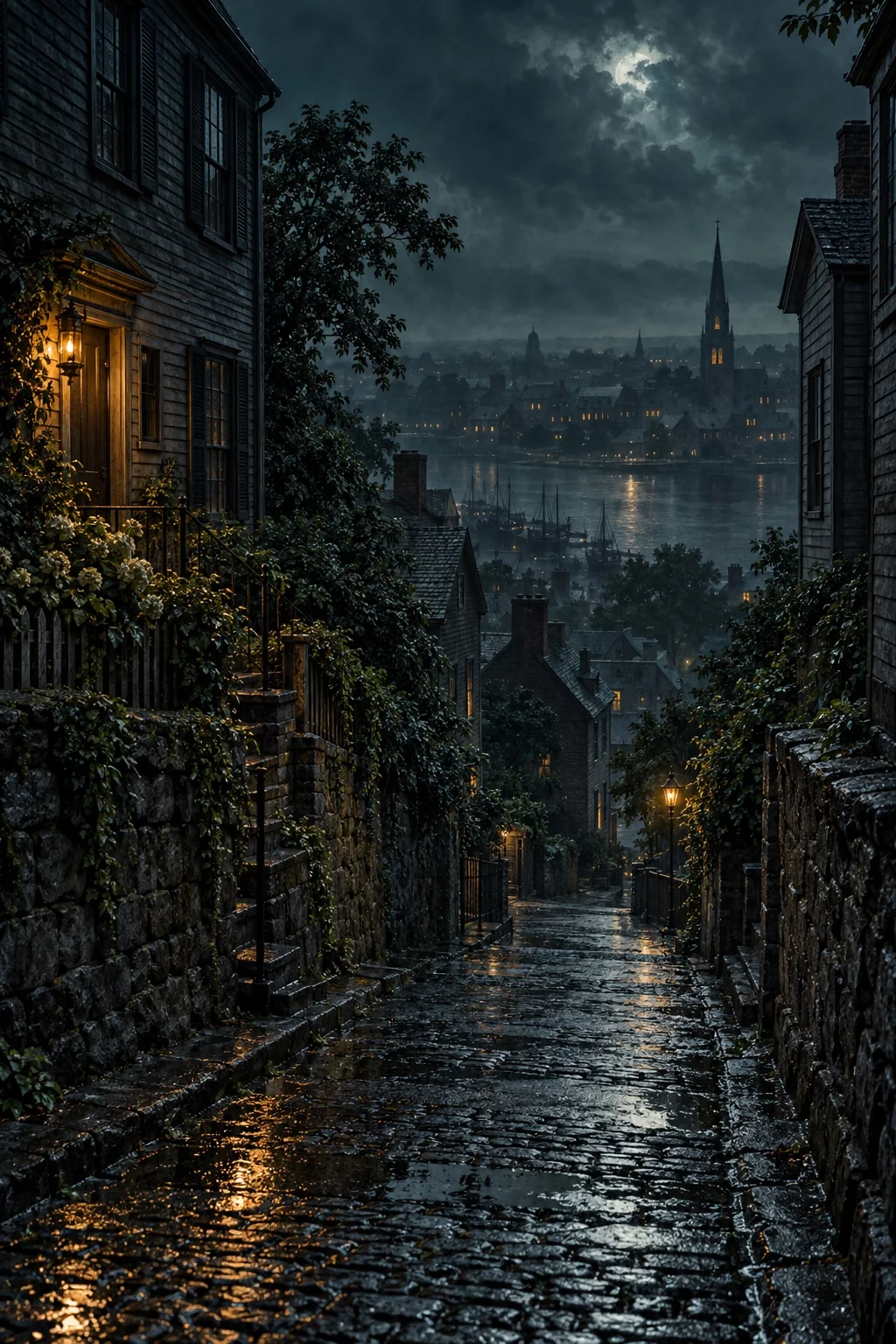
Providence, Rhode Island, is both a real city and a major setting in Lovecraft’s fiction. Its steep streets, old houses, family records and changing skyline shape The Case of Charles Dexter Ward, The Shunned House and The Haunter of the Dark. The stories make local observation a route toward discoveries that the city’s visible surface cannot fully contain.
5 min read · 883 words
Charles Dexter Ward’s antiquarian city
Charles Dexter Ward's early fascination with Providence grows through solitary walks and attention to old buildings. His interest is not initially presented as supernatural. He wants to understand the earlier lives of streets, houses and families whose traces remain around him.
Sources: [1]
The city's records eventually reveal his connection with Joseph Curwen. Portraiture and documentary research become ways of reconstructing an ancestor, while that ancestor's own intentions have made the later reconstruction dangerous.
Ward's story thus develops from a recognizable local activity into the recovery of a deliberately concealed past. The specificity of the setting allows historical inquiry and personal obsession to reinforce one another.
Town, household and the Pawtuxet property
The Ward narrative moves between the family's Providence household and Curwen's former property in the Pawtuxet area. The distinction matters: the investigation does not remain inside a single ancestral mansion. Its domestic, archival and experimental sites have different functions.
Dr. Willett's descent beneath the later property exposes evidence unavailable through the city's ordinary records. What Ward has recovered on paper becomes a material arrangement of laboratories, cells and pits. The city-centered investigation opens into a deliberately hidden underground history.
Providence remains the social world from which Ward's changed behavior is judged. His family, physicians and acquaintances see consequences before they understand their origin.
Sources: [1]
The house on Benefit Street
The Shunned House attaches its fictional history to a Benefit Street building. The narrator begins from a sense of contrast: familiar associations with literary imagination coexist with an actual place, within the fiction, that has brought prolonged suffering to its inhabitants.
His uncle Elihu Whipple researches the household's past. Illnesses, deaths, strange dreams and the fate of the Harris family become parts of a pattern extending across generations. The cellar concentrates the physical clues, including abnormal growth and an outline that takes on increasing significance.
The result is an urban horror whose scale is measured partly through persistence. The surrounding city has continued to change, while the house repeatedly defeats the ordinary expectation that successive residents will lead unrelated lives.
Sources: [2]
A deliberate intervention
The narrator and his uncle do more than collect anecdotes. They keep watch in the cellar with equipment intended to confront the suspected force. The experiment fails catastrophically for Whipple, forcing the survivor to revise his understanding.
Later excavation exposes a portion of an immense buried body. The narrator's final intervention ends the building's destructive influence in the story. Local history has led to a physical cause and an attempted remedy, rather than to a haunting that can only be witnessed.
This sequence also changes how the house can be occupied. The ending connects the removal of its horror with the possibility of ordinary tenancy, bringing the cosmic scale of what lies beneath back to the everyday uses of a city building.
Sources: [2]
The church across the city
The Haunter of the Dark gives Providence a different visual structure. Robert Blake looks from his lodging toward a distant, abandoned church on Federal Hill. Repeated observation turns the skyline into a destination. He crosses the city to investigate an object that had first existed for him as a shape seen from a window.
Inside, he finds evidence associated with the Starry Wisdom sect and the Shining Trapezohedron. The building's darkness becomes an immediate mechanism of danger, and the city's electric lighting becomes relevant to containment.
The story's movement is partly a reversal: Blake first directs his gaze toward the church, then becomes increasingly aware of a presence reaching back toward him.
Sources: [3]
Light, weather and collective action
The final electrical failure in The Haunter of the Dark makes a familiar urban system suddenly essential. The danger is tied to darkness, so a storm and interruption of power alter what the entity can do.
People near the church respond with lights and warnings. Their knowledge of the place has practical force, even though Blake initially approaches the district as an outsider attracted by its strangeness. The episode gives the neighborhood a protective role within the narrative.
That collective response differs from Ward's privately pursued research and from the two-person vigil in The Shunned House. The same city supports several kinds of investigation and resistance.
Sources: [3]
Documentary realism and invented events
The three stories repeatedly use documents, testimony, dates and recognizable urban features. These devices anchor their events, but the events remain fictional. A surviving street name does not authenticate Curwen's experiments, Blake's final perceptions or the buried entity beneath the shunned house.
For reading the stories, it is useful to separate a building's role in the plot from questions about an actual architectural model. This entry follows the literary evidence; the individual work and location entries provide the more detailed narrative accounts.
Providence within the larger geography
Compared with Carter's far-ranging dream journey, these Providence narratives repeatedly begin in a close field of observation: a family portrait, a cellar, a distant steeple. Their larger revelations grow from sustained attention to that small field.
Providence's importance is therefore not simply that many terrible things happen there. It supplies a model of knowledge in which walking, looking and reconstructing local history can unsettle the apparent boundary between the familiar city and an immeasurably older world.
References
- The Case of Charles Dexter Ward — original text
The fictional narrative is evidence for what the story says, not proof of events in the real world.
- The Shunned House — Unspeakable Tales ebook
The fictional narrative is evidence for what the story says, not proof of events in the real world.
- The Haunter of the Dark — Unspeakable Tales ebook
The fictional narrative is evidence for what the story says, not proof of events in the real world.
- The Dream-Quest of Unknown Kadath — original text
The fictional narrative is evidence for what the story says, not proof of events in the real world.
At a glance
Providence, Rhode Island
The Case of Charles Dexter Ward; The Shunned House; The Haunter of the Dark
Architecture; family history; documents; observation
The city as represented in the fiction