

The Shunned House
The Shunned House follows an unnamed Providence investigator and his uncle, Dr. Elihu Whipple, as they trace generations of illness to a house on Benefit Street. Family records, servants’ recollections, anomalous vegetation and a forgotten burial ground lead to an attempted scientific confrontation with a vampiric presence. The story joins a densely documented local history to an intimate loss, and ends with an unusually effective removal of the immediate threat.
9 min read · 1,877 words
Composition and the two publication dates
Lovecraft wrote the story on October 16–19, 1924. Its publication history requires a distinction between printing and ordinary publication. W. Paul Cook's Recluse Press printed sheets for a book in 1928, but financial difficulties prevented the planned issue. The story subsequently appeared in Weird Tales in October 1937, after Lovecraft's death.
The H. P. Lovecraft Archive accordingly records the 1928 Recluse Press printing in its bibliography. A date of 1937 in another reference need not contradict that record: it can identify the magazine appearance rather than the earlier unissued book project. Brown University holds a typed manuscript, linked from the Archive's data page.
Sources: H. P. Lovecraft Archive — fiction in composition order, The Shunned House — bibliographic data, H. P. Lovecraft Historical Society — The Shunned House production notes
Poe walks past an unrecognized horror
The opening imagines Edgar Allan Poe repeatedly passing the house while visiting Providence and courting Sarah Helen Whitman. The narrator finds irony in a master of horror walking beside a place whose history could rival his inventions without recognizing its significance.
This is a framing device, not an assertion that Poe investigated the fictional events. It places the narrator's hidden knowledge beside a recognizable literary and urban history. The house looks merely dilapidated to an ordinary pedestrian; its significance depends on records that almost no one has assembled.
The detailed description then establishes a colonial house on a steep hillside. Alterations to Benefit Street have exposed the western cellar wall directly to the sidewalk. The proximity matters throughout the climax: the investigators can be surrounded by an extraordinary threat while ordinary city life remains only a door away.
Childhood visits and the cellar pattern
As a boy, the narrator explores the deserted building with other children. Broken windows, abandoned furniture, a neglected attic and deformed garden growth provide the visible setting, but the cellar produces the greatest unease.
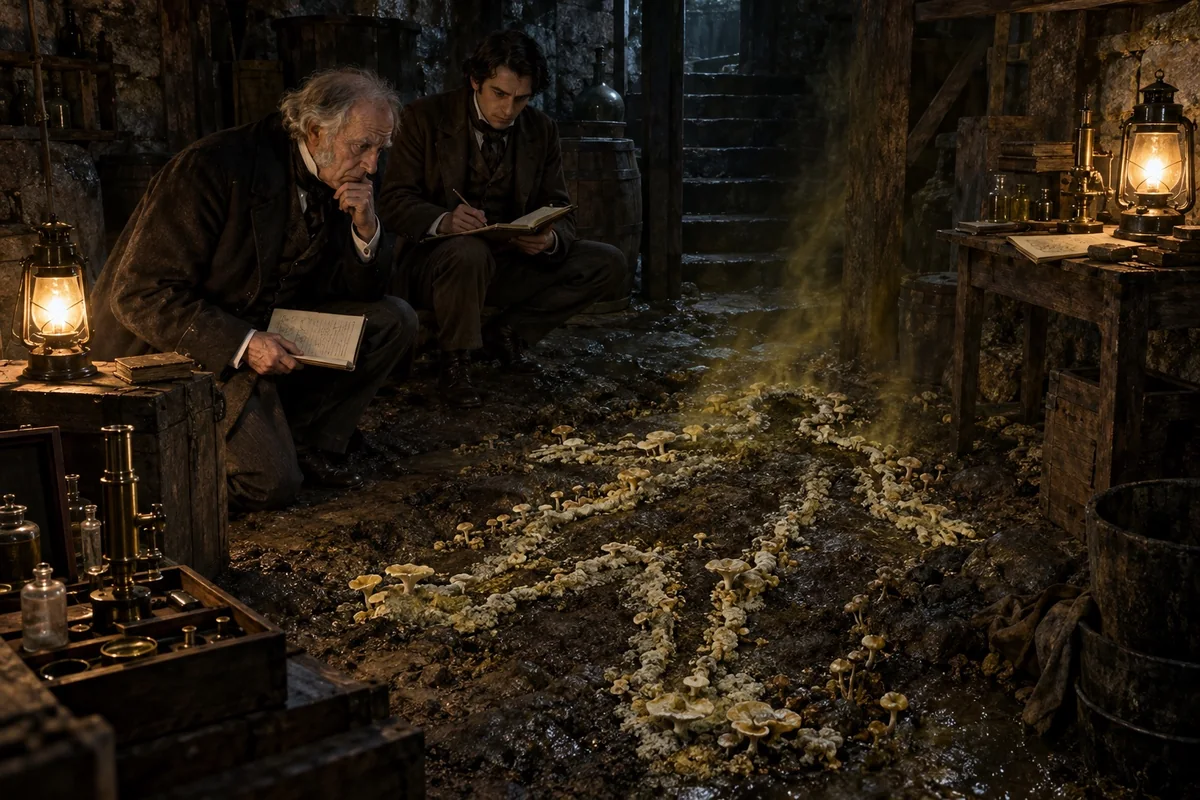
Its earthen floor supports strange pale fungi, sometimes faintly luminous as they decay. Near the old kitchen fireplace, patches of mold or mineral deposit occasionally suggest a huddled human figure. The pattern is intermittent, preventing it from becoming a simple, stable clue.
On one rainy afternoon the boy thinks he sees a yellowish exhalation rise from the patch. His uncle responds with a suggestive smile rather than an explanation. Only when the narrator is older does Whipple share the extensive history he has collected.
The first Harris household
William Harris builds the house in 1763 and moves in with his wife Rhoby Dexter and their children. The promising new home quickly becomes a place of losses. A baby is stillborn, two daughters die, servants decline, and William himself dies after becoming weakened.
Rhoby's surviving household is managed by her sister Mercy Dexter. Rhoby's mental condition deteriorates; traditions later describe her speaking unfamiliar idiomatic French and complaining of a presence that attacks her. Mercy, initially strong, also loses her health.
The younger William Harris supplies a revealing contrast. Periods away from the building coincide with improvement, and military service takes him out of its influence. When he returns with his wife Phebe, another stillbirth and Mercy's death finally persuade him to leave the property.
Inheritance, tenants and repeated illness
The family's departure does not end the house's use. After William and Phebe die in the 1797 epidemic, a relative responsible for their son's property rents it despite William's wish that it remain empty. An economic obligation is used to justify continuing occupation.
The resulting history consists of repeated tenant changes, illness and death. Officials order fumigation in 1804. Later newspaper reports describe dying people becoming strangely aggressive, while the final illnesses in 1860–61 include French utterances that the sufferers should not know.
The narrator emphasizes that neighboring houses are unaffected. The pattern appears attached to the particular site rather than to the Harris bloodline or the whole district. By the time of his childhood, its reputation makes the house effectively impossible to rent.
Servants’ testimony and the vampire hypothesis
Whipple's records preserve explanations that respectable opinion has largely dismissed. The servant Ann White believes a vampire is buried below the house and urges a search. Other reports describe stolen breath, loss of blood, biting and strange forms in the cellar.
The narrator does not initially accept the traditional explanation wholesale. He compares the reports because they repeat details across different periods and witnesses. A dismissed servant's observation can thus become evidentially useful without every element of local folklore being treated as literal fact.
The investigators' eventual theory borrows the notion of a life-draining presence while imagining a more unusual physical basis. Their language of matter, energy and additional dimensions belongs to the story's speculative fiction; it does not turn the vampire hypothesis into established science.
The older ground and the Roulets
The narrator extends the inquiry beyond the house to the land beneath it. Records identify an earlier lease to Etienne Roulet and his wife. Their cottage and burial ground occupied the area before the Harris building, and the narrator finds no record that the Roulet graves were removed.
The family had come to Rhode Island as French Protestant refugees. Surviving local traditions connect Etienne and his son Paul with unpopular practices and a later riot that apparently ended the family's presence. The narrator also notices a name-and-place correspondence with a much older French account concerning Jacques Roulet.
These connections supply his proposed explanation of the French speech and the buried influence. They remain a reconstruction assembled from incomplete records and hostile traditions. The story's use of foreign ancestry and religious suspicion as markers of danger needs to be recognized as part of its prejudiced framing, not adopted as a judgment about actual Huguenot refugees.
The vigil of June 25, 1919
A nocturnal observation of the yellow vapor persuades Whipple that they should act together. On June 25, 1919, they install a cot, chairs and equipment in the cellar with the owner's permission, withholding their more extraordinary expectations.
Their equipment includes a specially arranged Crookes tube with batteries and reflectors, together with military flamethrowers. The alternatives reflect their uncertainty: they do not know whether the suspected presence will be susceptible to radiation or to physical destruction.
The watch begins at ten in the evening. They plan to alternate resting and observation, keeping the street door unlocked as an escape route. Their preparations combine methodical planning with a dangerous confidence that they can identify and destroy something whose actual nature remains unknown.
Whipple’s dream and the second watch
While Whipple sleeps, his face seems to shift through unfamiliar expressions. He mutters in French and wakes crying that he cannot breathe. His dream has combined a threatening crowd, a burial-like pit and changing rooms and inhabitants, some resembling members of the Harris family.
The nephew attempts to understand the experience as a product of their research and expectations. Whipple's education also provides an ordinary explanation for his ability to speak French. The story preserves those possible explanations before the decisive manifestation.
They exchange places, and the narrator falls asleep. His own dreams involve confinement, hostility and difficulty communicating. A scream in his uncle's voice wakes him to a different light and a much stronger odor.
The manifestation and Whipple’s death
A yellowish luminous vapor rises near the fireplace, taking unstable, partly human and partly monstrous suggestions of form. It envelops Whipple, whose appearance and behavior have changed catastrophically.
The narrator activates the Crookes tube because he judges the threat intangible. Its light changes the scene's appearance but produces no effective attack on the presence. As Whipple disintegrates, his face seems to repeat the features of many people from the house's history.
The nephew escapes through the street door. His hope that one final expression represented his uncle trying to say goodbye gives the scene its emotional center. It is a bereaved interpretation of an almost unreadable event, not proof that Whipple has become the controlling intelligence behind the manifestation.
The buried body and the second intervention
Returning at dawn, the narrator finds no usable trace of his uncle and no longer sees the doubled-up floor pattern. He reconsiders the vapor as an emanation from something below ground rather than the whole of the threat.
He returns prepared to excavate and attack the buried source. Digging near the fireplace exposes a huge translucent, gelatinous structure whose curved form he identifies as an elbow. Only this part is uncovered; the story never supplies a complete anatomical view of the body beneath the house.
The narrator pours sulfuric acid into the excavation. Violent fumes and a noise disturb the surrounding area, but local people attribute them to ordinary urban causes. He loses consciousness during the operation, then finishes after recovering. These events describe a fictional confrontation, not a safe or reproducible method of investigating an old building.
A house released from its history
After the intervention, the cellar's atmosphere changes and the abnormal fungi wither. The narrator fills the excavation and finally gives way to grief for Whipple. He later tells Carrington Harris enough for the owner to help with necessary explanations.
The following spring brings ordinary growth to the garden. The house is rented successfully, the old trees bear apples and birds return. These changes support the narrator's belief that the localized danger has ended.
His relief coexists with affection for the old building. He would regret its eventual replacement by an unattractive modern development. The ending separates preservation of historic architecture from preservation of the destructive thing concealed beneath it.
The entity and its uncertain classification
The threat drains life, manifests through vapor and seems to preserve or reproduce traces of previous victims. Its buried form has grown to enormous size. Those features support the story's comparison with vampirism, but they do not make it a conventional walking corpse with a fully explained biography.
The narrator's reconstruction associates it with the Roulet history, especially the possibility of a surviving pattern of agency or energy. He cannot independently demonstrate every step of that origin. The visible elbow establishes material presence without resolving the relationship between the buried body, the vapor and the many apparent identities.
The story does not name this being as Cthulhu, a shoggoth or another familiar Mythos species. Assigning such an identity would replace the text's distinctive uncertainty with an unsupported classification.
Real buildings and fictional deaths
The Historical Society's commentary identifies two architectural inspirations: a house Lovecraft saw in Elizabeth, New Jersey, and the Providence building at 135 Benefit Street. Lovecraft's aunt Lillian Clark had lived in the latter. Those connections concern inspiration; the deaths, Roulet investigation and buried entity belong to the fiction.
Sources: H. P. Lovecraft Historical Society — The Shunned House production notes
How the story constructs its evidence
The five-part structure moves from a familiar streetscape to family history, then to deeper land records, an experiment and a direct intervention. Each stage changes the significance of material already introduced. The cellar stain becomes a possible outline, the French speech becomes a historical connection, and the apparently peripheral servants' stories become a source of practical insight.
Whipple embodies both strengths and limits of that method. His records make the investigation possible, while his confidence in modern apparatus cannot protect him. The nephew succeeds only after revising their account of what needs to be attacked.
Unlike stories that end with an unavoidable cosmic return, The Shunned House allows a specific threat to be removed. The victory remains costly and private. Providence resumes its ordinary life without understanding either the danger it escaped or the person lost in confronting it.
References
- H. P. Lovecraft Archive — fiction in composition order
Composition dates; question marks and ranges retain the source uncertainty.
- The Shunned House — bibliographic data
- H. P. Lovecraft Historical Society — The Shunned House production notes
Publication and inspiration notes accompany the society’s audio adaptation; invented adaptation characters are not attributed to Lovecraft’s original.
- The Shunned House — Unspeakable Tales ebook
The fictional narrative is evidence for what the story says, not proof of events in the real world.
At a glance
H. P. Lovecraft
16–19 October 1924
1928 printing; October 1937 magazine publication
Recluse Press sheets; later Weird Tales
Fiction in five sections
Unnamed nephew of Dr. Elihu Whipple
Providence; cellar vigil begins June 25, 1919
Unnamed vampiric presence and buried body
Local threat destroyed; Whipple does not survive