

Pickman’s Model
Pickman’s Model follows an admirer of an ostracized Boston painter into a studio where artistic realism acquires a literal and terrifying explanation. Told as a nervous conversation after the painter’s disappearance, the story gradually turns criticism of disturbing pictures into evidence of a concealed nonhuman world.
8 min read · 1,579 words
Composition, publication and narrative form
Lovecraft wrote Pickman’s Model in 1926. Its first publication was in the October 1927 issue of Weird Tales, volume 10, number 4. The story belongs to the period in which his fictional New England and dream narratives were acquiring connections through recurring people and creatures.
The speaker is Thurber, who addresses an acquaintance named Eliot. Eliot’s side of the conversation is omitted, but questions and reactions can be inferred from Thurber’s replies. Requests for drinks and changes of pace create the impression of someone trying to narrate an experience he still finds difficult to control.
Pickman has already disappeared when the conversation takes place. The question is therefore not simply what will happen during the studio visit, but why Thurber broke with an artist he continues to regard as extraordinarily talented. The opening also establishes his new fear of cellars and the subway, anticipating the location and implications of the revelation.
A painter excluded from respectable Boston
Richard Upton Pickman specializes in disturbing figures and expressions. Thurber contrasts the force of his work with the conventional imagery of commercial illustration, arguing that genuine terror requires unusual knowledge of form, anatomy and the viewer’s response.
Other acquaintances have withdrawn. Dr. Reid, interested in comparative pathology, believes that Pickman’s face is changing in an increasingly nonhuman direction and speculates about his habits and diet. Thurber initially dismisses such claims as imagination inflamed by the paintings.
The canvas Ghoul Feeding is refused by the Art Club and rejected as a gift by the Museum of Fine Arts. No buyer appears. After Pickman vanishes, the painting goes to his father in Salem. The story also gives the artist a family association with the witch trials, introducing ancestry as another possible route between respectable New England and the terrors in his work.
Sources: [3]
Thurber’s growing admiration
Thurber begins planning a monograph on weird art and visits Pickman repeatedly for information and conversation. The painter’s theories become as compelling as his pictures. This admiration develops just as Pickman’s wider circle contracts, making Thurber a receptive listener for more private disclosures.
The artist claims that certain subjects cannot be conceived or properly depicted in the comfortable modern environment of Back Bay. He favors the older North End, where generations of life, conflict and belief have accumulated in the buildings. What other people see as obsolete or undesirable, he regards as a source of imaginative access.
This argument prepares the visit by appealing to Thurber’s own interests. Pickman does not immediately announce that he keeps company with monsters. He offers an opportunity to see stronger work in a setting that supposedly enables it. The invitation is persuasive because it initially sounds like an extreme version of an artist’s ordinary search for the right studio.
Sources: [3]
The hidden studio and the history it claims
Pickman describes old wells, cellars and connecting tunnels beneath the North End. His account joins witches, smugglers and seafarers in a history of activities conducted outside the reach of respectable authorities. He presents the surface city as only part of the inhabited world.
He has rented an old house from a Sicilian owner under the name Peters. Its boarded windows suit him, and an ancient brick well in the cellar is a particular attraction. The arrangement lets him work without explaining the address to his professional acquaintances.
The pair travel toward Battery Street and enter a sequence of narrow, aging lanes. Thurber cannot later reconstruct the route with confidence. The geography includes recognizable Boston landmarks, but the hidden studio and its monstrous connections remain elements of the fiction. Pickman’s claims should not be used as historical evidence that the actual neighborhood contained the network he describes.
Sources: [3]
Paintings of an underground population
The first room reveals figures that range from almost human to unmistakably alien. Their bodies and faces suggest a population living in graveyards, tunnels and old buildings. Familiar surroundings make their presence more disturbing than an entirely remote fantasy landscape would be.
Some pictures concern earlier New England. A feeding lesson with a human child and images of substituted children imply exchanges between the underground beings and human households. A figure in a Puritan family portrait seems to resemble Pickman, giving the visitor another reason to wonder about the artist’s origins.
These images are clues presented through art. They do not individually prove an entire genealogy or explain exactly how a human might become a ghoul. The narrative accumulates suggestions before offering a narrower piece of evidence about the living model for one particular canvas.
Sources: [3]
Modern Boston becomes part of the horror
The next room removes the comfort of historical distance. One painting shows creatures entering a subway station through a broken floor and attacking the passengers. Others place them behind domestic equipment in cellars or show an underground cross-section of Beacon Hill.
A group gathered around a Boston guidebook appears to find its account of famous people buried at Mount Auburn amusing. The image gives the monsters a recognizable social activity while making the human meaning of a cemetery horribly unstable. A burial place can be a cultural monument to one population and a source of food to another.
Thurber is increasingly troubled by the paintings’ exactness. He sees neither deliberate distortion nor the usual visual signals of a dream. Their figures occupy their settings with an objectivity that suggests close observation. His earlier praise of Pickman’s realism begins to become an explanation he would prefer not to accept.
Sources: [3]
The cellar, the canvas and the interruption
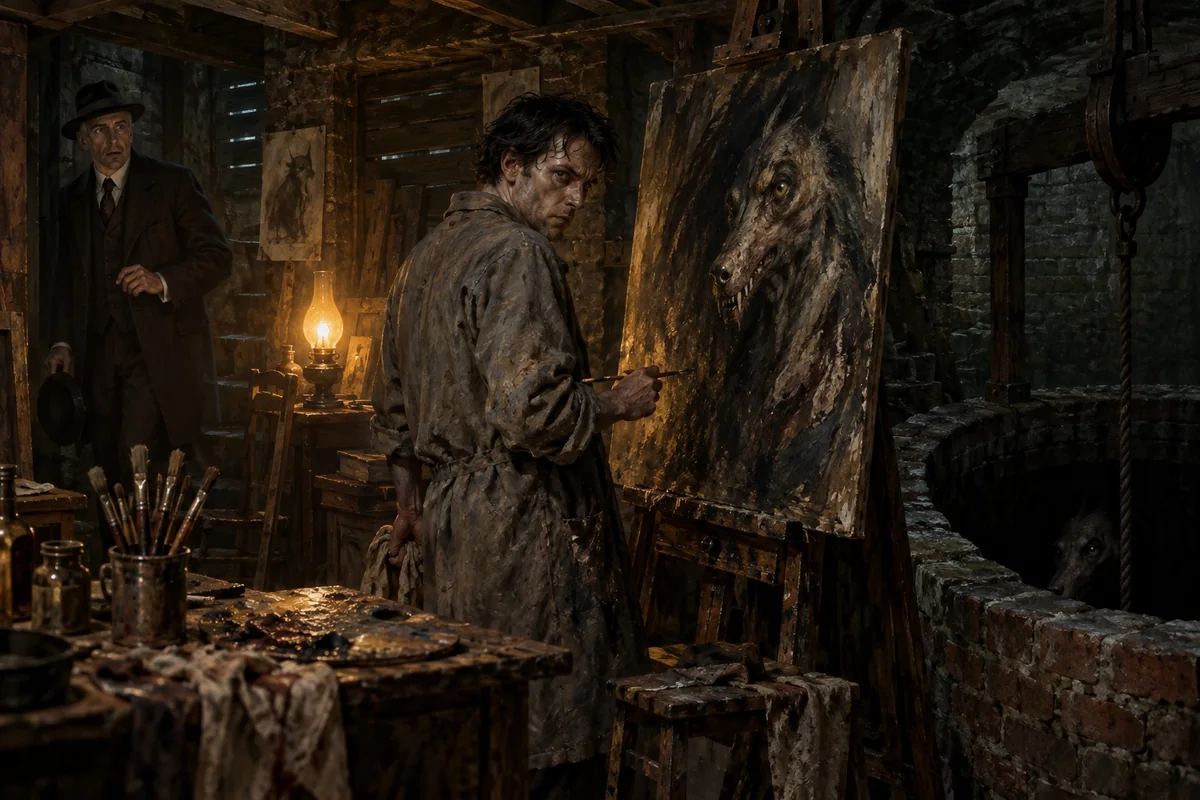
The actual working studio is below ground, near a broad brick well covered with a wooden disc. Unfinished paintings reveal careful construction and precise attention to perspective. A camera stands nearby, and Pickman explains that photographs allow him to work from views without carrying his equipment around the city.
He uncovers a large painting of a canine-faced creature feeding on a human body. Thurber cries out. More than the subject alone, the figure’s apparent life overwhelms him. A curled paper is pinned to the canvas, and he reaches to examine what he assumes is a photograph for the background.
Sounds from the adjoining cellar interrupt him. Pickman draws a revolver, orders silence and shuts the connecting door. Scrambling, movement of wood against masonry, strange vocal sounds and six shots follow. On returning, the artist blames oversized rats associated with the old tunnels. Thurber does not see the source of the disturbance directly.
Sources: [3]
The photograph and the ending
Pickman escorts his shaken guest out through a different route. They walk back downtown, and Thurber never speaks to him again. The decisive discovery comes the following morning, when he finds the curled paper in his coat and realizes that he pocketed it during the interruption.
The picture is not a background study. It shows the creature from the canvas standing against the cellar studio’s identifiable wall. Thurber has been looking at a portrait based on a living sitter. The photograph gives a literal meaning to the artist’s repeated claim that terror should be painted from life.
Thurber burns the evidence and cannot bring himself to guide the police to the house. He concludes that Pickman was not wholly human, while leaving open whether this resulted from birth or from something the painter discovered. The spoken account ends with personal certainty, but the evidence that might persuade an outside investigator has been destroyed.
Sources: [3]
Artistic judgment and failed reassurance
Thurber’s admiration survives the revelation. He still calls Pickman a great artist, separating the quality of the work from the horror of its source. That persistence gives the story more tension than a simple warning that disturbing pictures are badly made or morally worthless.
His initial theory also proves uncomfortably accurate. He believes that powerful art depends on knowledge and observation, then discovers how far that principle extends. The explanation that validates his judgment destroys his security.
The account invokes real artists, including Fuseli, Goya, Doré, Sidney Sime, Anthony Angarola and Clark Ashton Smith, as points of comparison. Their presence situates Pickman within Thurber’s critical vocabulary. It does not imply that these real artists shared the fictional painter’s practices or encountered his creatures.
Sources: [3]
Ancestry, prejudice and the city
The story layers fears about bodily change onto anxieties about old families and urban space. Reid’s speculative language about development and degeneration gives one explanation for Pickman’s altered appearance, while the paintings suggest other routes through ancestry and childhood exchange.
Pickman’s speech also contains ethnic contempt toward the people living in the North End. His insistence that they cannot understand the district belongs to his prejudiced viewpoint. The reader can follow the fictional history of the studio without accepting his hierarchy of who has the right to interpret a neighborhood.
These elements work together to make belonging unstable. The ostensibly cultivated artist may have closer ties to the creatures below than to the club that excludes him. The apparent boundary between civilized observer and monstrous subject becomes difficult to maintain.
Sources: [3]
Connection with The Dream-Quest of Unknown Kadath
The Dream-Quest later presents Richard Upton Pickman as a ghoul encountered by Randolph Carter. He retains memories, some English and the ability to help a former human acquaintance. This appearance supplies a continuation beyond the disappearance that Thurber cannot explain.
It also changes the angle of view. Pickman’s Model discovers the underground population from outside through a frightening image; The Dream-Quest enters its social world and finds friendship and cooperation as well as danger. Carter is a separate character from Thurber, and the later story should not be used to replace the earlier witness’s limited knowledge with an omniscient account.
References
- H. P. Lovecraft Archive — fiction in composition order
Composition dates; question marks and ranges retain the source uncertainty.
- H. P. Lovecraft Archive — fiction in publication order
First publication dates and venues; issue dates can differ from actual release dates.
- Pickman's Model — Unspeakable Tales ebook
The fictional narrative is evidence for what the story says, not proof of events in the real world.
- The Dream-Quest of Unknown Kadath — original text
The fictional narrative is evidence for what the story says, not proof of events in the real world.
At a glance
H. P. Lovecraft
1926
1927, October
Weird Tales, 10, No. 4
Fiction