

Boston
Boston appears in Lovecraft’s fiction as a city of art, concealed antiquity and remembered beauty. Pickman’s Model contrasts the North End with fashionable artistic life, while The Dream-Quest of Unknown Kadath makes Boston part of Randolph Carter’s recovered attachment to the waking world. The city can open both downward into horror and inward into the sources of dream.
4 min read · 801 words
Pickman and the artistic community
Pickman's Model is framed as Thurber's explanation to Eliot of why he has broken with Richard Upton Pickman. The painter's disturbing work has already alienated members of their artistic circle. Thurber initially responds differently: he admires the technical skill and emotional force that others find intolerable.
Sources: [1]
Boston's art world therefore provides more than a place to display the pictures. It establishes competing judgments about what art can legitimately depict, and it gives Pickman a reason to distinguish his public working life from a secret studio.
Thurber's interest in a study of weird art helps draw him into the painter's confidence. His eventual terror emerges from a relationship built around aesthetic admiration.
Back Bay and the North End
Pickman attacks Back Bay as too new to possess the accumulated memories he seeks. He contrasts its fashionable streets with the older North End, where generations of habitation seem to him to have concentrated a richer supernatural past.
The contrast is explicitly the painter's argument. It tells the reader how he understands his work and why he wants to paint elsewhere. His claims about ghosts, witches and subterranean connections belong to the story's invented explanation of the neighborhood.
The North End's value to him is not simply picturesque decay. He treats it as access to experiences and forces that a more recently made urban environment cannot supply.
Sources: [1]
The route to the concealed studio
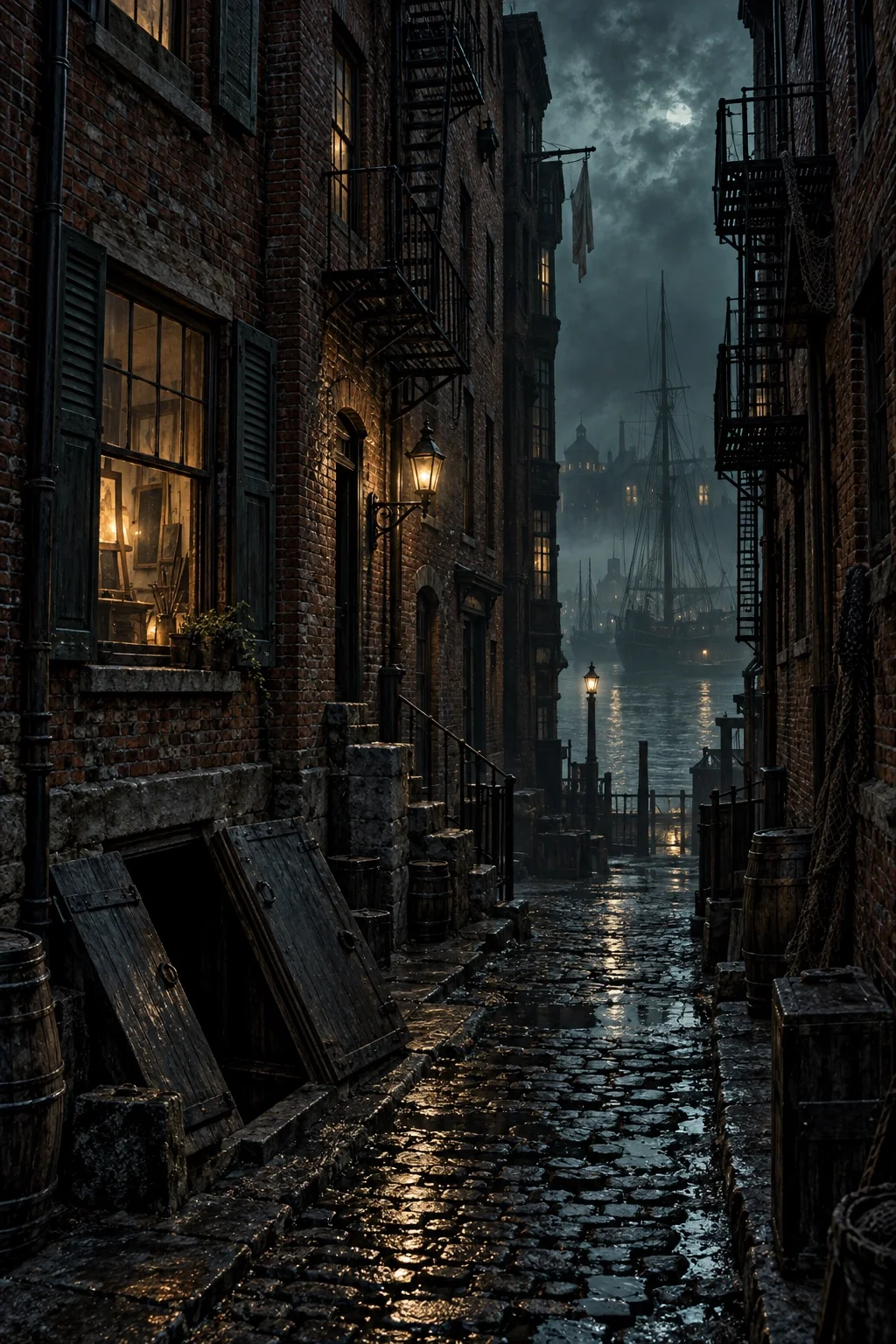
Pickman leads Thurber away from familiar public streets into an increasingly difficult network of alleys. Names and landmarks make the start of the journey recognizable, but the visitor loses the ability to reconstruct the entire route.
The studio is housed in an old building whose upper and lower spaces contain increasingly disturbing paintings. The descent from ordinary city life into a private collection mirrors the movement from general admiration to a discovery Thurber cannot explain as imagination alone.
The city has not disappeared. Its recognizable fabric has instead acquired hidden openings. The horror depends on continuity between an ordinary inhabited district and spaces absent from the visitor's working map.
Sources: [1]
Cellars, tunnels and proximity
Pickman describes passages connecting old houses, burial grounds and the waterfront. Beneath the studio, the presence of a well and disturbing sounds suggests that his account may have a physical basis. He briefly leaves Thurber while dealing with an interruption below.
The paintings place monstrous activity beside recognizable aspects of human life. Their force comes partly from that proximity: the creatures are not confined to a remote fantastic country where the viewer could safely leave them.
Thurber's later discovery of a photograph changes the status of what he has seen on canvas. The artist's astonishing realism acquires a source outside invention, retrospectively transforming the studio visit into an encounter with evidence.
Sources: [1]
The city remembered in the dream quest
The Dream-Quest of Unknown Kadath gives Boston a markedly different emotional role. Carter's longing for the sunset city is bound to impressions gathered from places he knew and loved in New England. What appears at first to be the object of an entirely foreign quest is inseparable from memory.
Boston belongs to the explanation of that desire. The story's return toward the waking world makes familiar urban beauty something recovered, rather than merely a limitation from which dream travel offers escape.
Read beside Pickman's Model, this use prevents Boston from becoming a single-purpose setting. The old city can generate dread through what lies behind its visible surfaces and wonder through what those surfaces have already given the imagination.
Sources: [2]
Pickman across the two stories
Carter also encounters Pickman in the Dreamlands, now among the ghouls. He becomes a useful intermediary in a world whose inhabitants are less uniformly hostile to Carter than their appearance might suggest.
The connection joins the Boston painter to a larger nonhuman geography, but the stories approach him from different positions. Thurber discovers the source of an artist's images; Carter benefits from acquaintance with a figure already at home among the beings that frightened the earlier narrator.
Those different relations are part of Pickman's significance. A creature's place in a story depends on the observer, the circumstances and the possibility of communication, as well as on physical form.
Reading the historical claims
Pickman's rhetoric combines real place names with claims about witchcraft, ancestral knowledge and hidden tunnels. Its authority is part of his persuasion of Thurber. The narrative's use of specific streets should not turn those supernatural claims into verified Boston history.
For the literary map, the essential movement is clear: public artistic society, the North End route, the concealed studio, and the spaces beneath it. The precise reconstruction of every turn would require evidence beyond what the visitor successfully remembers.
Sources: [1]
References
- Pickman's Model — Unspeakable Tales ebook
The fictional narrative is evidence for what the story says, not proof of events in the real world.
- The Dream-Quest of Unknown Kadath — original text
The fictional narrative is evidence for what the story says, not proof of events in the real world.
At a glance
Boston, Massachusetts
North End; Back Bay
Hidden artistic geography; remembered source of dream beauty
Selected fictional representations