

The Dream-Quest of Unknown Kadath
Randolph Carter searches the Dreamlands for the gods who can explain a city he has seen only at sunset. His journey crosses trading ports, the moon, subterranean kingdoms and the frozen north, gathering allies whose frightening appearances conceal loyalties more dependable than the assurances of a god.
17 min read · 3,432 words
Composition, first publication and literary connections
Lovecraft composed The Dream-Quest of Unknown Kadath from approximately autumn 1926 to 22 January 1927. It remained unpublished during his lifetime and first appeared in the Arkham House collection Beyond the Wall of Sleep in 1943. The late publication should not obscure its place among the works written before The Colour out of Space and The Dunwich Horror.
The narrative gathers people and places associated with earlier fiction, including Ulthar, Atal, Kuranes, Celephaïs and Richard Upton Pickman. Their roles are transformed by the longer quest. A figure introduced in a frightening short story can become an ally, while a place once imagined as the answer to longing becomes a setting in which longing continues.
Randolph Carter is an experienced dreamer. He enters with knowledge of languages, customs, routes and previous acquaintances. His competence allows the story to begin beyond the usual threshold of disbelief: the question is not whether a dream world exists, but whether he can travel through its particular dangers and discover what his desired city means.
Sources: H. P. Lovecraft Archive — fiction in composition order, H. P. Lovecraft Archive — fiction in publication order, The Dream-Quest of Unknown Kadath — original text, The Cats of Ulthar — Unspeakable Tales ebook, The Other Gods — Unspeakable Tales ebook, Celephais — Unspeakable Tales ebook, Pickman's Model — Unspeakable Tales ebook
The sunset city and the decision to seek Kadath
Carter has repeatedly seen a beautiful city in dreams but has been interrupted before reaching it. When further access is denied, he decides to find the gods of Earth at Kadath and ask them to restore the vision. The goal is intensely personal: he wants a place whose beauty seems more complete than anything available to him elsewhere.
Nasht and Kaman-Thah, the priests at the cavern of flame, warn him against the undertaking. They distinguish the comparatively limited gods of Earth from the greater powers that protect them. Seeking an explanation from the Great Ones may bring Carter within the attention of the Other Gods and their messenger Nyarlathotep.
The warning establishes a recurring pattern. Knowledgeable figures advise Carter to abandon or reconsider the quest, and he continues because the desired city seems to outweigh the danger. His persistence is a strength in surviving individual obstacles but also the quality that repeatedly leads him into new ones.
The descent through the stages of sleep gives the journey a formal entrance. Beyond the Gate of Deeper Slumber lies an interconnected geography with its own distances and communities. The dream setting does not mean that Carter can casually wish every obstacle away.
The enchanted wood, the zoogs and Ulthar
In the enchanted wood, Carter communicates with the zoogs, small secretive inhabitants whose knowledge includes both dreamland and some routes toward the waking world. Their conversation directs him toward Ulthar and its old religious learning. Some follow him with less than wholly innocent curiosity.
Ulthar offers a gentler surface: houses, cultivated country, a temple and an abundance of cats protected by the town’s law. Carter’s kindness toward the cats creates a relationship that later becomes indispensable. The treatment of the pursuing zoogs also makes clear that peaceful appearance does not remove predation from the world.
At the temple, Carter consults Atal, now an elderly patriarch. Atal remembers the danger encountered with Barzai and urges caution. Carter obtains more information after sharing the zoogs’ wine, which loosens the priest’s reserve.
The clue concerns a face carved on Mount Ngranek on the island of Oriab. The gods’ features may be recognized in their descendants, allowing a traveler to infer where the divine population has wandered. Carter turns the search for an inaccessible place into a search for recognizable bodies and family resemblance.
Sources: The Dream-Quest of Unknown Kadath — original text, The Cats of Ulthar — Unspeakable Tales ebook, The Other Gods — Unspeakable Tales ebook
Dylath-Leen and the black galley
Carter follows trade routes toward Dylath-Leen, a dark port built largely of basalt. Merchants can tell him about Oriab and the ships that visit Baharna. While waiting for passage, he hears disturbing accounts of black galleys whose traders exchange valuable rubies without revealing the rowers who move their vessels.
The port tolerates this commerce because the goods are desirable. Its economic appetite creates the opening through which Carter is captured. After accepting a drink from one of the strange merchants, he loses control of his situation and wakes aboard a galley.
The voyage crosses the boundary of an ordinary sea journey. The ship passes beyond the terrestrial horizon and reaches the moon. The traders’ bodies and their relation to the concealed masters of the traffic become clearer when Carter sees the lunar settlement.
The incident establishes one of the quest’s recurring dangers: a familiar commercial or social exchange can conceal a system of enslavement. Carter’s skill in obtaining information does not protect him from every offer made by people who know more about the transaction than he does.
The moon and the intervention of the cats
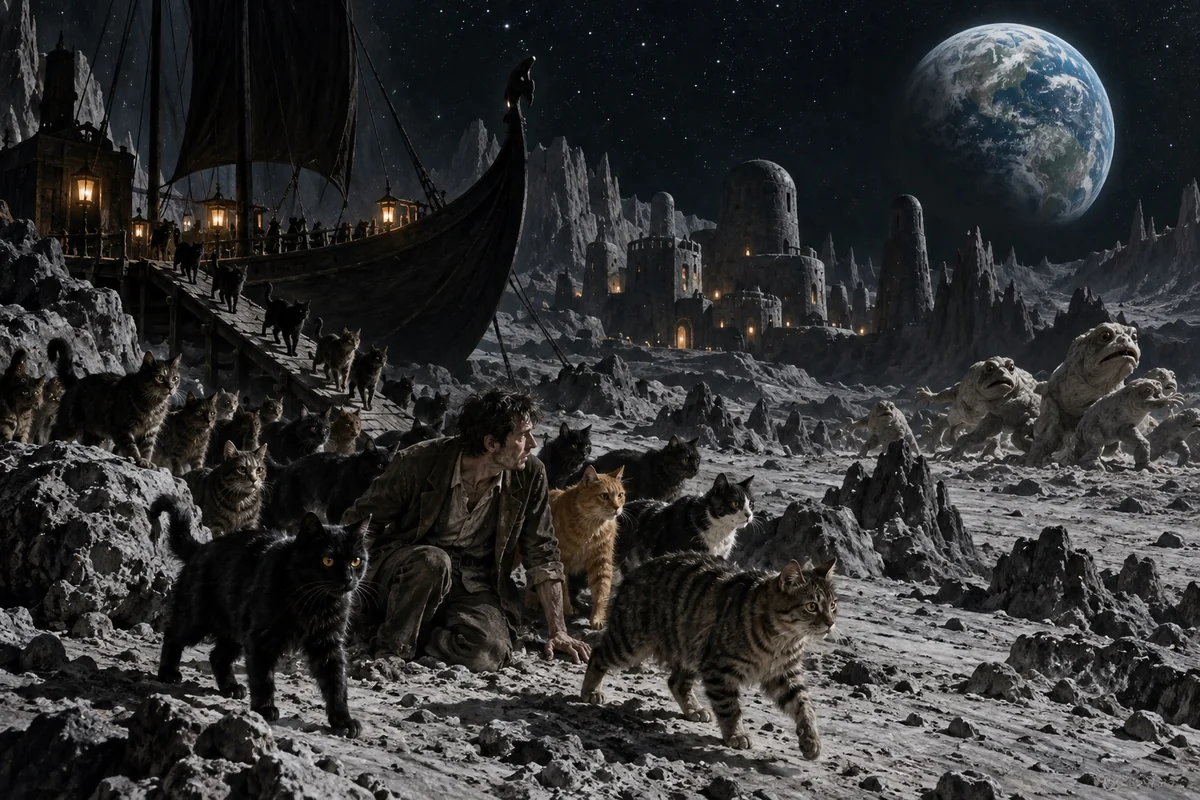
The lunar masters are pale, toad-like beings with tentacular facial structures. The apparently human merchants belong to a subordinate population, whose members are used as workers and also subjected to more disturbing forms of exploitation. Carter’s capture has placed him inside a larger system rather than an isolated kidnapping.
The cats reach the moon by their own means and conduct raids against its inhabitants. Their arrival gives Carter a chance to escape. The connection established at Ulthar now matters directly: he is recognized as someone who has treated cats well, and the rescuers accept him as an ally.
After the confrontation, they carry him back to Dylath-Leen. He warns the city against continued traffic with the black galleys, but the attraction of the rubies persists. The rescue has saved one traveler without reforming the port’s entire economy.
The cats’ role is more than comic relief. They possess collective organization, martial ability, routes and information unavailable to Carter. The episode makes reciprocal relations across species an effective source of power, in contrast with the deceptive bargains offered by the galley merchants.
Oriab, Baharna and the face on Ngranek
Carter eventually sails to Oriab and reaches Baharna, a large terraced port. Its trade, crafts and routes into the island give the journey another concrete social setting. He gathers information and obtains the means to approach Ngranek, whose difficult farther face bears the image he seeks.
The climb is dangerous because the relevant side of the mountain is remote and difficult to traverse. Carter’s persistence finally reveals the carved face, which he recognizes as resembling certain northern sailors he has seen in Celephaïs. The clue advances the original plan: those mariners may carry the gods’ ancestry and point toward their region.
Success immediately produces another setback. Night-gaunts seize him on the mountain and carry him down into the underworld. Their faceless bodies, silent flight and restraining tails make the experience terrifying, but their actions do not settle their eventual allegiance in the narrative.
The quest thus repeatedly separates the acquisition of a clue from possession of a safe route onward. Carter knows more than he did before the climb, yet must survive an entirely new geography before he can use the information.
The Vale of Pnath and the return of Pickman
The night-gaunts leave Carter in the Vale of Pnath, a dark region filled with bones cast down from the places above. Great bholes move unseen through the depths. The traveler’s immediate problem is physical escape, not interpretation of a divine mystery.
A route upward brings him among ghouls. His earlier acquaintance with Richard Upton Pickman has prepared him to recognize their appearance and attempt communication. He learns that Pickman himself has become a ghoul of some standing nearer the waking world.
Carter meets the transformed artist seated on a gravestone taken from Boston. Pickman retains enough memory and speech to understand him and offer help. The scene changes the significance of a figure whose earlier story associated art with the discovery of horrifying models. Here the ghoul can be a friend, guide and organizer.
Pickman proposes routes that would either return Carter toward the waking world or lead through other dangerous regions. Carter resists awakening because he fears losing the dream’s hard-won knowledge, particularly his memory of the faces that may guide him north. He chooses the more hazardous continuation rather than a safe reset.
Sources: The Dream-Quest of Unknown Kadath — original text, Pickman's Model — Unspeakable Tales ebook
The kingdom of the gugs and the Tower of Koth
The route to the enchanted wood passes through the subterranean kingdom of the gugs. These enormous beings once lived above but were banished below after an offense against the gods. A curse prevents them from opening the great trapdoor that leads back to the wood, although it does not prevent them from pursuing intruders through their own towers.
Pickman sends three ghouls to help Carter and advises him to disguise himself as one of them. Their knowledge of the city, their ability to see in darkness and their physical endurance compensate for his human limitations. A stolen gravestone becomes a practical tool rather than merely a macabre decoration.
The group encounters ghasts from the Vaults of Zin, the creatures on which the gugs prey. A fight between a gug sentry and the ghasts creates an opportunity to move through the sleeping city. Later, a ghast threatens the party on the immense stairway and is killed with the slab.
The climb through the Tower of Koth is exhausting because the steps were built for bodies far larger than Carter’s. At the top, the companions use the gravestone to help raise the stone barrier. Escape depends on cooperation, leverage and timing. The vast underworld is navigable only because allies understand how its dangers relate to one another.
Return to the surface and the route to Celephaïs
Back above, Carter continues through a world whose familiar paths now carry obligations from the underworld. The ghouls’ assistance is not forgotten, and the quest later turns toward their rescue when he learns of their capture. Help given in one episode creates responsibilities in another.
He also becomes involved in the relations between zoogs and cats. The wood’s inhabitants are not passive sources of information; they have their own intentions toward neighboring creatures. Carter’s knowledge and loyalties influence events within that local conflict.
Travel toward Celephaïs brings him through further waterways and commercial settings, including Hlanith. Ports, inns, cargoes and conversations provide continuity between spectacular encounters. The Dreamlands have routine work and exchange as well as unique marvels.
The northern sailors remain his immediate objective. Their resemblance to the face on Ngranek offers a clue grounded in recognition rather than a map. Carter must find the right people, learn where they travel and avoid revealing too much of his purpose.
Kuranes and the limits of an imagined kingdom
In Celephaïs, Carter visits Kuranes, whom he knew in the waking world. Kuranes has achieved the dream sovereignty sought in his own earlier story, ruling a place of extraordinary beauty. Yet he no longer finds its unlimited wonders sufficient.
Because his waking body is dead, he cannot return to the English country of his childhood. Instead he has recreated a small landscape of familiar buildings, fields and social details within his kingdom. His longing has moved from escape into fantasy toward recovery of the particular world that formed his memory.
Kuranes warns Carter both about the gods and about the disappointment that may follow possession of the desired city. He suspects that the traveler will ultimately value remembered New England more than an apparently perfect unknown place. Carter listens but continues.
The conversation anticipates the ending without simply announcing it. Kuranes offers a possible interpretation of desire, while Carter still treats the sunset city as something externally withheld. The quest will have to carry him much farther before he can recognize the relevance of his friend’s experience.
Sources: The Dream-Quest of Unknown Kadath — original text, Celephais — Unspeakable Tales ebook
The northern sailors and twilight Inganok
Carter finds the sailors whose faces resemble the image on Ngranek and takes passage aboard their ship, presenting himself as interested in work connected with onyx. Their home is Inganok, a northern land of twilight, fine stonework and unease about the regions beyond its settled districts.
The city’s beauty differs from Ulthar’s domestic warmth and Dylath-Leen’s sinister commerce. It has a distinctive architectural and cultural identity, yet its people avoid the northern wastes and speak cautiously of the mountains and plateau beyond. Cats will not travel there, removing a source of help on which Carter has previously relied.
He obtains a yak and moves through the quarries toward increasingly deserted country. A gigantic abandoned excavation suggests work on a scale beyond the local human industry. The animal’s growing fear precedes Carter’s recognition that he is being followed.
The northern boundary is guarded by immense carved mountain forms and shantak-birds. A suspicious trader overtakes Carter and forces him onto one of the creatures. The clue that seemed to lead toward the gods has again placed him in the hands of an intermediary whose purposes he cannot trust.
Leng and the monastery
The shantak carries Carter across the mountains to Leng. From above, he recognizes the inhabitants as related to the merchants of the black galleys. Their horns, hooves, tails and broad mouths had been concealed or imperfectly understood in the trading port. The moon episode and the northern journey are parts of a connected geography of power.
He is brought to a monastery associated with the high priest whose appearance is withheld in the narrative’s customary epithet. Wall paintings disclose wars, servitude and relations among Leng, the lunar beings and neighboring regions. The architecture becomes another archive through which Carter learns how the threats he has met are connected.
He also learns a fact that will change his options: the night-gaunts do not serve Nyarlathotep. They acknowledge Nodens, and the shantaks fear them. The creatures that once abducted him may therefore be useful against the forces now controlling his route.
Carter escapes into passages leading away from the monastery and eventually reaches Sarkomand, where routes descend to the ghouls’ world. His flight is not merely another return to the beginning. It brings new knowledge about alliances and an opportunity to act on the debt he owes his earlier guides.
The rescue of the ghouls
Carter discovers that the ghouls who helped him have fallen into the hands of enemies connected with the black galleys. He seeks Pickman’s assistance rather than continuing toward Kadath alone. The quest temporarily becomes a rescue mission.
Pickman organizes ghouls and night-gaunts for an attack. Their cooperation draws on existing agreements and complementary abilities: the night-gaunts provide silent reconnaissance and flight, while the ghouls can fight, plan and use captured equipment. Carter contributes information about the enemy and the immediate situation.
The operation includes the capture and use of a galley and fighting around the enemy’s stronghold. It is one of Lovecraft’s most extended episodes of collective action. The allies are not interchangeable monsters assembled for spectacle; the narrative repeatedly distinguishes their tasks and limitations.
Afterward, Carter receives more help than he had originally requested for the continuation north. His willingness to interrupt his private quest for the sake of companions has strengthened the network that will carry him to its apparent destination. The episode gives reciprocity a concrete consequence in the plot.
The flight to Kadath
The ghouls and night-gaunts escort Carter across the northern regions. Knowledge of the shantaks’ fear provides a way through defenses that defeated him when he traveled alone. The same landscape becomes passable because his position within its alliances has changed.
Kadath appears as a remote onyx castle in the cold waste. Its scale and isolation seem to promise the final answer after the long sequence of ports, caverns and detours. Yet the Great Ones are absent when Carter arrives.
The absence is the central reversal of the destination. Carter has traveled to the gods’ home in order to ask about another city, only to discover that the gods themselves have left. The place that seemed to organize the entire quest is no longer occupied in the way the traveler expected.
Nyarlathotep appears as the authoritative interpreter of this situation. His commanding, human-like presentation differs from the grotesque bodies of Carter’s allies, but the narrative will make that outward distinction an unreliable guide to trust.
Nyarlathotep explains the sunset city
Nyarlathotep tells Carter that the desired city was formed from the places and impressions of his own New England. Its beauty is not an independent perfection hidden somewhere beyond ordinary experience. It gathers remembered roofs, streets, landscapes and emotional associations into a dream creation.
The gods of Earth have been attracted to it and abandoned Kadath. Carter is therefore offered a role in persuading them to return. The explanation makes him both the seeker of the city and, without understanding it, its creator.
This disclosure fulfills the significance of Kuranes’s warning. The object of longing draws its power from the traveler’s own history. The journey across an immense strange world has been directed by a desire whose material lay closer to home than he knew.
Nyarlathotep combines that genuine explanation with a dangerous offer of transport. Truth becomes part of the deception. The fact that he can explain the city accurately does not mean he intends Carter to reach it safely.
The shantak’s false route and Carter’s leap
Carter departs on a shantak under instructions that seem to lead toward the desired city. The flight instead carries him toward the central chaos associated with Azathoth. Music and cosmic wonder help conceal the fatal direction until he recognizes the trap.
He cannot make the creature obey him. The means of transport is controlled by the power that supplied it, repeating the danger of entrusting oneself to an apparently helpful intermediary. The promised route is itself the instrument of destruction.
Carter nevertheless retains the ability to act within the dream. He leaps from the shantak and falls through immense regions toward the world he remembers. Earlier knowledge and the guidance associated with S’ngac and Nodens help orient the escape, while Nyarlathotep’s effort to complete the trap fails.
The leap is a final exercise of agency. Carter cannot overpower the cosmic beings or command the entire Dreamlands, but he can recognize the deception and choose a dangerous alternative to passive arrival at its intended endpoint.
Boston and the ending
Carter awakens in Boston. The familiar world now carries the beauty he had pursued in the remote sunset city. Awakening does not simply dismiss the quest as meaningless; it changes how he understands the source of what he sought.
The narrative also returns to Nyarlathotep and the gods at Kadath, preserving an imaginative world beyond Carter’s immediate waking perspective. The ending is therefore more layered than an ordinary revelation that nothing happened. The dream journey has its own actions and consequences even as its central desire is traced to earthly memory.
Kuranes’s predicament gives the return additional force. Carter can still wake into a world the dream king can only reconstruct. What looked like a limitation of ordinary life becomes a possession whose value is clearest to someone who has lost it.
The conclusion is comparatively restorative within Lovecraft’s fiction, but it follows genuine terror and deception. Carter gains a changed relation to home, not a guarantee that every dream power is harmless or every future journey will end as safely.
Alliances, appearance and the gods
Carter’s survival depends repeatedly on relations with nonhuman beings. Cats, ghouls and night-gaunts have their own motives and customs, but they can remember kindness, honor agreements and provide reliable help. Their frightening or unfamiliar appearance does not determine the moral quality of every interaction.
Nyarlathotep reverses that pattern. His magnificent presentation and knowledge make him persuasive, yet he uses truth to guide Carter toward destruction. The story’s distinction between appearance and conduct is enacted through the journey rather than supplied only as an abstract lesson.
The Great Ones, the gods of Earth, are limited and capricious. The Other Gods belong to a more dangerous order that protects them. Nodens has a separate relation to the night-gaunts and assists the escape, but the text does not require a universal moral classification of every being in Lovecraft’s fiction.
These patterns coexist with hierarchical and prejudiced descriptions of some peoples and places. The narrative can cross one boundary of sympathy while maintaining others. A detailed reading should preserve that complexity rather than treating the helpful monsters as proof that the text has escaped all of its author’s assumptions.
Geography, continuity and connected reading
The Dreamlands are connected through trade, roads, rivers, sea routes, aerial movement and passages into the underworld. Carter cannot reach every place from every other place at will. Knowledge of routes, timing, species-specific abilities and local authority is as important as bravery.
The book is therefore a major source for the wiki’s geography and creature entries. Its use of familiar names should still be read in context: Pickman’s ghoulish life here changes the emphasis of Pickman’s Model, and Kuranes’s longing complicates the triumph imagined in Celephaïs. Continuity develops through new narrative uses rather than through an unchanged encyclopedia of facts.
Useful companion stories are The Cats of Ulthar, The Other Gods, Celephaïs and Pickman’s Model. Carter’s other stories explore related questions of dream, identity and access through different structures. The linked entries on Kadath, the Great Ones, Nyarlathotep, Nodens, the ghouls and night-gaunts separate the participants’ roles without reducing this long journey to a list of encounters.
Sources: The Dream-Quest of Unknown Kadath — original text, The Cats of Ulthar — Unspeakable Tales ebook, The Other Gods — Unspeakable Tales ebook, Celephais — Unspeakable Tales ebook, Pickman's Model — Unspeakable Tales ebook
Related music
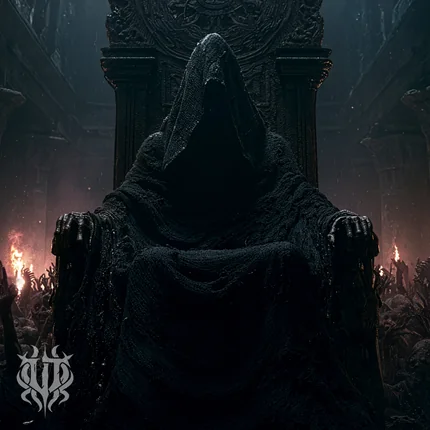
A Thousand Masks is a dark metal song inspired by Nyarlathotep, the Crawling Chaos who walks among humanity, hiding behind countless faces and whispered lies.
References
- H. P. Lovecraft Archive — fiction in composition order
Composition dates; question marks and ranges retain the source uncertainty.
- H. P. Lovecraft Archive — fiction in publication order
First publication dates and venues; issue dates can differ from actual release dates.
- The Dream-Quest of Unknown Kadath — original text
The fictional narrative is evidence for what the story says, not proof of events in the real world.
- The Cats of Ulthar — Unspeakable Tales ebook
The fictional narrative is evidence for what the story says, not proof of events in the real world.
- The Other Gods — Unspeakable Tales ebook
The fictional narrative is evidence for what the story says, not proof of events in the real world.
- Celephais — Unspeakable Tales ebook
The fictional narrative is evidence for what the story says, not proof of events in the real world.
- Pickman's Model — Unspeakable Tales ebook
The fictional narrative is evidence for what the story says, not proof of events in the real world.
At a glance
H. P. Lovecraft
Autumn? 1926–22 January 1927
1943
Beyond the Wall of Sleep, Arkham House
Fiction