

Ghouls
Lovecraft’s ghouls are corpse-eating, dog-featured beings associated with graveyards, tunnels and the boundary between human and nonhuman life. Pickman’s Model presents them as a terrifying reality behind an artist’s work, while The Dream-Quest of Unknown Kadath develops their language, friendships, political cooperation and capacity to assist a human traveler.
7 min read · 1,413 words
Bodies and recognizable features
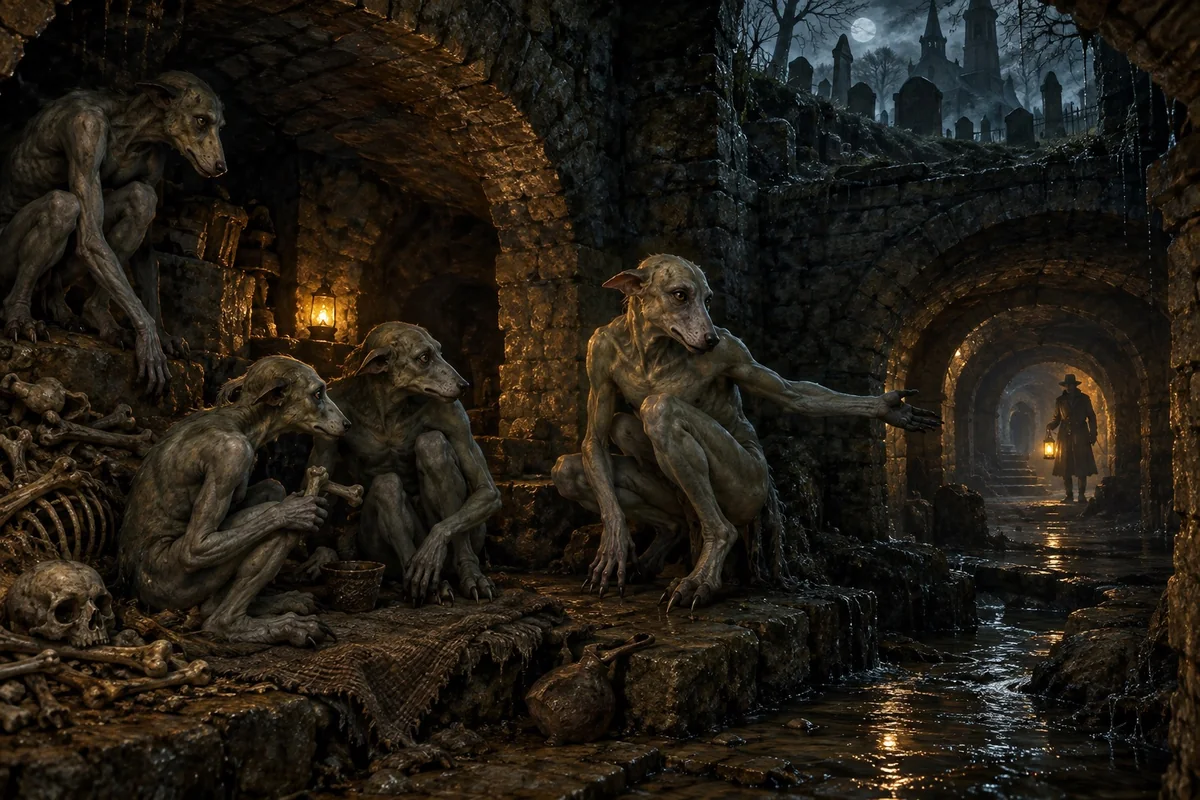
The ghouls in The Dream-Quest are rubbery, generally naked and canine in facial appearance. Their customary movement is a stooping lope. Carter can make himself superficially resemble one by removing his beard and clothes, covering his skin in the appropriate dirt and adopting their gait.
Pickman’s Model provides a more elaborate visual description through a painting of a creature feeding. Its face has pointed ears, a flattened nose, drooling lips and bloodshot eyes. Clawed hands, a body marked by mould and partly hoof-like feet contribute to the effect. The final revelation gives Thurber reason to believe that this apparently impossible anatomy was painted from a living model.
The two accounts overlap without functioning as identical anatomical specifications. Their emphasis changes with viewpoint: an art enthusiast registers appalling visual detail, whereas a traveler among ghouls increasingly notices behavior and communication. Neither story provides a standardized height or a complete biological classification.
Feeding and the world beneath cemeteries
Ghouls obtain food from the dead and move through underground passages connected with burial grounds. In The Dream-Quest, discarded bones fall from the edge of their domain into the Vale of Pnath. Carter reasons that these deposits can help him find their territory even when he cannot see the surrounding landscape.
Their feeding practices are disturbing to him, and some individuals regard his living body with an interest that is far from reassuring. Friendship with particular ghouls does not guarantee that every member of the population will behave safely toward a human visitor.
Pickman’s pictures include attacks on living people and monsters waiting in cellars. These are depicted events within paintings, not a catalog of independently documented incidents in the story’s Boston. The photograph proves something important about the model’s existence, but it does not separately authenticate every scene on every canvas.
Pickman’s Model: art as evidence
Thurber recounts his association with Richard Upton Pickman to a listener named Eliot. The painter has lost respectable professional support because of his subjects, yet Thurber initially admires the technical power of work that other viewers find intolerable.
A visit to Pickman’s hidden North End studio reveals paintings that connect colonial New England, modern Boston and an underground population. One depicts creatures breaking into the subway; another presents tunnels beneath Beacon Hill. Still another gives the ghouls a grotesque appreciation of a guidebook’s information about famous burials.
In the cellar studio, a covered well appears to connect the building with older passages. Strange noises interrupt the visit, and Pickman leaves the room with a revolver before dismissing the disturbance as rats. Thurber later discovers that he has accidentally taken a photograph pinned near a canvas. It shows the painted monster posed against the actual cellar wall. The artist’s convincing technique is therefore linked to observation rather than mere invention.
Sources: [1]
Children, changelings and uncertain origins
Several paintings imply contact between human families and ghouls across generations. In one, creatures instruct a human child in their feeding habits. Other images suggest substitutions between children of the two populations. A painted Puritan household includes a figure whose resemblance to Pickman troubles Thurber.
These clues invite explanations involving ancestry, exchange or gradual transformation, but the narrator cannot choose a complete biological history. His final comments allow for Pickman having been born under unusual circumstances or having crossed a forbidden boundary later.
The story’s uncertainty should remain visible. It does not establish that every ghoul began as a human, that eating a fixed quantity of human flesh inevitably causes transformation, or that all ghoul children are stolen from human homes. Those would be broader rules than the evidence permits.
Sources: [1]
Pickman after his disappearance
The Dream-Quest gives a more explicit later view of the artist. Carter encounters a ghoul identified as the former Richard Upton Pickman. Its features have changed enough to obscure its human origin, but it still remembers some English and retains its connection with Carter.
Pickman sits on a tombstone dated 1768 that has been taken from Boston’s Granary Burying Ground. This concrete object connects the subterranean setting with the waking city. It also turns a familiar feature of a human cemetery into furniture within another community.
Carter’s acquaintance with the artist is separate from Thurber’s narrative in Pickman’s Model. Carter is not identified as Thurber, and the two accounts need not be merged into one witness’s biography. What matters here is the continuity of Pickman’s identity across a visible bodily change.
Language, memory and friendship
Carter has learned enough of the ghouls’ language through his earlier contact with Pickman to make himself understood. A ghoul answers his calls from Pnath, and the traveler gains access to passages leading toward the community above. Speech and recognition become practical means of survival.
Pickman converses through a mixture of limited English and ghoul sounds. He understands Carter’s objective, explains the dangers ahead and proposes alternative routes. Other ghouls can receive instructions, act as guides and participate in coordinated decisions.
These behaviors complicate a description of the population as merely bestial. Their bodies and feeding practices remain alien to Carter, but memory, loyalty and negotiation are recognizable. The novella does not require him to find them beautiful or harmless before he can acknowledge those capacities.
Sources: [2]
The waking world and the Dreamlands
The ghouls Carter meets are specifically associated with the graveyards of the waking world. Pickman explains that they do not normally conduct their business in the burial grounds of upper dreamland, where other beings are active. This distinction helps explain why his knowledge cannot supply a simple, direct route to every destination Carter names.
One option is to leave through a waking cemetery and begin the dream journey again. Carter rejects that possibility because he fears losing the knowledge accumulated during the present quest. Another route leads through Sarkomand and its stairs into the lower gulfs.
The geography therefore joins different realms through particular passages and practices. It does not make the entire Dreamlands one enormous ghoul settlement. Nor should the briefly mentioned web-footed inhabitants of upper dreamland’s graveyards be silently renamed ghouls.
Sources: [2]
The journey through the gugs’ kingdom
Pickman reluctantly agrees to help Carter reach the Tower of Koth, whose stairway rises toward the enchanted wood. Three ghouls accompany the traveler, bringing a large tombstone that can serve as a lever for the heavy door above.
The route crosses the realm of the gugs. These giants fear ghouls sufficiently to yield ground in their own immense burial places, but the journey remains dangerous. Ghasts emerging from the Vaults of Zin attack without making useful distinctions between potential victims.
The companions’ assistance includes local knowledge, physical effort and willingness to take risks. Carter in turn contributes plans and action. Their relationship develops through shared danger rather than through a simple magical command that forces them to obey him.
Sources: [2]
War against the moon-beasts
The three guides are later captured, and Carter discovers their plight near Sarkomand. He carries the information to their people, setting in motion a rescue and a larger conflict with the moon-beasts. Night-gaunts provide crucial aerial support for the ghoul forces.
The fighting on the island is costly. When the survivors are counted, more than a quarter of the ghouls have been lost. Pickman has the wounded placed aboard the captured galley instead of permitting the older practice of killing and eating injured companions.
That intervention is evidence of Pickman’s policy, not a claim that all ghouls share modern humanitarian standards. The text specifically contrasts his preference with an existing custom. The same population can show loyalty, courage and appalling habits without fitting neatly into an entirely benevolent or entirely malicious category.
Sources: [2]
Why the two portrayals belong together
In Pickman’s Model, the central question is whether the artist’s visions correspond to an actual hidden world. The ghouls supply the answer and transform familiar streets, cellars and cemeteries into potential entrances to it. Thurber ends with knowledge that makes ordinary urban life harder to endure.
In The Dream-Quest, that hidden world is already part of the traveler’s experience. The emphasis shifts from proving its existence to finding a way through it. Ghouls consequently acquire the social detail that a frightened visitor to one studio never has time to discover.
The second treatment broadens the first without cancelling its horror. Pickman’s friends can help Carter while still feeding on corpses, and the people beneath Boston can maintain a community while remaining terrifying to those above. This coexistence of personal sympathy and physical revulsion gives Lovecraft’s ghouls a distinctive role among his creatures.
References
- Pickman's Model — Unspeakable Tales ebook
The fictional narrative is evidence for what the story says, not proof of events in the real world.
- The Dream-Quest of Unknown Kadath — original text
The fictional narrative is evidence for what the story says, not proof of events in the real world.
At a glance
Pickman’s Model; The Dream-Quest of Unknown Kadath
Dog-like features, rubbery bodies, stooping gait
Consumption of the dead
Richard Upton Pickman
Randolph Carter
Night-gaunts
Boston graveyards; the lower abysses; Sarkomand
Not established by these stories