

The Alchemist
The Alchemist follows Antoine, the last count of a declining French family whose male titleholders repeatedly die around the age of thirty-two. His investigation of a centuries-old curse leads beneath his own castle, where an apparent hereditary doom becomes the work of a single, unnaturally persistent avenger. The story combines ancestral guilt, material decay and the pursuit of prolonged life.
6 min read · 1,068 words
Composition and publication
Lovecraft wrote The Alchemist in 1908. Its first publication came in the November 1916 issue of The United Amateur. The gap between composition and appearance matters: its position in a publication list should not be mistaken for its position in the development of his fiction.
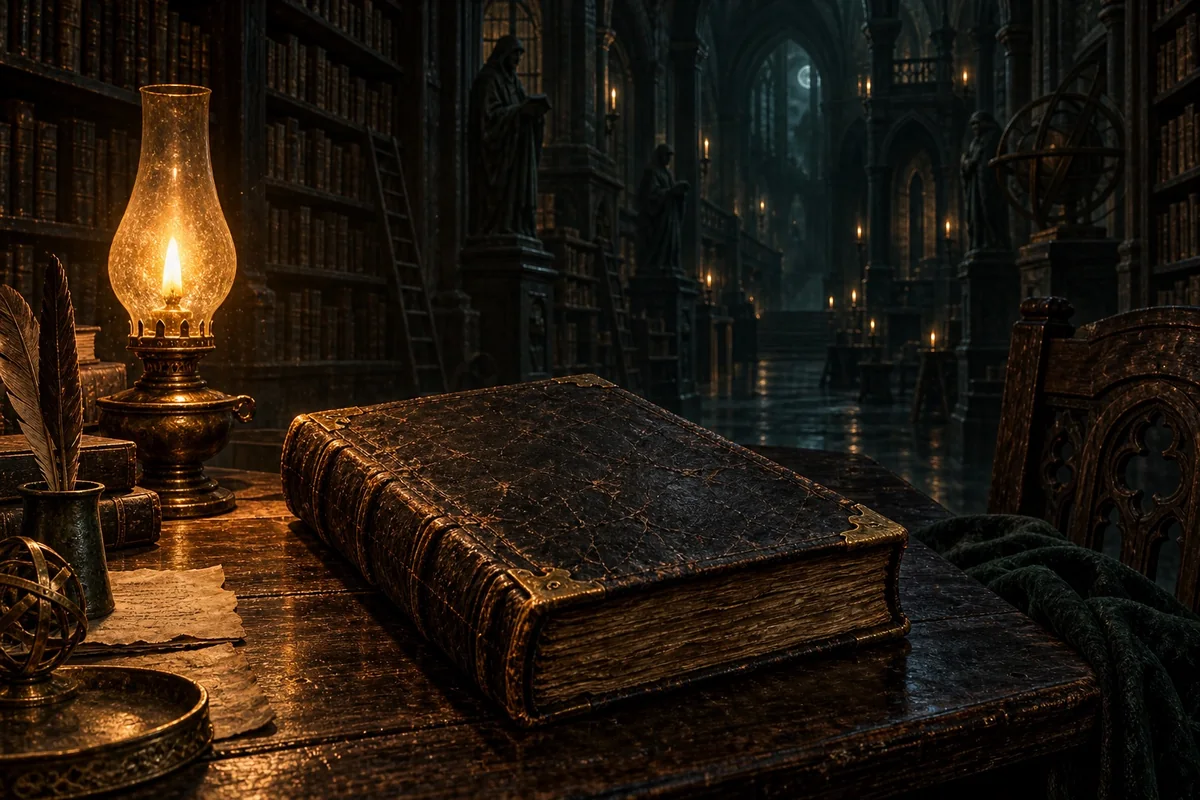
The tale belongs to his early Gothic writing. Its ruined castle, inherited manuscript and secret laboratory establish the situation through a family history rather than through the extraterrestrial civilizations of his later stories.
Sources: H. P. Lovecraft Archive — fiction in composition order, H. P. Lovecraft Archive — fiction in publication order, The Alchemist — Unspeakable Tales ebook
Antoine and the ruined estate
The narrator introduces himself as Antoine, the last of the Comtes de C——, and looks back from the age of ninety. The opening therefore already tells the attentive reader that the expected age limit did not end his life.
His family occupies a French castle that has deteriorated from a formidable fortress into a collection of abandoned wings and towers. Poverty contributes to the collapse, while aristocratic pride prevents the family from seeking commercial employment. Only one of the four principal towers remains inhabited.
Antoine's father died when a stone fell from a deserted parapet, a month before his son's birth. His mother died in childbirth. An elderly servant, Pierre, consequently becomes both guardian and teacher.
An education shaped by concealment
Pierre prevents Antoine from mixing with the neighboring peasant children. He initially explains the separation through social rank, but the adult narrator recognizes another purpose: keeping local stories of the family curse from him.
The result is an upbringing among old books, wooded ravines and largely empty rooms. Antoine develops an interest in occult learning while receiving only fragments of his own family history. His guardian's omissions make ordinary questions about ancestry increasingly frightening.
He gradually notices that the counts have all died young. At twenty-one, Pierre gives him a document transmitted and supplemented across generations. Reading it changes a pattern of early deaths into what Antoine accepts as an explicit sentence against himself.
Michel Mauvais and the original injustice
The family record traces the curse to the thirteenth century. Michel Mauvais, an alchemist living on the estate, and his son Charles Le Sorcier have acquired a sinister local reputation. Stories accuse them of crimes, but those allegations must be distinguished from the particular incident the document describes.
When Count Henri's son Godfrey disappears, Henri leads a search to Michel's cottage. Finding the old man beside a cauldron, he kills him without establishing that he has harmed the child. Godfrey is then found alive in an unused room of the castle.
Charles returns to learn that his father has been killed needlessly. He pronounces a curse against Henri's line and throws liquid from a vial into the count's face. Henri dies at approximately thirty-two. The initiating crime is thus an aristocrat's lethal error, followed by the son's deliberate revenge.
The succession of deaths
The record follows the family through repeated losses. Godfrey dies from an arrow while hunting; Robert is found dead in a field; Louis drowns in the moat. The recurrence of the same age makes otherwise different circumstances seem to express a single invisible power.
Antoine initially imagines that Charles's descendants might be maintaining the revenge. Inquiry produces no known descendants, and he returns to searching occult books for protection. His rational alternative fails because it assumes the original avenger must have died within an ordinary human lifetime.
He decides never to marry. As no other family branches survive, that decision would end the threatened succession even if he cannot save himself.
The approach of the deadline
Pierre dies as Antoine approaches thirty, leaving him alone in the estate. Antoine measures his remaining time carefully, down to the movements of the library clock, but becomes increasingly active in exploring the parts of the castle he formerly feared.
Less than a week before the expected limit, he descends through a ruined tower into damp lower passages. A trapdoor opens onto steps and a long underground corridor ending at a heavy oak door. He cannot force the door and begins to retreat.
It then opens behind him. A gaunt man in archaic clothing appears, with black hair, a long beard and exceptionally pale skin. The supposedly deserted castle has concealed a resident.
The encounter with the avenger
The stranger speaks in a medieval form of Latin familiar from Antoine's studies. He recounts Michel's death and Charles's revenge, explaining that Godfrey's hunting death and Robert's poisoning were deliberate acts. He also describes Charles's investigations into an elixir capable of extending life.
Before Antoine grasps the full implication, the man raises a vial to attack him. Antoine throws his torch, setting the stranger's clothing alight. The vial breaks against the passage without killing its intended victim, and Antoine loses consciousness.
On recovering, he enters the room beyond. It contains an alchemical laboratory, a heap of yellow metal that he does not verify as gold, and an exit into a wooded ravine. That opening explains how the hidden occupant could reach the castle independently of its inhabited rooms.
What the ending establishes
The badly burned stranger remains alive long enough to identify himself as Charles Le Sorcier. He claims to have survived for six centuries through alchemy and to have personally enforced the curse throughout that period.
The explanation transforms the meaning of inheritance. The counts did inherit danger from their ancestor's crime, but the mechanism is an individual continuing to commit murder, rather than an impersonal force automatically striking each generation.
Alchemy supplies the extraordinary premise. The narrative provides no reproducible recipe and does not establish immunity to injury: the man who has defeated ordinary aging can still be fatally burned. Antoine's survival to ninety completes the opening's promise that the chain was broken.
Family memory and the wider fiction
The castle is both a damaged inheritance and an archive of concealed action. Its unused spaces preserve the very threat its owner studies at a distance in books. The revelation joins documentary history to a physical discovery beneath the family home.
The Case of Charles Dexter Ward offers a later comparison involving alchemy, concealed identity and a dangerous relationship with the past. The Rats in the Walls also uses an inherited estate and underground investigation. These are thematic connections: neither story identifies its antagonist as Charles Le Sorcier, and The Alchemist names no Cthulhu Mythos deity.
Sources: The Alchemist — Unspeakable Tales ebook, The Case of Charles Dexter Ward — original text, The Rats in the Walls — Unspeakable Tales ebook
References
- H. P. Lovecraft Archive — fiction in composition order
Composition dates; question marks and ranges retain the source uncertainty.
- H. P. Lovecraft Archive — fiction in publication order
First publication dates and venues; issue dates can differ from actual release dates.
- The Alchemist — Unspeakable Tales ebook
The fictional narrative is evidence for what the story says, not proof of events in the real world.
- The Case of Charles Dexter Ward — original text
The fictional narrative is evidence for what the story says, not proof of events in the real world.
- The Rats in the Walls — Unspeakable Tales ebook
The fictional narrative is evidence for what the story says, not proof of events in the real world.
At a glance
H. P. Lovecraft
1908
1916, November
The United Amateur, 16, No. 4
Fiction