

The Case of Charles Dexter Ward
A young Providence antiquarian reconstructs the history of an ancestor who learned to interrogate the dead. When Charles Dexter Ward succeeds in reviving Joseph Curwen, historical research becomes a struggle over identity, bodily survival and knowledge that its original possessors never agreed to surrender.
13 min read · 2,599 words
Composition, publication and the medical frame
Lovecraft wrote The Case of Charles Dexter Ward from January to 1 March 1927. The first publication was an abridged Weird Tales serial in May and July 1941. The unabridged text appeared in Beyond the Wall of Sleep in 1943. The history of publication is therefore separate from the story’s own chronology, which extends to April 1928.
The opening presents an apparent medical mystery: a young patient has vanished from confinement under circumstances that do not admit an ordinary escape. Physicians disagree about when his condition began and how to interpret the changes in his knowledge and behavior. Dr. Marinus Bicknell Willett’s understanding ultimately exceeds the diagnosis with which the case was first approached.
The narrative then moves backward through Ward’s research and further backward into Joseph Curwen’s eighteenth-century life. It returns to the modern investigation only after establishing the historical pattern. This arrangement lets the reader recognize repetitions before every character has assembled the same evidence.
Sources: H. P. Lovecraft Archive — fiction in composition order, H. P. Lovecraft Archive — fiction in publication order, The Case of Charles Dexter Ward — original text
Ward’s Providence and the beginning of the research
Charles Dexter Ward is born in 1902 into a prosperous Providence family. His interest in the past develops through the city’s streets, old buildings, cemeteries and collections. Antiquarian attention is initially an ordinary intellectual passion supported by real places and available records.
Genealogy brings Joseph Curwen into that field of interest. Changes of surname and deliberate family silence have obscured the connection, but Ward discovers enough documentary evidence to identify the ancestor. What the family had allowed to disappear becomes precisely what attracts his attention.
A portrait of Curwen reveals an extraordinary resemblance to the young researcher. The image is recovered from old paneling and brought into Ward’s environment, making the ancestor’s presence visually intimate before any resurrection takes place. The likeness will later make substitution possible.
Documents found behind the paneling in 1919 redirect the research. Ward turns from broad study of the past toward specialized investigation of the methods Curwen used. The change is not merely an increase in enthusiasm: he is beginning to reconstruct a practice, rather than only a biography.
Curwen’s arrival and suspicious longevity
Curwen comes to Providence from Salem in March 1692. He establishes himself as a merchant and acquires property, including the Pawtuxet farm that becomes the center of his secret work. His commercial activities supply both ordinary wealth and routes through which unusual materials can be obtained.
Over the following decades, his failure to age as expected attracts suspicion. He attempts to manage his public position through useful activity, contributions and social ties. The contrast between outward respectability and private experiment becomes a repeated feature of his life.
His books, purchases and shipments suggest interests extending beyond conventional trade. The farm is isolated enough to conceal activity, yet not so remote that neighbors cannot notice lights, sounds or movements. Its hidden spaces gradually become a focus of rumor.
The narrative mixes fictional events with real Providence names and historical surroundings. That technique gives the invented investigation a documentary texture. It does not make Curwen’s sorcery or the raid on his property part of independently established local history.
Marriage, reputation and Ezra Weeden
Curwen marries Eliza Tillinghast, whose prior engagement to Ezra Weeden is broken. The marriage helps him acquire a more acceptable social position and connects his lineage with the family through which Ward later descends. It is both a public alliance and a means by which the future can remain available to him.
Weeden’s resentment leads to persistent observation of Curwen. With Eleazar Smith assisting during periods when seafaring duties take him away, he watches movements around the farm and records disturbing evidence. Personal grievance becomes the starting point of an inquiry with much wider consequences.
The watchers hear voices in different languages and infer the presence of extensive underground spaces. They see traffic and behavior incompatible with the merchant’s ordinary explanation of his affairs. Their evidence grows through repeated surveillance rather than a single encounter.
Eventually the matter reaches prominent residents. The decision to act emerges from the accumulation of reports, disappearances and observations that cannot comfortably be dismissed as the bitterness of one disappointed suitor.
The secret project and the correspondents
Curwen works with distant associates, including Orne and Hutchinson, whose correspondence reveals a shared pursuit of knowledge through the recovery of the dead. Their exchanges concern remains, procedures, results and dangers. The tone can be practical even when the subject is appalling.
The essential idea is that a dead organism can be reduced to a material residue from which its form may be called back. A sufficiently complete recovery can provide a person capable of answering questions. The past becomes accessible through the forced testimony of its former inhabitants.
This project differs from ordinary historical preservation. Graves and remains are valuable because they can supply minds to interrogate. The dead are treated as information resources, and resistance from a summoned person is a problem to overcome rather than a reason to respect refusal.
The letters also warn that not everything recovered will be what the experimenter expects. Ancient remains can produce dangerous presences, and errors in material or identification may have consequences beyond a failed laboratory trial. That warning anticipates Willett’s later accidental summoning.
The raid of 1771
The organized attack on Curwen’s property takes place on the night of 12 April 1771. Men assemble, divide their tasks and approach the farm and its associated structures. The planning gives the event the form of a local military operation rather than an improvised visit by a few frightened neighbors.
What happens inside is only partially preserved. Witnesses outside hear violence, extraordinary voices and sounds that exceed their ability to identify. The surviving accounts are fragmentary, and those who return suppress much of what they know.
Curwen is killed, his activities are disrupted and the site’s history is deliberately obscured. The destruction of documents and the silence of participants explain why Ward later has to work through scattered traces rather than consult one complete narrative.
The attack does not entirely end Curwen’s influence. His earlier preparations and surviving papers create a route through which a future descendant may recover him. The historical victory becomes provisional because the method being opposed can cross the boundary of an individual death.
From antiquarian study to resurrection
Ward follows the traces far beyond the point at which his family regards the investigation as healthy curiosity. He studies occult and chemical materials, searches for the ancestor’s remains and travels to consult people connected with the old correspondence. His work becomes increasingly secretive.
The recovery of Curwen’s grave supplies the material necessary for the decisive experiment. Ward brings the ancestor back through the process involving essential salts and invocation. The result is not a metaphorical influence of the past on the present: another person has returned with his own knowledge, desires and capacity to act.
The resemblance already established by the portrait now becomes dangerous. Curwen can move in Ward’s world under disguise and eventually exploit their likeness more completely. The young researcher has produced someone who can use his body’s appearance as a social instrument.
Ward’s achievement therefore changes his position. He is no longer the sole investigator directing a project about a safely dead ancestor. He has become the less experienced partner of a man whose original work depended on domination and whose plans extend beyond the descendant’s scruples.
Dr. Allen and the modern laboratory
The revived Curwen operates under the identity of Dr. Allen, using a false beard and dark glasses. At the Pawtuxet property, he and Ward establish work connected with the old underground spaces. Reports of unusual deliveries, grave violations and disturbing activity echo the eighteenth-century history.
The repetition makes the modern events legible to the reader. Curwen has resumed a recognizable project under altered circumstances, while Ward is gradually discovering the practical and moral consequences of what he restored.
Ward becomes frightened and attempts to seek help. His objections make him an obstacle to Curwen and the correspondents, who regard his hesitation as weakness. The conflict is not simply between madness and recovery; it concerns whether he will continue participating in what the revived researchers intend.
The apparent disappearance of Allen is followed by a change in Ward’s behavior. This sequence later helps Willett understand that one identity has not harmlessly left the household. The person still visible has changed because the two men were never merely different names for the same modern researcher.
The changed patient and Willett’s suspicions
The patient treated as Ward displays an unusual distribution of knowledge. He lacks some expected familiarity with modern life and personal history while showing intimate command of an older period. His handwriting, speech and manner are significant clues because they do not change in the pattern ordinary observers expect from memory loss alone.
Willett has known the real Charles and can compare the present behavior with the person he remembers. He also examines the documents and circumstances surrounding the laboratory. His investigation gradually links medical observation with the historical research rather than keeping the two in separate categories.
The patient’s physical resemblance to Ward makes the deception sustainable. Small differences, including a scar associated with Curwen’s portrait, become important precisely because the overall likeness is so strong. Identity must be inferred from converging details rather than one immediately obvious visual contradiction.
The hospital frame is thus a problem of misclassification. The institution contains someone whose condition is being explained as a change within one person, when the underlying event is the replacement of that person by another.
The descent beneath Pawtuxet
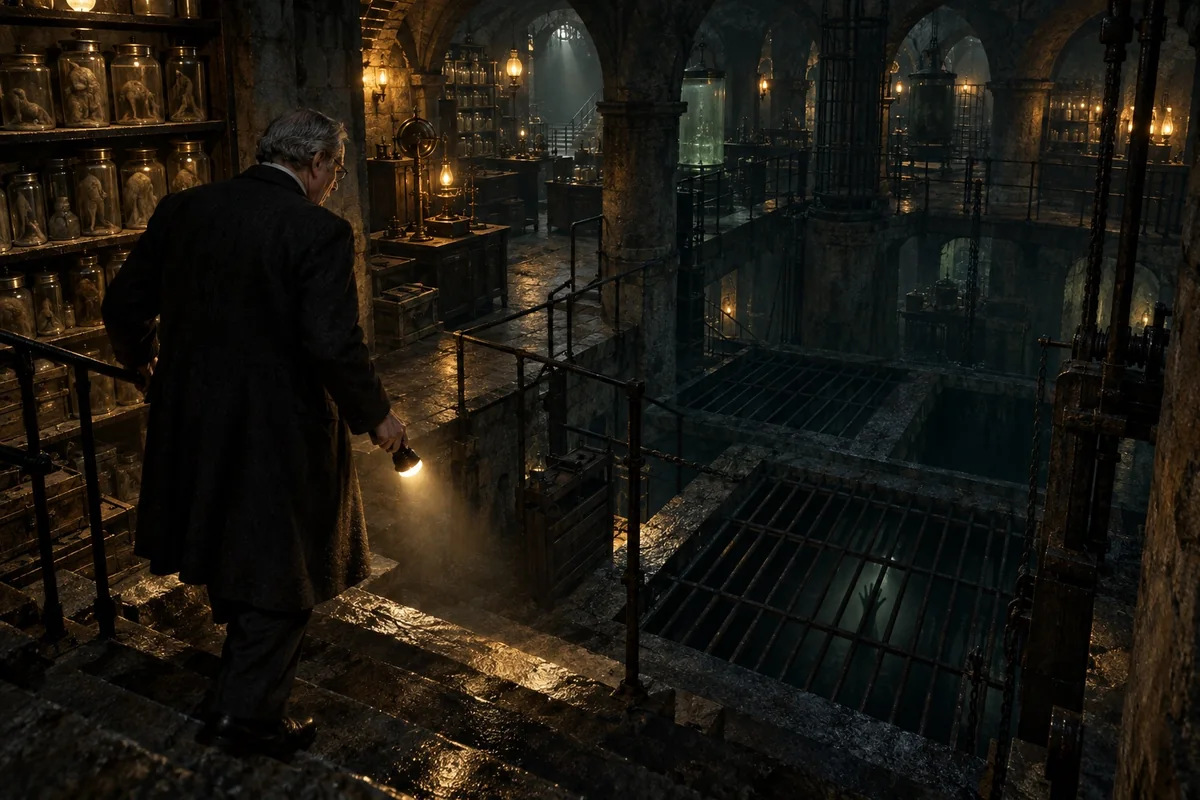
Willett and Ward’s father investigate the bungalow, and Willett enters the underground complex. The descent reveals an extensive organization of rooms, passages, stored materials and pits. It gives physical form to the secret project hinted at by the letters and historical surveillance.
The places of confinement contain horrifying results of the experiments. Some restorations are incomplete or otherwise unsuitable for the researchers’ purposes. Their continued existence makes the laboratory an environment of suffering rather than a neutral collection of failed samples.
The smell, darkness and sounds force Willett to confront what the terminology of research has concealed. Words such as salts, specimens and custodians belong to practical systems, but the things designated by them can still be living, hungry or capable of distress.
The descent also provides information he will later use. He studies written formulas and the arrangement of materials, acquiring knowledge not by safely reading about the project but by moving through its consequences.
The paired formulas and the accidental summoning
Two related formulas recur in the notes, associated with complementary operations. One calls a presence from the prepared material; the other reverses the process. Their relation becomes the means by which an apparently irreversible return can be undone.
While examining the laboratory, Willett speaks the summoning formula and produces a presence from the stored material. The event overwhelms him. When he recovers, he is outside the depths, and the route to the laboratory is no longer available in the same way.
A written message found on him instructs him to destroy Curwen. The handwriting belongs to a much older form than that of the modern participants. The summoned presence has apparently understood the situation and acted independently of the intentions of the men who stored its remains.
The narrative does not securely name this being. Later speculation may identify it with a historical figure, but the source’s evidence supports an ancient, knowledgeable and effective agent whose full identity remains withheld. Its warning demonstrates the danger Curwen’s correspondents had recognized: the experimenter cannot assume mastery over everything recovered.
Allen, Curwen and the discovery of Ward’s fate
Detectives recover Allen’s false beard, glasses and samples of writing. Comparison with the portrait, the old manuscripts and the changed patient brings the identities together. Ward’s father tests the resemblance by altering a photograph of his son with the disguise; witnesses recognize the result as Allen.
Willett reconstructs the moment when Curwen entered the Ward household and took the descendant’s place. Sounds remembered by a servant and the changed conduct afterward support the conclusion. The real Charles had been killed, not merely subjected to a temporary loss of memory.
In the house, Willett finds and deals with the concealed remains. The scene is narrated through sounds, smoke and his behavior rather than a fully explicit description of every action. His subsequent communication with the father combines confirmation of the loss with an effort to contain its most unbearable details.
The discovery changes the purpose of the final hospital visit. Willett is no longer attempting to cure Charles. He is preparing to confront the ancestor who murdered him and who continues to occupy his place in the world.
The final confrontation on 13 April 1928
Willett visits the patient at the private hospital on Conanicut Island. He reveals enough of the investigation to remove the possibility that Curwen can continue the deception. The old man’s reactions confirm knowledge and motives incompatible with the identity he has been performing.
Curwen attempts to use an invocation, but Willett speaks the complementary formula he learned below the bungalow. The revived body collapses into the residue from which the process had restored it. The disappearance that opened the case is therefore the result of dissolution rather than escape through a window or door.
The final action is possible because Willett has combined personal knowledge, historical documents, physical clues and the laboratory’s own method. Curwen is defeated by an investigator who learns enough of the forbidden practice to reverse it without adopting its continuing purpose.
Charles does not return when the impostor is destroyed. That loss prevents the ending from becoming a simple restoration of the original household. The threat is contained, but the person whose curiosity opened the way has already paid a cost the successful intervention cannot undo.
The correspondents and the wider aftermath
The narrative adds reports of destruction connected with the locations of Curwen’s associates: a house in Prague and Castle Ferenczy in Transylvania. Willett interprets these events as the work of the presence he accidentally called up. The reports support the suggestion that the intervention extended beyond Providence.
The text does not show every action of that agent directly. Its ability to find and oppose the correspondents is inferred through the message and later news. The distinction matters because the ending expands the consequences without giving the reader an unrestricted view of the hidden struggle.
The old network’s apparent destruction also reflects a vulnerability within its method. The researchers sought to control the knowledge of the dead, but recovered an intelligence capable of acting against them. Their accumulated power did not make them immune to the consequences of their own procedures.
Historical knowledge, identity and adaptation
The novel’s central inversion turns antiquarian love into predatory extraction. Ward begins by valuing buildings, records and continuity with the past. Curwen treats the past as a reserve of captive informants. The difference is ethical even though both men initially appear devoted to knowledge.
The portrait and the essential salts are complementary devices. One supplies a visible continuity across generations; the other makes that continuity bodily and active. Together they allow an ancestor to replace a descendant while appearing to confirm a family resemblance.
Yog-Sothoth is invoked in the formulas, but the novel does not provide a complete independent account of that entity. Its resurrection procedure should also be distinguished from Herbert West’s chemical reanimation: the works use different mechanisms, narrative aims and relationships between body and knowledge.
Roger Corman’s The Haunted Palace (1963) and Dan O’Bannon’s The Resurrected (1991) adapt the premise in different ways. Their separate entries provide production credits and distinguish screen transformations from this novel’s documentary structure. Connected pages on Ward, Curwen, Willett, Providence and essential salts develop the principal people, setting and process without losing the sequence through which the case is solved.
Sources: The Case of Charles Dexter Ward — original text, Herbert West—Reanimator — original text, The Haunted Palace (1963) — credits, synopsis and release history, The Resurrected (1991) — credits, synopsis and release history
Related music
The Key and the Gate is a dark metal retelling of The Dunwich Horror, following Wilbur Whateley’s doomed search for forbidden knowledge and the power of Yog-Sothoth.
References
- H. P. Lovecraft Archive — fiction in composition order
Composition dates; question marks and ranges retain the source uncertainty.
- H. P. Lovecraft Archive — fiction in publication order
First publication dates and venues; issue dates can differ from actual release dates.
- The Case of Charles Dexter Ward — original text
The fictional narrative is evidence for what the story says, not proof of events in the real world.
- Herbert West—Reanimator — original text
The fictional narrative is evidence for what the story says, not proof of events in the real world.
- The Haunted Palace (1963) — credits, synopsis and release history
- The Resurrected (1991) — credits, synopsis and release history
At a glance
H. P. Lovecraft
January–1 March 1927
1941, May & July
Weird Tales, 35, Nos. 9 & 10
Fiction