

The Call of Cthulhu
A scholar’s inherited papers, a young sculptor’s dreams, a police raid and a sailor’s hidden account converge on a being waiting beneath the Pacific. The Call of Cthulhu turns the act of connecting evidence into the central action of cosmic horror: its narrator discovers that a coherent explanation may be more frightening than an unexplained mystery.
14 min read · 2,771 words
Composition, publication and narrative form
Lovecraft composed The Call of Cthulhu in the summer of 1926. Its first publication was in the February 1928 issue of Weird Tales. Those dates should be kept separate from the events inside the fiction, especially the disturbances and voyage of 1925. The story is presented as a document found among the papers of the late Francis Wayland Thurston of Boston, giving its first-person warning a posthumous frame.
There are three titled movements: The Horror in Clay, The Tale of Inspector Legrasse and The Madness from the Sea. They do not simply advance through one continuous adventure. The first opens an inherited archive and reconstructs recent dreams; the second goes back to a much older investigation; the third connects both with events at sea. The reader moves between kinds of record before reaching the direct encounter.
Thurston is an investigator and compiler rather than an eyewitness to Cthulhu’s emergence. His account contains Angell’s notes, reported conversations, a newspaper item and Johansen’s manuscript. That arrangement creates distance from the central event while showing how several apparently independent channels can come to support the same explanation.
Sources: H. P. Lovecraft Archive — fiction in composition order, H. P. Lovecraft Archive — fiction in publication order, The Call of Cthulhu — Unspeakable Tales ebook
Opening: an inheritance that should have remained separate
Thurston begins with a reflection on the limited range of human knowledge and the danger of assembling its scattered parts. The warning describes what his own narrative will do. Each document might have remained an isolated curiosity; bringing them together changes their implications and the compiler’s sense of safety.
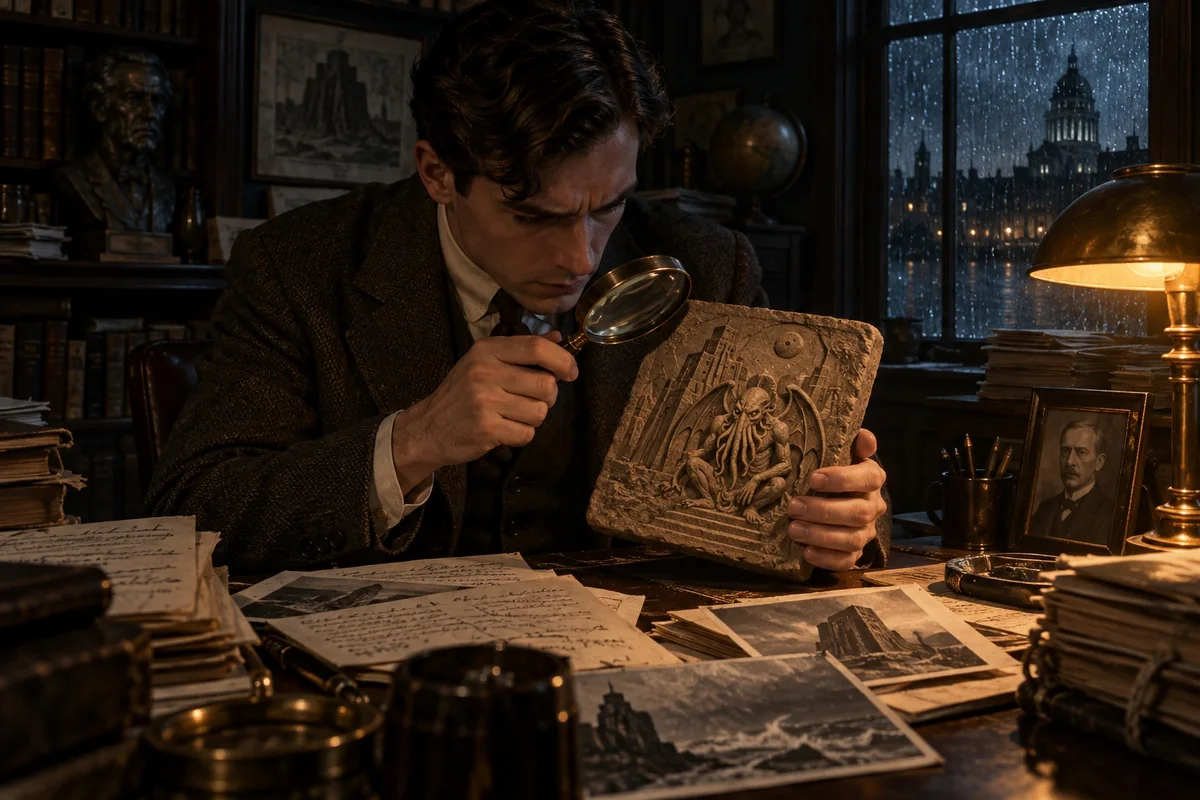
His great-uncle, Professor George Gammell Angell, has died after an incident near the Providence waterfront. Angell was an authority on ancient languages. While sorting the scholarly papers, Thurston discovers material that differs from the expected academic collection: a recent clay bas-relief, notes headed around the Cthulhu cult, reports of dreams and newspaper clippings describing strange disturbances.
The relief is especially awkward evidence because it is obviously new. Its imagery suggests a remote and unfamiliar civilization, but it cannot itself be an excavated ancient object. The papers explain why Angell nevertheless gave it so much attention. The young artist who made it had apparently reproduced details known from an older and geographically distant investigation.
At first Thurston suspects deception or suggestion. He imagines that Henry Anthony Wilcox has learned enough about the earlier material to impress an elderly scholar. This initial suspicion is important: the narrator does not begin as a believer seeking confirmation. The story progressively removes explanations that had allowed him to treat the evidence as harmless.
Wilcox’s relief and the dreams of 1925
Wilcox is a young sculptor studying at the Rhode Island School of Design and living in Providence’s Fleur-de-Lys Building. On 1 March 1925 he brings Angell a relief made during an extraordinary nocturnal experience. Its figure has a tentacled head, a roughly human arrangement of limbs and wings, with strange signs and immense architecture behind it.
His account associates the dream with an earthquake and a vision of wet stone cities. Words and impressions arrive as something only approximately representable in ordinary sound. Angell recognizes correspondences with the earlier cult evidence and begins questioning him about membership in secret societies. Wilcox cannot explain that connection because he does not understand the reason for the scholar’s interest.
Angell asks him to continue reporting his dreams. On 23 March, however, Wilcox becomes seriously ill and ceases his visits. During the disturbance he speaks of an enormous moving presence, then falls into periods of lethargy. On 2 April the condition ends abruptly; his ordinary dreams return and provide no further useful material for Angell’s inquiry.
The dates make the dreams more than atmospheric opening scenes. They will later correspond with the sailors’ encounter and the storm that ends the episode. At this stage, however, neither Wilcox nor the scholar possesses the maritime information needed to understand that correspondence.
Angell’s survey and the limits of his archive
Angell’s investigation reaches beyond one artist. He solicits dream accounts from numerous acquaintances and gathers reports of unusual behavior in different parts of the world. Artists and poets provide the strongest apparent parallels, while business people and most scientists produce little that clearly resembles Wilcox’s experience.
The surviving archive is not a complete collection of independently preserved testimony. Thurston has digests and notes, and some subjects are identified by numbers rather than names. He initially considers whether leading questions or selective summaries have produced an artificial pattern. The story makes the reader confront the same problem: a compiler’s evidence can be suggestive without being fully recoverable for inspection.
Newspaper clippings enlarge the geography. They describe alarming dreams, disturbed behavior, religious excitement and unrest. These reports pass through the narrator’s racial and colonial assumptions; their arrangement turns disparate peoples and events into signs of a threatening global connection. They should be read as the story’s construction of a pattern, not as a historical record of real coordinated disturbances.
The archive is powerful precisely because it remains incomplete. Angell has collected enough to perceive recurrence but not enough to discover the event at its center. Thurston’s later chance encounter with a different newspaper fills the decisive gap.
Legrasse at the archaeological meeting
The second movement returns to a 1908 meeting of the American Archaeological Society in St. Louis. Inspector John Raymond Legrasse has brought an idol from a police raid near New Orleans, hoping that scholars can identify the unfamiliar religion associated with it. His purpose is investigative rather than antiquarian.
The small object shows a crouching, winged being with tentacles and claws. Its unknown material and inscriptions resist the assembled experts’ classifications. The contrast between fine workmanship and an unplaceable tradition makes it disturbing: it does not look like an incompetent imitation of familiar art, yet no recognized school accounts for it.
William Channing Webb supplies a partial connection. During an earlier Greenland expedition he had encountered a ritual whose image and chant resemble the Louisiana material. The correspondence links distant places, but it gives no ordinary account of migration or exchange that would explain their relation. The experts can recognize that there is a problem without solving it.
Angell’s attendance at the meeting explains his response to Wilcox seventeen years later. The resemblance is not merely a product of his general interest in obscure sculpture. He has already seen an object, heard words and learned testimony that the sculptor seems to reproduce without access to that earlier occasion.
The swamp raid and Castro’s explanation
Legrasse’s raid followed reports of disappearances and frightening activity in the swamps. The police encounter a ritual gathering around the idol, accompanied by violence and evidence of human sacrifice. The scene establishes the immediate horror of the cult, while rumors of presences farther in the darkness suggest that the visible participants may not be the whole threat.
Questioning the prisoners yields a shared chant and, from the elderly Castro, a wider account. He speaks of beings who came from the stars, occupied Earth before humanity and remain preserved in stone houses at R’lyeh. Their condition depends on cosmic cycles. Cthulhu maintains their preservation and will have a role in their return when the circumstances permit release.
Castro describes dreams as the means by which these beings communicated with early humans. The sinking of R’lyeh interrupts that contact, leaving a cult charged with preserving knowledge and expectation. The prophecy includes a violent overturning of human restraint and order, imagined by its adherents as liberation. The narrator experiences the same prospect as annihilation of the world he values.
This is testimony transmitted through an interrogation and later scholarly notes. It is the story’s central explanation, but it is not delivered by an impartial narrator outside the fiction. Castro refuses to elaborate some details, and other elements remain uncertain. His account gives the subsequent events a pattern without turning the story into a complete theological handbook.
Thurston’s own inquiries
After reading Angell’s papers, Thurston visits Wilcox intending to expose an imposture. The meeting changes his judgment. The sculptor appears sincere, his art bears the continuing effects of his dreams, and he does not display the secret knowledge Thurston had expected to uncover. Thurston retreats toward the possibility of forgotten indirect influence, preserving a rational explanation for as long as he can.
He also travels to New Orleans, sees Legrasse’s idol and interviews surviving participants in the older investigation. Castro has died by then. These inquiries confirm much of Angell’s material and encourage Thurston’s ambition to establish himself through the discovery of an unknown religion. Intellectual curiosity and the hope of recognition help keep him working even as the evidence becomes darker.
Angell’s death acquires a new possible significance. Thurston begins to suspect that his uncle knew enough to attract dangerous attention. The association rests partly on his interpretation of the waterfront incident and his prejudiced assumptions about the cult’s reach. The story does not produce a confession or independent proof of murder. Suspicion becomes one of the consequences of accepting the larger pattern.
The newspaper discovery and the route to Johansen
The decisive clue arrives accidentally in Paterson, New Jersey. Visiting a museum colleague, Thurston notices an old issue of the Sydney Bulletin used beneath mineral specimens. Its picture shows an idol closely resembling the one in Legrasse’s possession. An apparently discarded piece of paper contains the maritime evidence missed by Angell’s extensive clipping operation.
The report concerns the armed yacht Alert, found disabled with one living man and one dead companion aboard. The survivor is Gustaf Johansen, formerly second mate of the schooner Emma. His public account describes an armed confrontation, the capture of the yacht and deaths on an unknown island, but withholds the crucial explanation of what happened ashore.
Thurston notices the matching dates and begins traveling. In New Zealand he learns that Johansen has returned to Norway. By the time Thurston reaches Oslo, the sailor is dead. Johansen’s widow provides a manuscript written in English, a language she does not read, which preserves the fuller account he had withheld from public authorities.
The journey ends with another document rather than a living witness. Thurston can reconstruct the encounter, but cannot question Johansen about ambiguities or recover the island for inspection. The accumulating pattern becomes privately convincing while the chances of ordinary public verification diminish.
The Emma, the Alert and the island
The Emma had been driven from its expected course before encountering the Alert on 22 March 1925. The yacht’s crew orders the schooner to turn back and then opens fire. The Emma’s survivors board and seize their attacker after losing three of their own men, including the captain and first mate. Johansen takes command of the remaining group.
The eight survivors continue aboard the captured Alert and reach an uncharted island on 23 March. They encounter enormous worked stone and an architecture whose angles disrupt ordinary judgments of surface, slope and orientation. The place seems newly raised from the sea, with marine deposits and immense structures suggesting only a small exposed portion of something larger.
Their exploration reaches a huge portal bearing the familiar monstrous figure. The difficulty of understanding the door’s position and movement is part of the danger. The men are not archaeologists equipped to decode the site, and their physical contact with it has consequences they cannot anticipate.
When the opening releases a dark interior and then Cthulhu, the story’s indirect signs acquire a bodily counterpart. Sculpture, dream and cult testimony have led to a living presence, but the sailors do not possess the archive that would explain its identity. They encounter the center of the mystery with less understanding than Thurston later gains from reading about them.
Cthulhu’s emergence, the collision and the storm
The emerging being overwhelms the landing party. Men die from the encounter, from terror or while attempting to escape through the treacherous architecture. Johansen and William Briden reach their boat and then the Alert. The immense presence follows them into the water before the yacht can accelerate sufficiently to escape by ordinary flight.
Johansen turns the vessel toward the pursuer and drives into it. The impact disrupts the creature’s head and body into a foul green cloud, but the substance begins to gather again. This is an interruption that creates an opportunity to flee. The text does not establish that a steam yacht has permanently killed Cthulhu.
The storm of 2 April ends the extraordinary interval. Briden dies during the aftermath, and Johansen is eventually rescued in a severely disturbed condition. The island is no longer available as a stable place to which Thurston can lead a verifying expedition. The direct encounter has left a survivor, an idol and a private narrative rather than a captured specimen.
The matching dates connect the sea episode to Wilcox’s delirium and recovery. Thurston can now explain the dispersed evidence as the effects of one awakening. That explanatory success produces the final horror: the being’s apparent retreat is temporary, and the conditions allowing another return may recur.
The ending and the position of the reader
Thurston fears that he has followed Angell and Johansen into dangerous knowledge. He expects the cult may reach him and asks that the assembled account disappear rather than circulate further. His warning reverses the usual purpose of a scholarly discovery: the completed explanation has become something he wishes he could undo.
The opening frame identifies him as already dead. It does not state the mechanism of that death or prove all of his suspicions, but it prevents the final appeal from feeling securely resolved. The reader is encountering the very papers whose preservation the narrator regards as dangerous.
The ending also withholds a conventional victory. Johansen escaped the immediate pursuit, yet Cthulhu re-formed; R’lyeh disappeared, yet its earlier emergence implies recurrence; the cult suffered local intervention, yet its full extent remains unknown. Human action matters at the scale of a particular escape without supplying control over the larger cycle.
Reading the story therefore repeats Thurston’s central act. The reader assembles fragments and arrives at an explanation that none of the initial witnesses could possess. The horror depends on that act of synthesis as much as on the brief physical appearance of the creature.
Art, documents and racialized fear
Art serves as evidence before it serves as illustration. Wilcox’s relief is a material product of an experience he cannot explain, and its likeness to the older idol gives Angell a reason to investigate. The artist’s supposed sensitivity is valuable because it registers something outside the scholar’s direct perception. Expertise and imagination become uneasy collaborators.
Documents then connect different scales: one person’s illness, a local police action, an international religious pattern and an event in the remote Pacific. Each new record changes the meaning of previous records. The story’s documentary form makes cosmic horror an interpretive process rather than a sequence of disconnected frightening incidents.
That process is entangled with racism. The narrative repeatedly associates danger with racial mixture, foreignness, colonized peoples and departures from its narrator’s preferred social order. These descriptions are features of the text’s ideology, not neutral ethnographic observations. The cult’s global reach is imagined through a hierarchy in which some witnesses are treated as respectable authorities and others as inherently suspect.
A close reading can examine both the effective construction of dread and the prejudices used to construct it. Later responses to Lovecraft often change whose evidence matters or whose threatened world the reader is asked to value. Such responses belong to the work’s reception, while this story itself gives Thurston the controlling voice.
Mythology, adaptation and connected reading
The story establishes Cthulhu, R’lyeh and the cult as an interconnected group of inventions. The Necronomicon is mentioned as a text with meanings available to initiates, while Irem appears in Castro’s uncertain account of the cult’s center. The story does not present a direct appearance by every later major Mythos deity, nor does it explain the complete political organization of alien civilizations.
At the Mountains of Madness later adds an archaeological history involving Cthulhu’s spawn. That development belongs to a different narrative and a different body of evidence. Reading the two together enlarges the imagined past without erasing the limits of Castro’s testimony or Johansen’s experience.
The 2005 film The Call of Cthulhu, directed by Andrew Leman, adapts the investigation in the style of a silent film. Its separate entry documents the production and the change from written records to visual performance. The literary work remains especially useful for comparing adaptation choices because so much of its effect depends on a narrator reading other people’s accounts.
For further study, the character entries distinguish Angell’s scholarship, Wilcox’s involuntary art, Legrasse’s investigation and Johansen’s direct encounter. The Cthulhu and R’lyeh entries follow the being and place across other works. Those routes preserve the difference between a detailed reading of this particular story and the larger mythology assembled around it.
Sources: The Call of Cthulhu — Unspeakable Tales ebook, At the Mountains of Madness — original text, The Call of Cthulhu (2005) — credits, synopsis and release history
Related music
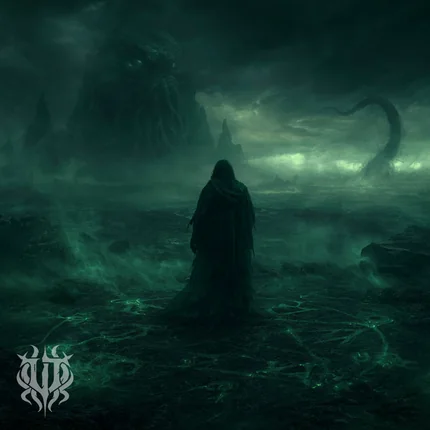
The Dead But Dreaming is a dark folk metal song inspired by The Call of Cthulhu, evoking R’lyeh, forbidden worship and the ancient dream beneath the sea.
References
- H. P. Lovecraft Archive — fiction in composition order
Composition dates; question marks and ranges retain the source uncertainty.
- H. P. Lovecraft Archive — fiction in publication order
First publication dates and venues; issue dates can differ from actual release dates.
- The Call of Cthulhu — Unspeakable Tales ebook
The fictional narrative is evidence for what the story says, not proof of events in the real world.
- At the Mountains of Madness — original text
The fictional narrative is evidence for what the story says, not proof of events in the real world.
- The Call of Cthulhu (2005) — credits, synopsis and release history
At a glance
H. P. Lovecraft
Summer 1926
1928, February
Weird Tales, 11, No. 2
Fiction