

The Crawling Chaos
The Crawling Chaos is a collaboration by H. P. Lovecraft and Winifred V. Jackson in which a medically induced vision carries its narrator from a collapsing coast toward apparent celestial refuge, then reveals the destruction of Earth. The story’s title should not be confused with an identification of its unseen forces as Nyarlathotep: that entity is not named in the narrative.
6 min read · 1,073 words
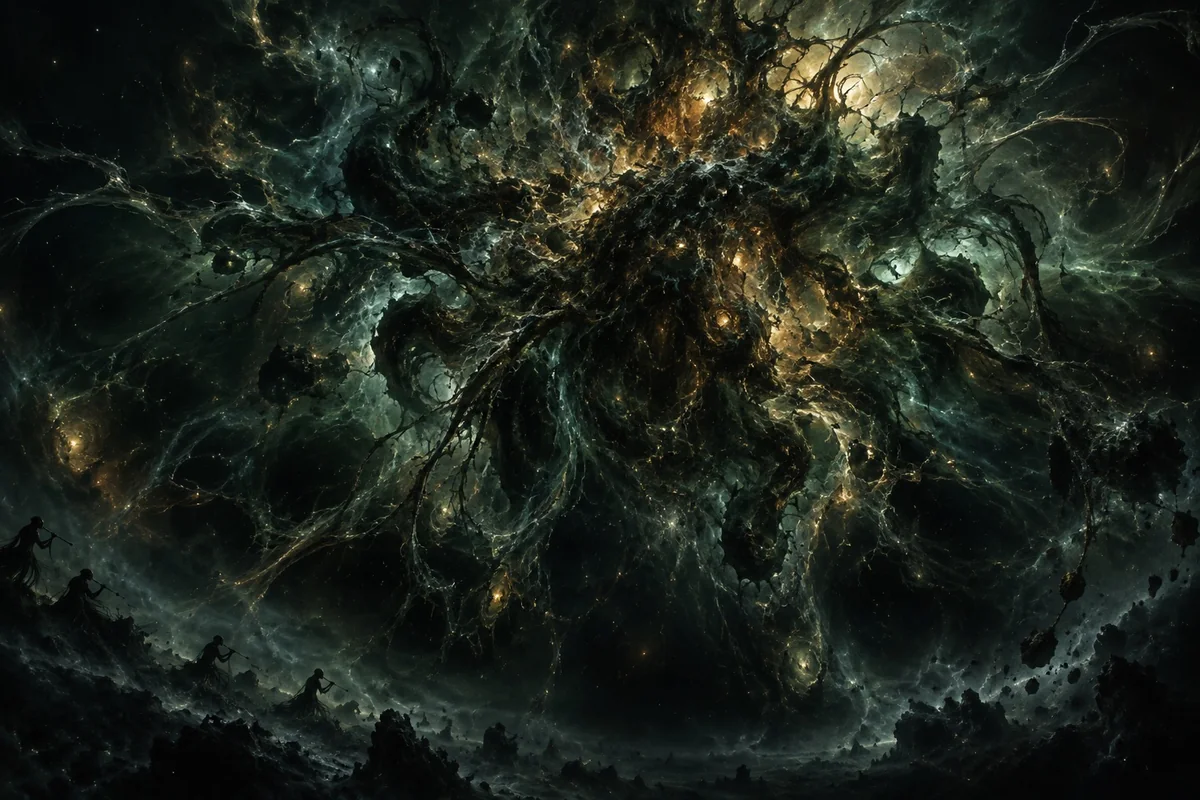
Composition, credit and first publication
The composition record places the collaboration in 1920–1921. It first appeared in the April 1921 issue of The United Co-operative, volume 1, number 3. The author credit belongs to Lovecraft and Winifred V. Jackson.
The story opens by invoking literary accounts of opium, including De Quincey and Baudelaire. Those references introduce an extraordinary narrated experience rather than a documentary explanation of what the drug necessarily produces.
Sources: H. P. Lovecraft Archive — fiction in composition order, H. P. Lovecraft Archive — fiction in publication order, The Crawling Chaos — original text
The medical frame
The unnamed narrator says he received opium only once, during an epidemic. An exhausted physician administered an overdose while attempting to relieve pain. The narrator survives and returns to ordinary life but remains troubled by the experience and refuses the drug afterward.
This retrospective frame establishes both an explanation for altered perception and the enduring significance of what was perceived. The vision need not be treated as a verified prophecy in order to understand why it dominates the survivor's memory.
The painful pounding in his head gradually changes into something apparently external. A sensation of falling gives way to the sound of enormous waves, linking the bodily onset of the episode with the landscape in which he finds himself.
Sources: The Crawling Chaos — original text
The room above the sea
He becomes aware of an ornate room with numerous windows, rich furnishings and an atmosphere at first more exotic than wholly alien. An approaching, undefined threat makes him close the shutters and light candles.
That action controls what he can see but cannot silence the pounding. Curiosity eventually draws him to another window, where he discovers the building's position on a high, narrow projection of land.
Huge dark waves are undermining the red earth below. The house is approximately three hundred feet above the water, yet its height offers no lasting protection because the foundation is being destroyed. He interprets the sea's persistence as deliberate hostility.
Sources: The Crawling Chaos — original text
The divided landscape
The narrator escapes through a door on the inland side. Looking around, he sees different seas and skies on opposite sides of the promontory: one green and sunlit, the other blue and calmer beneath a darker sky.
The small marble house combines architectural forms he associates with different cultures. Beyond it, an unusually white path runs between palms and unfamiliar plants in intense heat. He sometimes imagines that recognizable vegetation might look this way after a radical change of climate.
Those details suggest a disturbing mixture of familiarity and estrangement. The text initially withholds a secure location or date, so the setting cannot simply be assigned to a known island or Dreamlands city.
Sources: The Crawling Chaos — original text
The palm and the fear in the grass
Farther inland, a valley of tall grass stretches toward a huge palm that seems to beckon him. Fear of the sea briefly recedes, but the moving vegetation prompts another anxiety, associated with animals that might be concealed within it.
He remembers a tiger story by Kipling while strangely regarding that author as ancient. The lapse in temporal perspective is one of the indications that his ordinary frame of reference has become unstable.
Drawn toward the palm, he crawls through the grass despite imagining snakes and other threats. The pounding remains audible throughout the journey. Physical distance from the house does not sever his connection to the force destroying the coast.
Sources: The Crawling Chaos — original text
The offer of another existence
Beneath the palm he encounters a beautiful child, followed by a radiant pair and the sound of singing. The narrator perceives the pair as divine from their appearance; the story does not provide their personal names.
They promise refuge in Teloe, beyond the Milky Way and the Arinurian streams, describing golden rivers, luminous buildings and pleasure barges bound for Cytharion of the Seven Suns. These are destinations described in an invitation, not places the narrator subsequently explores in detail.
He rises into the air with the child, the pair and an increasing company of luminous youths and maidens. The child instructs him to look upward and never back at the world he has left.
Sources: The Crawling Chaos — original text
The backward look
For a moment, song and ascent seem to offer complete relief. The pounding sea then intrudes again, and the narrator looks down despite the instruction.
He sees Earth in devastation: abandoned cities, altered vegetation, drowned former settlements and seas consuming the remaining land. The earlier coastal erosion expands into a planetary catastrophe.
A fissure opens in the surviving land. The sea continues advancing until it pours into that opening, surrendering what it had conquered. The narrator imagines a conflict between a power in the waters and greater powers within the planet, but neither side receives a specific Mythos identity.
Sources: The Crawling Chaos — original text
The exposed depths and the final destruction
As the waters drain, submerged ruins emerge. The narrator recognizes London and Paris, then sees structures belonging to lands unknown to human memory. The retreat of the sea reveals successive layers of lost existence rather than restoring a habitable world.
Steam rises from the fissure and envelops the globe. The narrator discovers that his companions have vanished. A final eruption of fire and force destroys the world before his sight, leaving the other planets without Earth beneath a dying sun.
The narrative also returns him to a bed of convalescence. His survival belongs to the framing medical episode; it does not supply a physical itinerary by which someone escaped the actual destruction of the planet.
Sources: The Crawling Chaos — original text
Sound, escape and the title
The pounding is the story's strongest connection across changing scenes. It begins as pain, becomes surf, survives the flight inland and finally breaks through celestial music. Every apparent refuge remains vulnerable to a sound the narrator cannot exclude.
The title describes a developing experience of disintegration. Although Nyarlathotep is associated elsewhere with the phrase crawling chaos, this story does not name him or identify the sea, the interior powers or the radiant guides as his forms.
An encyclopedia can link the title to that potential confusion while preserving the distinction. Giving the catastrophe a familiar named perpetrator would resolve something this narrative leaves impersonal or unnamed.
Sources: The Crawling Chaos — original text, Nyarlathotep — Unspeakable Tales ebook
Related reading
The Green Meadow offers the closest collaboration-based comparison: a solitary traveler, unfamiliar shores and an apparent release from ordinary limitations lead toward a revelation that changes the meaning of escape.
Beyond the Wall of Sleep provides another comparison for a wider existence glimpsed through altered consciousness. The works share questions about perception and human limits, but their frames, destinations and outcomes remain distinct.
Sources: The Crawling Chaos — original text, The Green Meadow — original text, Beyond the Wall of Sleep — Unspeakable Tales ebook
Related music
A Thousand Masks is a dark metal song inspired by Nyarlathotep, the Crawling Chaos who walks among humanity, hiding behind countless faces and whispered lies.
References
- H. P. Lovecraft Archive — fiction in composition order
Composition dates; question marks and ranges retain the source uncertainty.
- H. P. Lovecraft Archive — fiction in publication order
First publication dates and venues; issue dates can differ from actual release dates.
- The Crawling Chaos — original text
The fictional narrative is evidence for what the story says, not proof of events in the real world.
- Nyarlathotep — Unspeakable Tales ebook
The fictional narrative is evidence for what the story says, not proof of events in the real world.
- The Green Meadow — original text
The fictional narrative is evidence for what the story says, not proof of events in the real world.
- Beyond the Wall of Sleep — Unspeakable Tales ebook
The fictional narrative is evidence for what the story says, not proof of events in the real world.
At a glance
H. P. Lovecraft; Winifred V. Jackson
1920/21
1921, April
The United Co-operative, 1, No. 3
Fiction