

Yig
Yig is the serpent deity whose feared vengeance shapes The Curse of Yig, a story developed by H. P. Lovecraft for Zealia Bishop. Described in the fictional tradition as a partly human father of snakes, he protects his children and punishes those who injure them. The story makes his apparent intervention inseparable from human fear, misinterpretation and a final discovery that unsettles the physician’s attempted natural explanation.
6 min read · 1,260 words
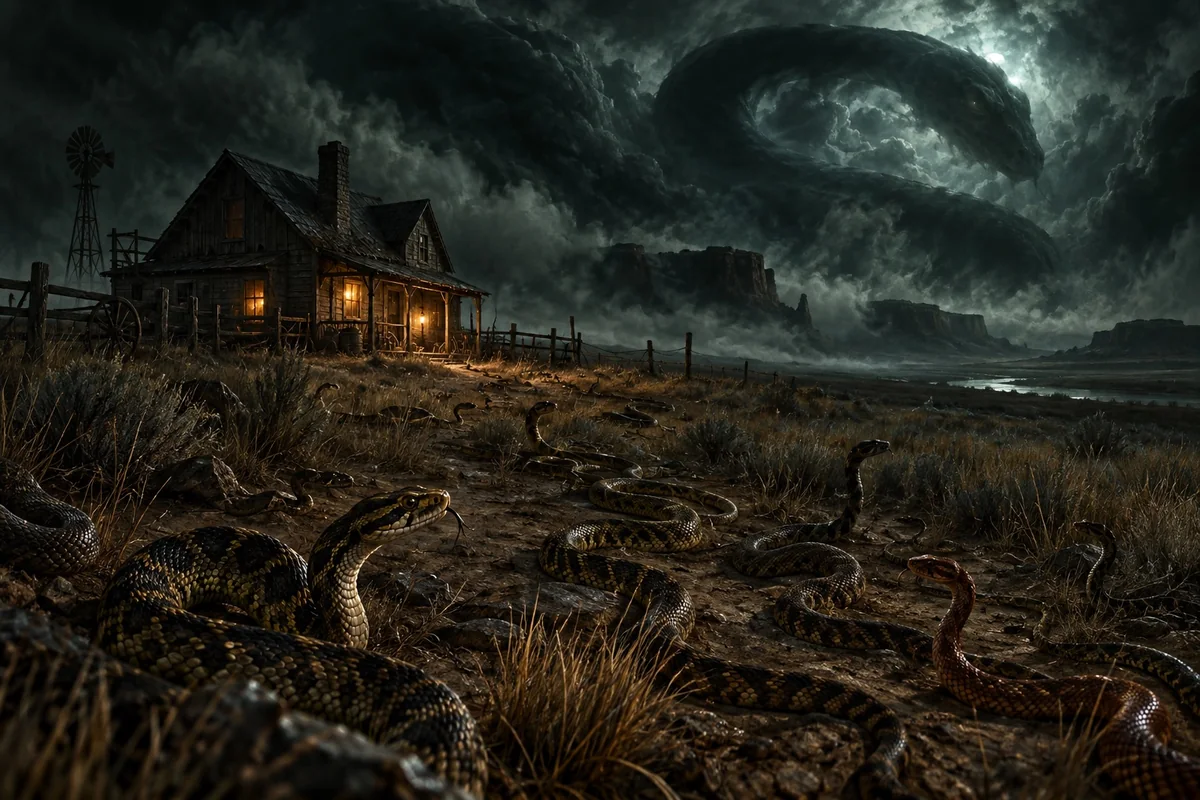
The father of serpents
The central tradition describes snakes as Yig’s children. His governing characteristic is devotion to them, especially a relentless response to people who kill or harm them. Respect for the snakes can therefore become a practical condition of coexistence with their divine protector.
Sources: [1]
Yig is not described as uniformly hostile. The account allows him a comparatively favorable disposition toward those who observe the required respect. His danger intensifies in autumn, when both the god and the snakes are said to become ravenous and difficult to restrain.
This seasonal change is important to the narrative. The Davis family’s journey establishes an offense early in the year, while the approach of the autumn rites makes delayed punishment increasingly imaginable. The god’s absence from immediate sight does not lessen the fear of an eventual reckoning.
Appearance and the limits of direct observation
Yig is described as partly human. Walker Davis repeats a claim attributed to Chief Grey Eagle that the god resembles a man until examined closely. That statement establishes a concealed difference rather than a complete anatomical portrait.
Audrey dreams of him in the form of Satan as represented in familiar cheap illustrations. The dream therefore draws on imagery she already knows. It is not an independent description proving that Yig has a particular set of horns, wings or other conventional demonic features.
During the final night she sees a head and shoulders approaching in darkness and takes the figure for the snake-god. The subsequent discovery identifies that figure as her husband. The scene cannot be used as a confirmed physical appearance of Yig, however convincing it is to Audrey in the moment.
Sources: [1]
The curse and transformation
The legend says that a person who harms Yig’s offspring may be tormented and turned into a spotted snake. This threat acts on Audrey through her husband’s repeated warnings after she kills a nest of young rattlesnakes.
At first the outcome seems to fit the legend through psychological collapse. Audrey is found moving along the floor and hissing after a night of terror and fatal violence. Her later deterioration includes bodily changes described by the doctor.
The ending introduces a different and more difficult problem. The being shown to the visiting ethnologist is not Audrey herself, but the surviving one of four offspring born to her three-quarters of a year after the catastrophe. It combines human and serpentine characteristics. The story uses this revelation to disturb the medical account without staging an unambiguous scene in which Yig performs a transformation.
Sources: [1]
Rites and the autumn soundscape
In the story’s account, communities use offerings, dancing, whistles, rattles and continuing drums to keep Yig away. Walker learns protective words and repeatedly seeks reassurance from people he believes understand the god.
The distant drumming carries across the plains through the Davis family’s autumn. Walker hears protection in it. Audrey increasingly experiences it as an intolerable reminder of the danger. One sound thus sustains two incompatible emotional meanings within the household.
When the drums finally stop during the terrible night, the silence becomes frightening as well. A noise Audrey had wished to escape has also been represented as the barrier against Yig. Its cessation leaves her unable to trust either sound or silence as evidence of safety.
Sources: [1]
The killing of the young snakes
On the journey from Arkansas to Oklahoma, Audrey discovers young rattlesnakes among rocks near a campsite. She kills them to prevent Walker, who has a severe fear of snakes, from seeing them and suffering another shock.
Walker arrives before she can hide the evidence. He interprets the act through the Yig tradition and predicts punishment. An attempted protection of her husband becomes the source of a new, prolonged fear for both of them.
The episode gives the supposed offense a human motive that differs from deliberate defiance of a deity. Audrey does not set out to challenge Yig. She acts on an immediate domestic concern, then finds herself trapped in an explanation whose consequences she can neither test nor undo.
Sources: [1]
The snakes in the cabin
After a Halloween gathering, the weather is cold enough for the Davises to maintain a fire overnight. They wake to discover the stone floor covered with rattlesnakes. Walker collapses, the lantern goes out, and Audrey is left in darkness.
A material explanation remains available: the snakes may have been sheltering beneath the rock and emerged toward the heat. Audrey herself briefly considers this possibility. Their presence need not prove that a god has directed them.
The catastrophe develops because she assumes Walker is dead and interprets later sounds through an earlier story about a body destroyed by snake venom. The dead animal near the hearth ultimately accounts for the sound she has taken as evidence of her husband’s fate. When he revives and approaches, her conviction that the snake-god is coming makes him unrecognizable to her.
Sources: [1]
McNeill’s explanation and its unresolved remainder
Dr. McNeill regards the immediate tragedy as a consequence of belief and fear. Walker’s phobia made him collapse; his stories primed Audrey to mistake him for the object of her terror. The body found afterward has no snakebite, so the account can explain his death without a supernatural attack.
McNeill nevertheless preserves the unusual survivor in a secluded part of the institution. Its existence is the final fact that the story refuses to absorb comfortably into his explanation. The narrator leaves with a lasting fear, though he acknowledges that natural explanations might be proposed.
The result is not a definitive laboratory proof of a god. It is a tension between an intelligible sequence of human errors and an extraordinary consequence whose origin remains disturbing. Yig governs the narrative partly as a belief and partly as the possible agency that belief cannot eliminate.
Sources: [1]
Invented tradition and real communities
The story assigns Yig beliefs to named Indigenous peoples and speculates about a relationship with Quetzalcoatl and Kukulcan. Those claims belong to the fictional narrator and characters. Yig’s literary genealogy should not be presented as established Indigenous religious history.
The narration also uses racial hierarchies and stereotypes in its treatment of both Native people and poor white settlers. These assumptions shape whose testimony is respected, whose fear is dismissed and how the landscape is made threatening.
A source-conscious account can describe the invented cult and its role in the plot while distinguishing it from the actual cultures whose names the authors used. The literary deity is not evidence that those communities practiced the specific rites described here.
Sources: [1]
Authorship and place in the tradition
The Curse of Yig was developed by Lovecraft for Zealia Bishop in 1928 and published in Weird Tales in November 1929. The collaboration belongs with the revision and ghostwriting portion of Lovecraft’s work, rather than being silently credited as a solo story under his own name.
Its horror depends less on an elaborate divine hierarchy than on local obligation and fear. The entry’s central evidence is the Davis tragedy and the medical frame. Elaborate later classifications of Yig require their own sources and should not replace the more ambiguous character of this initial appearance.
Yig in the ancient account of Out of the Aeons
T’yog includes Yig among the powers he believes will support humanity against Ghatanothoa. In that context the serpent god is a possible ally in resisting another being’s tyranny.
This is T’yog’s account of an anticipated alliance, not a scene in which Yig visibly intervenes. It complicates a reading of the deity as universally hostile while leaving the Davis family’s story and its uncertainty intact.
Sources: [4]
References
- The Curse of Yig — original text
The fictional narrative is evidence for what the story says, not proof of events in the real world.
- H. P. Lovecraft Archive — fiction in composition order
Composition dates; question marks and ranges retain the source uncertainty.
- H. P. Lovecraft Archive — fiction in publication order
First publication dates and venues; issue dates can differ from actual release dates.
- Out of the Aeons — original text
The fictional narrative is evidence for what the story says, not proof of events in the real world.
At a glance
The Curse of Yig
H. P. Lovecraft for Zealia Bishop
November 1929, Weird Tales
Father of serpents
Partly human; superficially manlike
Protection and vengeance for snakes
The story’s attributed Indigenous traditions are fictional evidence, not verified ethnography