

The Tale of Satampra Zeiros
The Tale of Satampra Zeiros is Clark Ashton Smith’s account of two thieves seeking abandoned wealth in Commoriom. Their entry into a temple of Tsathoggua releases a fluid predator that pursues them through the night. The survivor writes with the hand he has left, making the act of narration itself evidence of the expedition’s cost. Boastful professional pride and bodily terror remain intertwined throughout.
5 min read · 957 words
Publication and Hyperborean setting
Written in 1929 and published in Weird Tales in November 1931, the story belongs to Smith's Hyperborean fiction. Its names circulated within the Lovecraft circle, but its narrative voice and invented civilization remain Smith's particular creation.
The story places the thieves in Uzuldaroum, the inhabited capital, with abandoned Commoriom within a day's journey. These are distinct settlements. The movement between them carries the travelers from the ordinary difficulties of earning a dishonest living into a place that their society has deliberately left behind.
Sources: The Tale of Satampra Zeiros — source and publication reference, Clark Ashton Smith — The Tale of Satampra Zeiros
A thief writes his own warning
Satampra announces that he must write with his left hand. Before explaining the loss, he recalls successful thefts undertaken with Tirouv Ompallios. His confidence in their skill establishes the authority of an experienced criminal rather than that of a disinterested explorer.
The pair's circumstances have deteriorated. Better locks, alert guards and increasingly cautious owners make their profession less profitable. Their remaining money can buy either food or wine, and Satampra argues for the wine as an aid to inspiration.
The resulting plan is to raid the treasures of Commoriom. His elevated language turns theft into a noble enterprise, while practical details repeatedly expose the gap between self-presentation and circumstances. That comic distance survives even when the danger becomes real.
The abandoned city
The narrator attributes Commoriom's evacuation to the White Sybil of Polarion, whose prophecy warned of an unspecified disaster. He reports different interpretations of the threatened doom without proving which was correct.
The city is not simply a field of collapsed ruins. Many buildings remain impressively preserved, while the jungle occupies streets and surrounds palaces, tombs and shrines. Wealth is believed to remain inside because the population departed together.
The thieves treat that history as an opportunity. Their journey begins among farms and ordinary settlements, where they steal provisions, then enters an older and more oppressive forest. Repeated drinking sustains their courage but does not supply genuine knowledge of what awaits them.
The temple and the disappointing idol
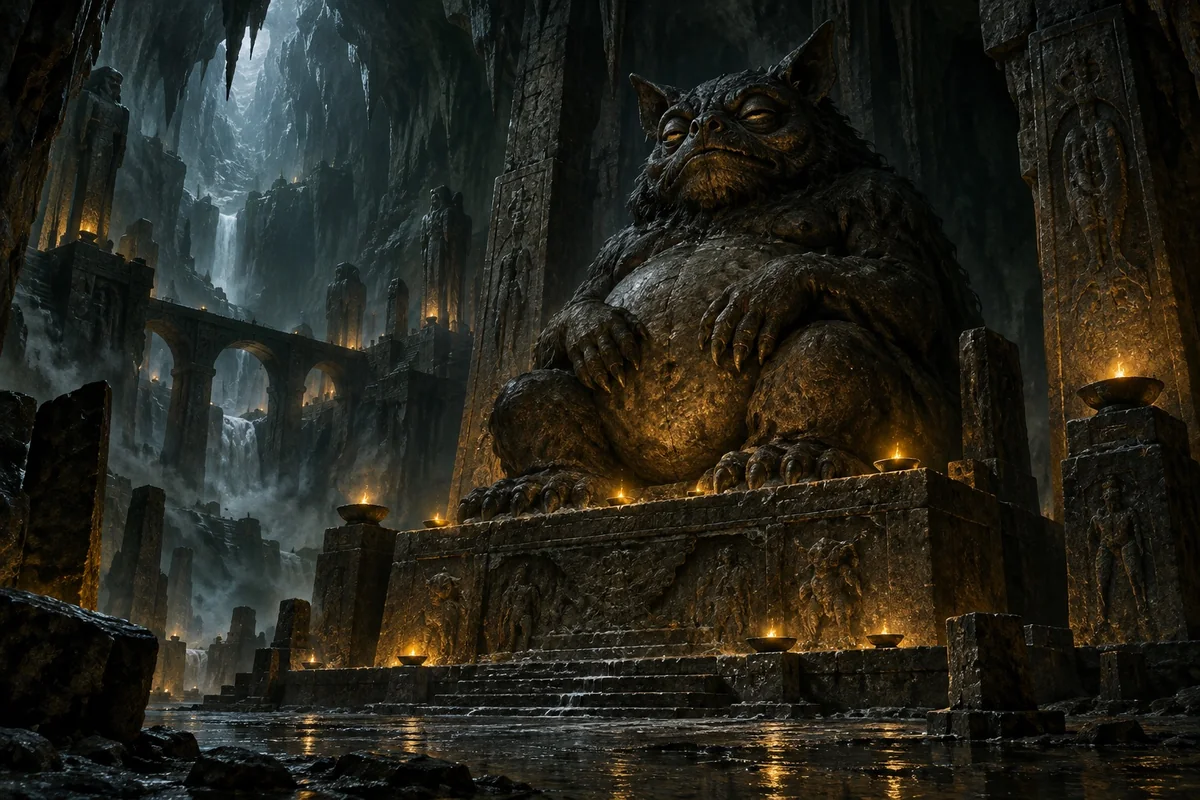
The temple of Tsathoggua is a squat basalt building unlike the more ornamented structures around it. Inside are an enthroned image, an altar and a large bronze basin. The thieves first inspect the image because they expect valuable adornments.
The statue depicts a heavy, sleepy, partly toad-like figure with suggestions of fur and other animal forms. It contains none of the detachable jewels the visitors hoped to steal. Their first judgment of the god is therefore financial disappointment.
The active threat comes from elsewhere in the chamber. The distinction is fundamental: the statue represents Tsathoggua, while the substance in the basin becomes the pursuing creature. The narrative does not show the god stepping down from his pedestal to chase the thieves.
The living substance
An offensive smell draws attention to the basin's dark contents. What first appears to be a creature rising from liquid proves to be the liquid itself forming a head, neck and reaching appendages.
The substance pours onto the floor and develops new means of movement. Its shifting shape defeats the expectations that ordinary anatomy would impose. Limbs, mouth and body proportions serve immediate purposes rather than remaining fixed.
The description supports a connection with the formless beings associated with Tsathoggua elsewhere, but this story does not give the particular creature a personal name or a complete species classification. Nor does its fluidity alone identify it as a shoggoth.
The circular pursuit
The thieves flee through the streets and into the jungle. Their familiarity with urban evasions cannot defeat a pursuer that changes its form and moves with little apparent effort. The night becomes an exhausting series of obstacles, uncertain routes and continued pursuit.
Satampra believes the creature could have overtaken them earlier and is prolonging the chase. That is his interpretation of its behavior, not a statement delivered by the creature. The distinction leaves its motives partly opaque.
At dawn they emerge near the same temple. Their apparent progress has described a circle. They enter and bolt its door, converting the place of first danger into a desperate refuge because it is the only shelter immediately available.
The last hiding places
Gaps in the decaying lintel defeat the locked door. The creature streams through them and reunites inside. Satampra reaches concealment behind the statue first; Tirouv climbs into the basin, where the predator overwhelms him.
Satampra's escape requires opening the noisy bolt. An appendage catches his right wrist, and he gets through the doorway at the cost of his hand. The loss fulfills the warning announced in the opening sentence.
The account does not narrate the full journey home, a later rescue of Tirouv or the destruction of the temple. Its final bodily detail is sufficient to close the testimony without supplying those additional episodes.
Greed, friendship and survival
The thieves' mutual loyalty is genuine within their profession, but the final scene exposes its limit under immediate threat. Satampra reaches the only adequate hiding place before his companion. His cultivated narrative manner cannot entirely soften that fact.
The idol's one useful quality turns out to be its bulk, which conceals a man rather than enriching him. Objects repeatedly acquire values different from those the thieves initially assign to them: wine encourages an ill-judged plan, treasure remains inaccessible and a disappointing statue offers momentary protection.
The tale therefore combines cosmic strangeness with a sharply individual voice. Its horror need not be translated into Lovecraft's usual scholarly viewpoint to belong in the wider tradition. The record of failure comes from a survivor whose vanity, humor and professional habits remain recognizably his own.
References
At a glance
Clark Ashton Smith
November 1931
Short story
Weird Tales