

Tsathoggua
Tsathoggua is a deity created by Clark Ashton Smith and adopted into Lovecraft’s fiction. Its characteristic toadlike appearance, lethargy and associations with subterranean worship belong to several related but distinct narratives. A careful account separates the god from its statues and from the shapeless organisms encountered near those statues; sharing a cult does not make these beings identical.
6 min read · 1,051 words
Smith’s creation and the shared vocabulary
The Tale of Satampra Zeiros was written in 1929 and published in Weird Tales in November 1931. Its circulation before publication allowed Lovecraft to use the name while the originating story remained unpublished.
Sources: [1]
That sequence makes authorship different from first appearance in print. Tsathoggua belongs to Smith’s creative contribution even where a reader encounters the name through Lovecraft first.
The borrowing is an example of the writers’ shared vocabulary, not evidence that Smith’s Hyperborea was invented by Lovecraft or that every later use must reproduce one fixed cosmology.
The image in the temple of Commoriom
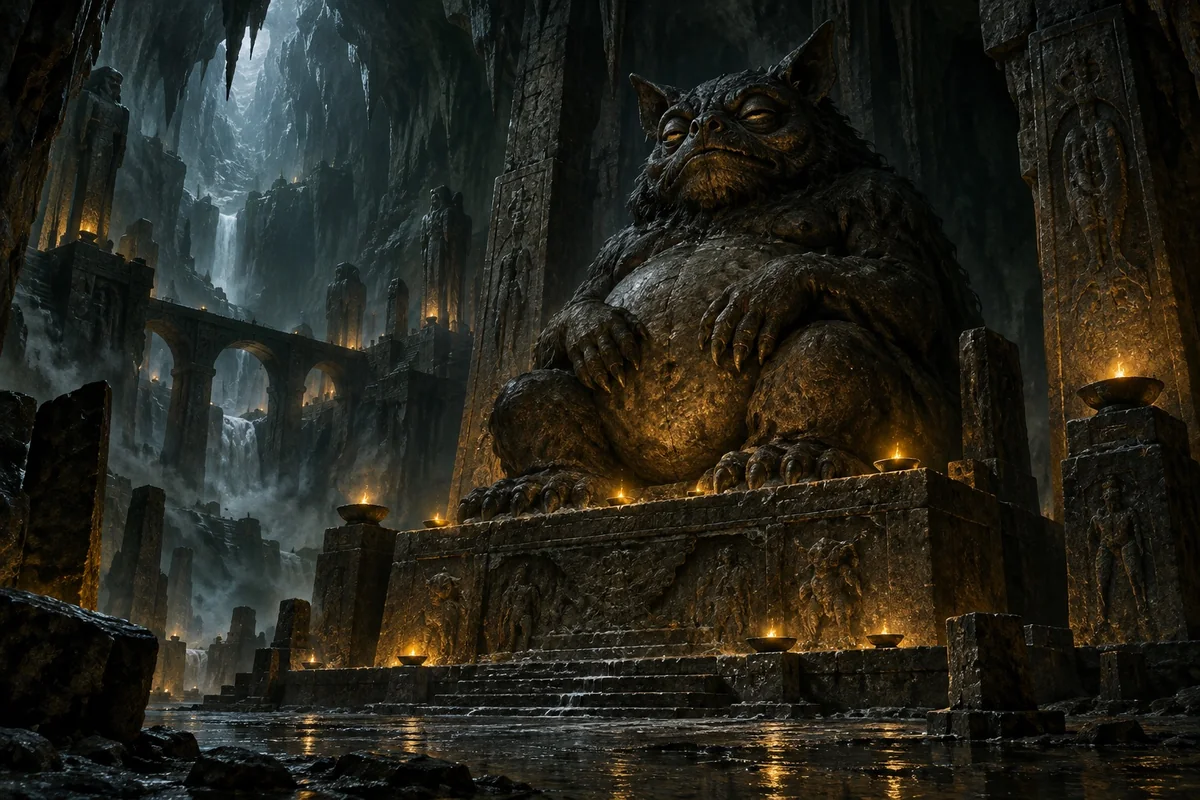
Smith’s thieves encounter a heavy, toad-headed idol with suggested fur, lowered eyelids and a protruding tongue. Batlike and slothlike qualities complicate its amphibian appearance.
The active danger emerges from a separate basin as a dark substance that forms appendages. The statue and the pursuer are distinct. This difference matters when identifying or illustrating the scene.
Sources: [2]
The speaking god in The Seven Geases
The Seven Geases gives Tsathoggua a direct encounter with the hunter Ralibar Vooz. A sorcerer’s compulsion sends the man below Voormithadreth as an offering, accompanied by a guiding familiar.
Tsathoggua’s physical presentation combines enormous girth, dark fur and a sleepy, toadlike aspect. The god has recently fed and declines the offered victim for the moment.
Instead of releasing him, it places him under another compulsory command and sends him onward to Atlach-Nacha. The episode makes the deity part of a chain of encounters in which survival at one threshold merely transfers the traveler to another.
Its lethargy is therefore not equivalent to harmlessness. It can redirect a person’s fate without becoming an energetic pursuer, and its momentary lack of appetite provides no general promise of mercy.
Sources: [3]
The deeper origin reported in The Mound
The Mound introduces Tsathoggua through the layered archaeology of K’n-yan, Yoth and N’kai. Manuscripts from Yoth associate the images with the older, lightless realm beneath them.
The Yothic scholars believed that N’kai had once contained an ancient civilization and that its images might represent a vanished race. Their interpretation belongs to the history of investigation inside the story, rather than to an omniscient explanation of the god’s ultimate nature.
When the people of K’n-yan discover Yoth and read its records, they inherit both the objects and the questions attached to them. The cult’s subsequent history is therefore inseparable from the movement of artifacts between civilizations.
Sources: [4]
The rise of worship in K’n-yan
The people of K’n-yan bring the images up from the red-lit region and establish shrines of basalt quarried there. Worship spreads and becomes a significant rival to the older cults of Yig and Tulu.
The city of Tsath retains a name associated with this period. The narrative also reports that a branch of the population carried the cult to the surface, where an image reached Olathoe in Lomar.
These connections extend the deity’s reach without giving a complete chronology for every temple. The account is transmitted through Zamacona’s record of what he learns, and some of the surface history is explicitly uncertain to the inhabitants themselves.
Sources: [4]
The expedition into N’kai
The decisive reversal occurs when explorers from K’n-yan enter N’kai with powerful searchlights. Earlier Yothic documents had reported no surviving life, but the new party encounters living masses of black viscous material.
These beings move through stone channels, assume temporary forms and worship images of Tsathoggua. Their presence overturns the assumption that the darkness contains only archaeological remains.
The survivors do not stay to learn everything about them. The text consequently supports their broad appearance and behavior but not an exhaustive biological account. Most importantly, it distinguishes their shapeless bodies from the toadlike images they venerate.
Sources: [4]
Suppression and the traces left behind
After the encounter, the route from Yoth is sealed. In K’n-yan, Tsathoggua’s images are destroyed through disintegrating technology, and the cult is abolished.
Zamacona later sees an empty temple that preserves the history of this change. Another former shrine has been reassigned to Shub-Niggurath. Architecture and place-names therefore retain traces of a worship the living society has repudiated.
The reaction is not a narrated defeat or death of Tsathoggua. It is a change in the behavior of one population after an exploratory disaster. Claims that the god itself was destroyed would confuse the disposal of images with the destruction of their subject.
Sources: [4]
Later uncertainty about the abyss
Subsequent generations attempt to rediscover the sealed entrance into N’kai and fail. Some begin to doubt the abyss, while scholars continue to assess older manuscripts and less secure later reports.
Tsathoggua’s association with the place thus persists through disputed evidence. The loss of access creates room for skepticism, suppression and renewed curiosity.
This is one of the deity’s distinctive functions in The Mound: its cult provides a history of how an advanced society adopts, fears and then questions knowledge inherited from another civilization. The story is concerned with the handling of that knowledge as much as with a god’s visible presence.
Sources: [4]
References in The Whisperer in Darkness
Tsathoggua appears among the names and ritual references that disturb Wilmarth during the Vermont investigation. The farmhouse speaker also connects it with N’kai and with writings attributed to the fictional high priest Klarkash-Ton.
That attribution playfully connects the shared mythology with Smith’s contribution. Within the scene, however, it is part of a disturbing speaker’s account, not information independently verified by Wilmarth’s own journey to the underworld.
The reference links the Vermont story to the underground geography of The Mound. It does not place Tsathoggua physically in Akeley’s farmhouse or establish that the beings visiting Vermont are its shapeless worshippers.
Sources: [5]
How to compare the accounts
The shared features are subterranean associations, unsettling bodily form and worship that survives or changes across immense periods. The narratives differ in how readers encounter the deity: through an image, through a speaking presence, through archaeological tradition or through another character’s account.
Those differences are useful rather than inconvenient. They explain why an encyclopedia should identify the source of a location, appearance or action instead of silently combining every description into one continuous biography.
A visual interpretation should likewise state whether it depicts the god, an idol or an associated organism. That simple distinction preserves the structure of the scenes and avoids converting every dark, shapeless creature in a temple into the same named being.
Related music
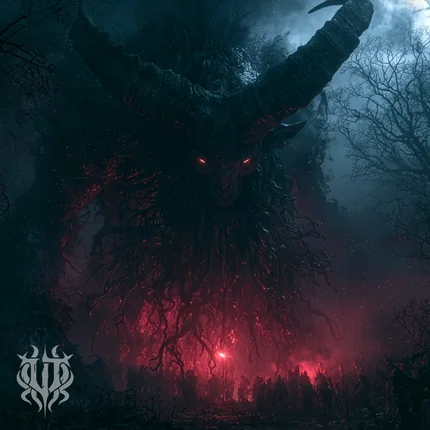
The Black Goat of The Woods is a dark metal tribute to Shub-Niggurath, the ancient woodland deity whose forgotten cults gather beneath twisted trees and indifferent stars.
References
- Tsathoggua — origin and appearances
- Clark Ashton Smith — The Tale of Satampra Zeiros
- Clark Ashton Smith: The Seven Geases — magazine text
Transcription of the Weird Tales text; used for a short account of Tsathoggua’s encounter with Ralibar Vooz.
- The Mound — original text
The fictional narrative is evidence for what the story says, not proof of events in the real world.
- The Whisperer in Darkness — original text
The fictional narrative is evidence for what the story says, not proof of events in the real world.
At a glance
Clark Ashton Smith
The Tale of Satampra Zeiros
Toadlike, heavy-bodied; furry and batlike associations in Smith
The Mound; The Whisperer in Darkness
God, images and shapeless worshippers are not interchangeable
N’kai, Yoth and K’n-yan in The Mound