

Hyperborea
Hyperborea is Clark Ashton Smith’s imaginary northern world of human kingdoms, wizards, lost learning and prehuman powers. Its cities stand above a much older subterranean world, while its remote past connects with the origins of life and its sorcerers can reach other planets. The setting accommodates grotesque comedy as well as cosmic terror, and its approaching ice gives human prosperity a temporary horizon.
5 min read · 1,033 words
A literary world before the ice
Smith's Hyperborea is a fantastic prehistoric setting. Human institutions coexist with creatures associated with much older forms of life, surviving gods and beings beneath the mountains. The world is not a reconstruction of an established historical civilization.
The ending of The Door to Saturn locates the revival of Zhothaqquah's worship in Mhu Thulan within the last century before the great Ice Age. This future gives the religious struggle a larger limit: the winning cult and its rivals inhabit a landscape that will itself undergo a profound transformation.
Ubbo-Sathla places Mhu Thulan in a region associated with what later becomes Greenland. That association offers a connection between ancient fiction and a modern frame, but does not amount to a fully surveyed map of the continent.
Cities, rulers and everyday institutions
The Seven Geases introduces Ralibar Vooz as a high magistrate of Commoriom and a cousin of King Homquat. His rank matters to the human attendants who accompany him into the mountains. He expects status, physical strength and command to secure obedience.
The Door to Saturn supplies another institution: a powerful priesthood capable of prosecuting a rival magician. Eibon's tower is a place of study and residence within that religious and political landscape.
Such details prevent Hyperborea from becoming only a collection of monster lairs. Its people hunt, hold office, cultivate reputations, dispute authority and possess expectations that may become useless when they encounter older powers.
Mhu Thulan and the northern coast
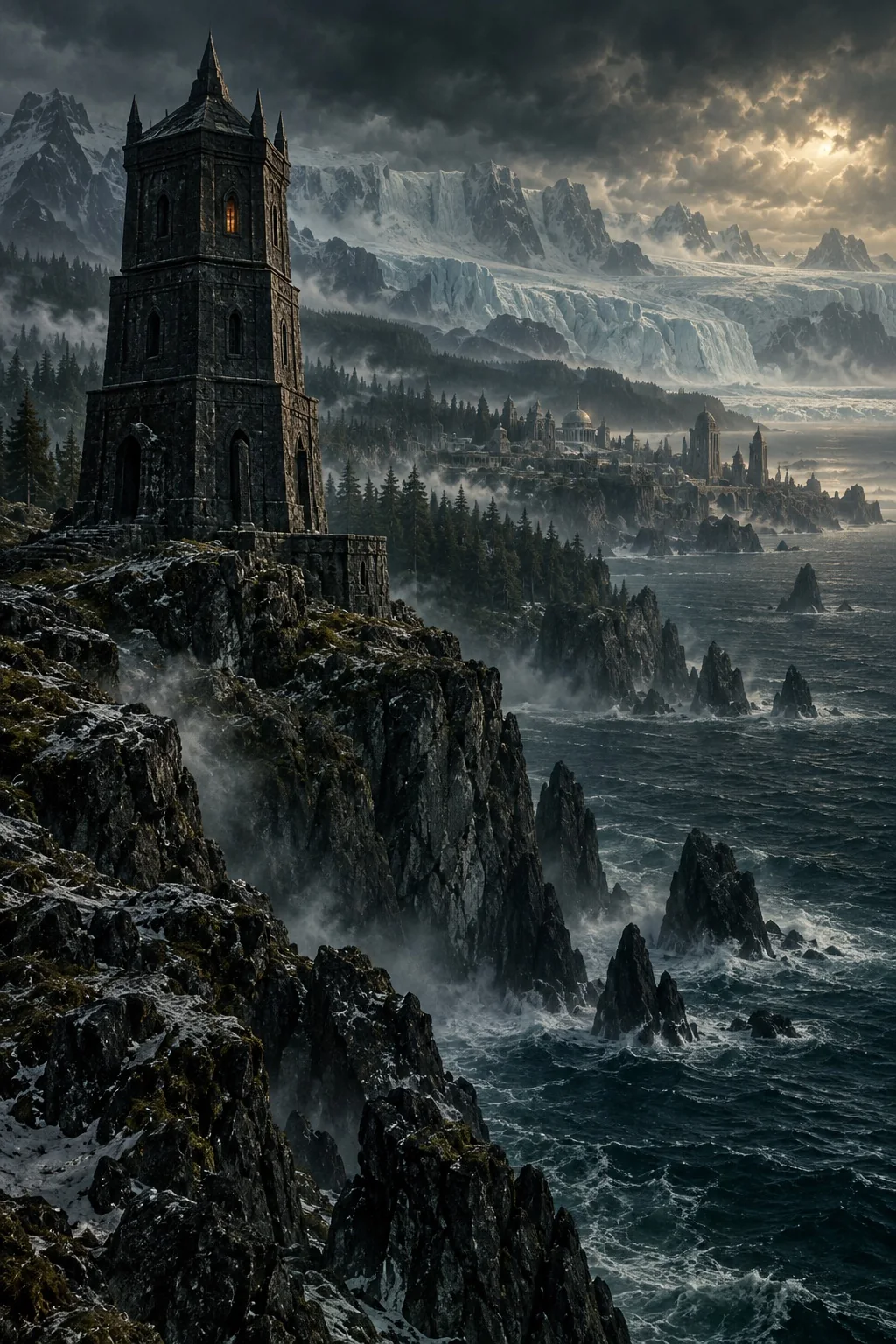
Mhu Thulan contains Eibon's tower on a headland above the sea. The black-gneiss building has five sides and a study concealing a passage to Cykranosh. Its setting combines remote coastal scenery with a direct connection to another planet.
Zon Mezzamalech also belongs to Mhu Thulan in Ubbo-Sathla. Through his room and crystal, a modern Londoner enters the remote northern past before continuing farther back toward the first life on Earth.
The region consequently serves as a junction for different kinds of distance. Eibon crosses astronomical space; Zon's experiment crosses time and the boundaries of identity. Neither journey needs to begin in a modern scientific laboratory.
The Eiglophian Mountains
Ralibar Vooz and his followers reach the black Eiglophian Mountains after a day's march from the capital. Their objective is Voormithadreth, a formidable volcanic mountain with four supposedly extinct craters.
Its lower approach leads from fertile plains and wooded hills into heated lava, obsidian cliffs, crevices and caves. Climbing equipment and the tactical problems of reaching a defended cavern receive close attention. Danger initially belongs to the physical terrain and the Voormis who inhabit it.
The sorcerer Ezdagor occupies a concealed place among these rocks. His circles of illusion disturb distance and orientation. Crossing from the hunters' expedition into his precinct changes the journey from a chosen pursuit into a compulsory descent.
Sources: [3]
Voormis and the limits of human certainty
The Voormis are shaggy, partly erect inhabitants of the mountain caves. They defend those caves and their families, while Hyperborean hunters pursue them for trophies. Ralibar Vooz displays their pelts in his home.
The hunters repeat competing accounts of their origin. Some tell of supernatural ancestry; Ralibar Vooz instead insists on a degraded remnant of an earlier population. These are beliefs expressed within a prejudiced hunting culture, not independently verified anthropological explanations.
The narrative reverses the magistrate's position when a geas forces him through their dens without weapons. The powerful collector of trophies becomes a vulnerable body passing through territory he no longer controls.
Sources: [3]
The world beneath Voormithadreth
Below the caves lie vast halls, descending passages and gulfs lit by an unexplained dim radiance. Tsathoggua occupies one chamber. Deeper still, the spider-god Atlach-Nacha spins crossings over a chasm, and a web leads to the palace of the prehuman sorcerer Haon-Dor.
Farther down are the laboratories of serpent-people and the Cavern of the Archetypes, whose forms are less solid than ordinary matter. Abhoth's generating pool occupies a cavern on the same general level as that primordial region.
The itinerary establishes local relationships among these places. It is not a complete census of the underworld, and the route used on the return journey bypasses several earlier destinations.
Sources: [3]
Gods, sorcerers and religion
Hyperborean divinity is not presented in a single tone. Eibon's patron supplies a useful warning and an escape route; Tsathoggua in The Seven Geases regards a visiting human as a possible meal but has recently eaten. Atlach-Nacha is too occupied with construction to spend time extracting a sacrifice from his armor.
The human cult of Yhoundeh, meanwhile, possesses an apparatus of persecution. Morghi's eagerness to arrest Eibon exposes religion as a social institution as well as a response to powers that actually exist in the fiction.
These stories mix genuine supernatural agency with satire of authority and self-importance. Their humor does not make the dangers unreal, and their dangers do not erase the characters' absurd assumptions.
Knowledge that survives the civilization
The Book of Eibon allows fragments of Hyperborean learning to reach readers in later settings. Ubbo-Sathla describes a chain leading through a lost Greek manuscript to a medieval French version owned in modern London.
The crystal associated with Zon Mezzamalech supplies another surviving object. Its appearance beside the book turns distant history into an active threat to the reader's identity.
Hyperborea is therefore both an inhabited setting in its own stories and a lost source invoked by later investigators. This double role connects Smith's independent imaginative world with the broader Mythos without reducing all of its inhabitants to Lovecraft's creations.
Sources: [2]
How its stories connect
A useful reading path begins with the human world of Eibon and Morghi, follows the vertical journey in The Seven Geases, and then moves into the more radical temporal descent of Ubbo-Sathla. Each reveals a different scale of the same imaginative setting.
The connections are strongest where names, places and attributed writings recur. Exact synchronizations remain limited: the stories do not provide enough dates to place every adventure into a comprehensive year-by-year chronology.
For encyclopedia navigation, the setting works best as a hub linking people, gods, places and objects while preserving the account supplied by each story.
References
- Clark Ashton Smith — The Door to Saturn (1932)
Original story; the host identifies these texts as believed to be in the public domain.
- Clark Ashton Smith — Ubbo-Sathla (1933)
Original story; the host identifies these texts as believed to be in the public domain.
- Clark Ashton Smith — The Seven Geases (1934)
Original story; the host identifies these texts as believed to be in the public domain.
At a glance
Clark Ashton Smith
Imaginary prehistoric northern world
Mhu Thulan; Eiglophian Mountains
Commoriom
Tsathoggua; Eibon; the Book of Eibon
The coming of a great Ice Age