

Clark Ashton Smith
Clark Ashton Smith (1893–1961) was a Californian poet, fantasist and visual artist whose work ranges from cosmic verse to darkly comic tales of sorcery and dying worlds. A correspondent of Lovecraft with an established creative identity of his own, he contributed Tsathoggua and other names to the shared Mythos vocabulary while developing independent settings such as Hyperborea, Averoigne and Zothique.
8 min read · 1,550 words
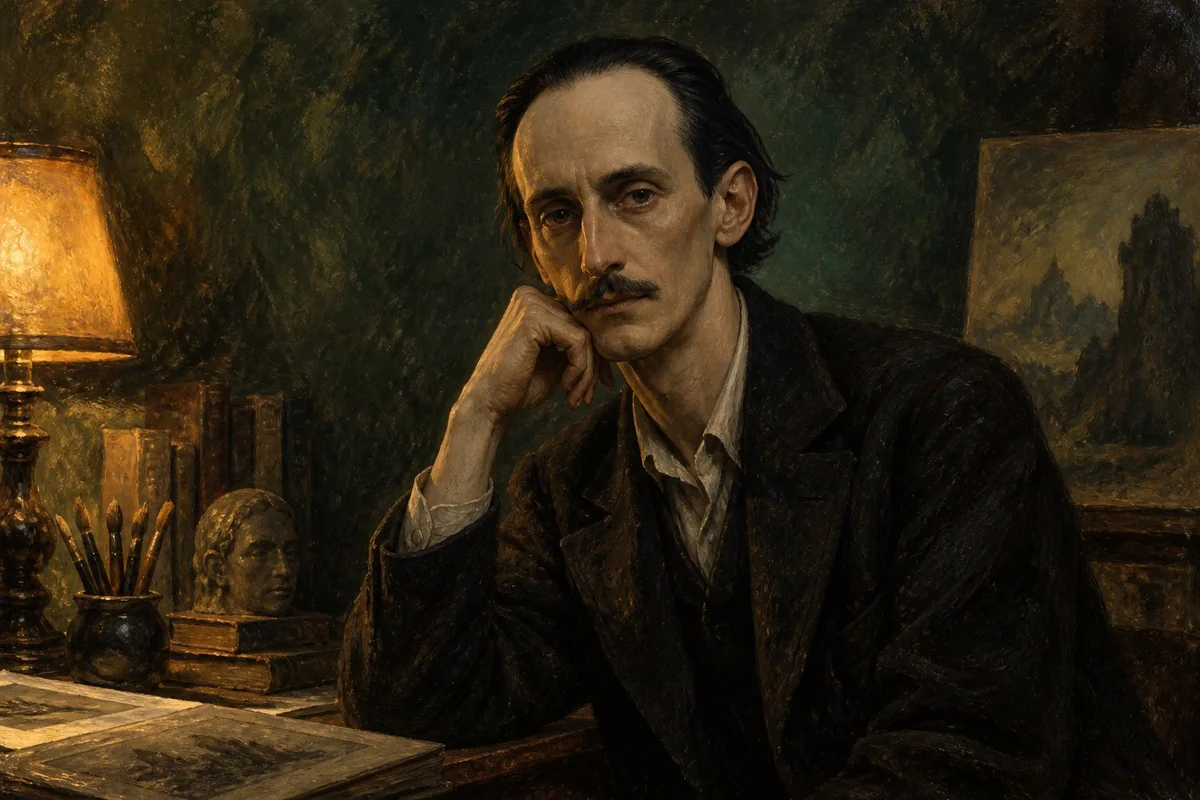
California, education and the early poetry
Smith was born in Long Valley, California, on 13 January 1893. His parents, Fanny and Timeus Smith, moved to Boulder Ridge near Auburn in 1902. He lived there for much of his life. After grammar school he continued his education through extensive independent reading rather than attending high school or college.
George Sterling became an important friend and literary mentor. Smith’s first poetry collection, The Star-Treader and Other Poems, appeared in 1912, when he was nineteen. The public attention given to the young poet preceded the main period of fantastic fiction now familiar to many readers. He married Carol Jones Dorman in 1954 and later divided his time between the Auburn region and Pacific Grove. He died at Pacific Grove on 14 August 1961.
Sources: A Biography of Clark Ashton Smith — publisher-hosted text
A poet before a Mythos contributor
Ebony and Crystal, published in 1922, provides a substantial early view of Smith’s imagination. Its contents move among desire, desolation, supernatural figures, remembered worlds and the relationship between beauty and death. It also places poems in verse beside poems in prose. The two forms belong to one creative project rather than to a neat division between serious poetry and preliminary storytelling.
The title’s materials suggest a useful way of reading the collection’s effects. Hard surfaces, precious stones, brilliant colors and darkness recur as means of giving sensory form to emotional or impossible states. In this encyclopedia’s reading, that material intensity is more than ornament. A feeling can become a landscape, a vanished affection can become a ruin and memory can seem to persist in carved or crystallized form.
Such writing helps explain the density of the later prose without reducing it to an effort to imitate Lovecraft. Smith’s imaginative language was already developing through his own poetry, literary friendships and reading. The visual splendor of a fictitious city or god belongs to a broader practice that also includes shorter lyrics about loss and desire.
Sources: Clark Ashton Smith — Ebony and Crystal: Poems in Verse and Prose
The Hashish-Eater and cosmic imagination
The Hashish-Eater; or, The Apocalypse of Evil occupies a prominent place in Ebony and Crystal. Its speaker begins with an extraordinary claim to sovereignty over dream and moves through a succession of cosmic landscapes. Stars, oceans, mountains, monstrous vegetation, sorcerers and fabulous creatures become participants in a vast movement of pursuit and escape.
The scale repeatedly exceeds ordinary human measurement, while the language keeps reaching for intensely material images: jewels, metal, stone, fire, wings and bodies. One late landscape contains forests of strangely fragile fungi; another presents a plain crossed by streams of broken metals and marble. The imaginative force comes from combining almost tactile particulars with impossible spatial and temporal dimensions.
The poem offers a useful comparison with Lovecraftian cosmic horror, but its voice and movement are different. Rather than beginning with a cautious investigator assembling documents, Smith presents an elevated speaker immersed in visionary experience. The declared mastery at the beginning is placed under pressure by what follows. The result makes imaginative ambition itself part of the drama, with splendor and terror difficult to separate.
The title alone should not be used to invent a medical or biographical explanation for Smith’s work. The reliable object of analysis here is the poem’s constructed speaker and sequence of images. A literary vision is not automatically a record of an experience undergone by its author.
Sources: Clark Ashton Smith — Ebony and Crystal: Poems in Verse and Prose
Desire, ruins and remembered beauty
Other poems show quieter versions of the same power to turn mental states into fantastic environments. The Kingdom of Shadows presents a solitary ruler among ruins, dead loves and unsuccessful attempts at recovery. The returning image of a ruined sovereignty makes grandeur an expression of loss rather than triumph.
Love Malevolent joins attraction to poison, flowers and the grave. The speaker’s desire persists despite the images of danger surrounding its object. Eidolon gives the remembered beloved a seemingly imperishable, sculptural presence. These poems do not require a common fictional geography to speak to one another; their connections lie in imagery, emotional conflict and the use of beauty as something powerful but not necessarily consoling.
For readers arriving from the monster entries, this is an important dimension of Smith’s range. His work can make the desired object as disturbing as the feared one. The sense of another world is often bound to an attraction the speaker cannot relinquish, rather than only to an intrusion that must be repelled.
Sources: Clark Ashton Smith — Ebony and Crystal: Poems in Verse and Prose
Several worlds, several kinds of history
Smith’s recurring settings should be distinguished from one another. Hyperborea is a legendary northern world threatened by the advance of ice. Averoigne is an imagined French region suited to medieval and early modern supernatural encounters. Poseidonis belongs to the remnants of Atlantis, while Zothique places sorcery and exhausted kingdoms on a far-future Earth. Other tales venture to Mars and independently imagined worlds.
These settings give him different historical distances and narrative possibilities. A religious institution in Averoigne is not automatically part of Zothique’s society, and a Hyperborean god’s borrowed name does not make the entirety of Smith’s fiction a province of Lovecraft’s New England. The Encyclopedia of Science Fiction emphasizes his importance to the imaginative development of planetary romance and the far future, a wider contribution than Mythos nomenclature alone.
Sources: Clark Ashton Smith — life and literary cycles, Clark Ashton Smith — biographical reference
Hyperborean irony: thieves and compulsory journeys
The Tale of Satampra Zeiros approaches an ancient temple through the self-justifying account of a thief. Satampra and Tirouv Ompallios seek treasure in abandoned Commoriom after spending scarce money on wine. Their confident explanation of the expedition collides with the temple’s actual danger. Tsathoggua’s squat, furry, drowsy-looking idol is distinct from the amorphous guardian in the basin. The comic voice and the physical catastrophe belong to the same tale.
The Seven Geases gives Ralibar Vooz a sequence of compulsory visits to increasingly strange beings and regions. The repeated transfers diminish the importance of the proud human traveler: each encounter can make him someone else’s unwanted problem. The pattern allows cosmic scale, grotesque invention and irony to work together. Smith’s powerful beings are not merely entries in a hierarchy; their attitudes and refusals shape the traveler’s experience.
Sources: Clark Ashton Smith — The Tale of Satampra Zeiros, Clark Ashton Smith — The Seven Geases
Exchange with Lovecraft
Lovecraft’s autobiography includes Smith among the literary relationships fostered through the world of amateur writing and correspondence. The relationship connects two writers whose work shares interests in immense time, invented divinities and the expressive possibilities of the strange. It does not establish a relation in which Smith’s entire imagination derives from Lovecraft’s.
Lovecraft’s The Whisperer in Darkness and the Bishop revision The Mound use Tsathoggua within their own occult and subterranean backgrounds. Reading those appearances beside Smith’s temple scene shows how a borrowed name changes function. In one work it belongs to a vividly rendered shrine and a thief’s disastrous adventure; in another it can help suggest a much larger body of forbidden lore beyond the immediate plot.
The distinction between borrowing and identity is central to a reliable Mythos reference. An occurrence in Lovecraft confirms that the name appears in that particular text. It does not authorize importing every later Smith story, genealogy or description into a scene that supplies none of those details. The productive exchange depends on recognizable connections while leaving room for separate narrative worlds.
Sources: H. P. Lovecraft — Autobiography: Some Notes on a Nonentity, The Whisperer in Darkness — original text, The Mound — original text, Clark Ashton Smith — The Tale of Satampra Zeiros
Arkham House and the collected fiction
Arkham House published Out of Space and Time in 1942 and Lost Worlds in 1944. Derleth’s contemporary publishing bibliography records 1,054 copies for the former and 2,043 for the latter. The collections brought together fiction previously scattered among magazines and presented a broad range of Smith’s settings and methods.
The contents of Out of Space and Time include Averoigne stories, The City of the Singing Flame, The Dark Eidolon, The Return of the Sorcerer and Ubbo-Sathla. Lost Worlds includes The Tale of Satampra Zeiros, The Seven Geases, stories of Malygris and other works spanning several cycles. These are collections arranged by a publisher, not single continuous novels. Their significance includes the juxtaposition of different kinds of Smith story within durable volumes.
Derleth’s 1959 history also lists later Smith projects among the press’s intentions. Such announcements need to be distinguished from the publication record of completed books. The broader history of Smith’s reception depends on publishers, editors and bibliographers who preserved prose, poetry, letters and visual work in different forms.
Sources: August Derleth — Arkham House: The First 20 Years, 1939–1959
Visual art, language and the scope of the legacy
Smith also drew, painted and made small sculptures. The biographical account describes his delight in carving and his continued visual work beyond the period of his most concentrated fiction writing. This gives a literal artistic counterpart to the sculptural bodies, precious materials and carved surfaces that appear in the literary work.
His far-future and planetary imaginings influenced later fantasy, with Jack Vance an important point of comparison identified by the Encyclopedia of Science Fiction. His legacy is therefore distributed across poetry, horror, fantasy and science-fictional world making. Reading him only for the first appearance of a familiar deity would miss the tonal range that allows a tale to be lavish, cruel, wistful and funny within the same sequence.
A balanced reading path includes poems from Ebony and Crystal, a Hyperborean adventure and stories from other cycles before treating the shared names as a complete account of his achievement. The interlinked creature and book entries are useful starting points, but the individual work remains the place where his language, pacing and ironies can be understood.
Sources: A Biography of Clark Ashton Smith — publisher-hosted text, Clark Ashton Smith — biographical reference, Clark Ashton Smith — Ebony and Crystal: Poems in Verse and Prose
References
- A Biography of Clark Ashton Smith — publisher-hosted text
Used for a concise account of Smith’s family, education, poetry debut and later life.
- Clark Ashton Smith — Ebony and Crystal: Poems in Verse and Prose
Original collection published in 1922; public-domain text. The transcription records corrections in Smith’s own copy.
- Clark Ashton Smith — life and literary cycles
Used for a concise orientation to distinct fictional settings, checked against separately cited primary works where developed.
- Clark Ashton Smith — biographical reference
- Clark Ashton Smith — The Tale of Satampra Zeiros
- Clark Ashton Smith — The Seven Geases
Hyperborean fiction, Weird Tales, October 1934; used for a short discussion of the sequence and tone.
- H. P. Lovecraft — Autobiography: Some Notes on a Nonentity
Written 23 November 1933. A retrospective self-portrait, not an independent biography; the original essay is public-domain text.
- The Whisperer in Darkness — original text
The fictional narrative is evidence for what the story says, not proof of events in the real world.
- The Mound — original text
The fictional narrative is evidence for what the story says, not proof of events in the real world.
- August Derleth — Arkham House: The First 20 Years, 1939–1959
The publisher’s own 1959 retrospective and bibliography; financial statements and judgments are attributed to Derleth. Public-domain edition at Project Gutenberg.
At a glance
13 January 1893 · Long Valley, California
14 August 1961 · Pacific Grove, California
Poetry, prose poetry, fiction, drawing, painting and sculpture
The Star-Treader and Other Poems, 1912
Hyperborea, Averoigne, Poseidonis and Zothique
George Sterling
Carol Jones Dorman; married 1954
Independent contemporary and correspondent of Lovecraft