

The Temple
The Temple presents the final manuscript of a German submarine commander whose disabled vessel reaches an ancient city on the Atlantic floor. His account combines technical observation, murderous authoritarianism and increasingly desperate explanations of events he cannot control. A small ivory head connects the submarine’s earlier voyage with a mysterious temple, but the manuscript ends before its writer enters the building.
7 min read · 1,404 words
The recovered manuscript and its writer
The framing identifies the document as a manuscript found on the Yucatán coast. Its writer, Karl Heinrich, Graf von Altberg-Ehrenstein, commands the German submarine U-29. He dates his concluding testimony to 20 August 1917 and writes while his vessel rests on the ocean floor.
Sources: [1]
This recovered-document structure gives the account a route to the reader without supplying an independent witness to the submerged city. The existence of a manuscript within the fiction does not authenticate each explanation offered by its author.
Karl introduces himself through rank, ancestry and national identity. Those commitments shape his account throughout. His confidence that a Prussian officer must remain rational becomes especially revealing when he treats prejudice and cruelty as evidence of discipline.
The Victory and the ivory head
On 18 June, U-29 torpedoes the British freighter Victory. Karl allows its crew to launch boats so that their evacuation can be filmed, then orders the survivors killed. The narrative establishes his willingness to murder before introducing anything supernatural.
After the submarine submerges and resurfaces, a dead young sailor is found clinging to its railing. His appearance strikes the officers as Mediterranean. Searching him reveals an antique ivory carving: a youthful head wearing a laurel crown.
Lieutenant Klenze keeps the object. The dead sailor is put overboard, but the boatswain Müller subsequently claims that the body moved and swam away. Karl rejects that report. The reader receives the alleged movement through a crewman's testimony, rather than a neutral description that settles what happened.
Sources: [1]
Disorder aboard U-29
Crew members suffer disturbing dreams and claim to see dead people outside the submarine. Their fear develops in the shadow of the killings, although the story does not provide a detached explanation of whether guilt, haunting or another force causes the experiences.
Karl responds with punishment. His narration repeatedly assigns weakness or disloyalty to regional and ethnic characteristics, particularly when describing men he regards as insufficiently Prussian. These judgments reveal the commander's worldview; they are not reliable explanations of the crew's behavior.
An unexplained current carries the vessel south. Dolphins accompany it for periods that Karl finds difficult to reconcile with ordinary animal behavior. The accumulation of anomalies undermines his confidence without making him reconsider the assumptions on which that confidence rests.
Sources: [1]
Mechanical disaster and the loss of control
An engine explosion kills two men and destroys the submarine's ability to propel and steer itself. Some systems remain usable, including its air-regeneration equipment, batteries and ballast arrangements, so the disaster does not immediately kill everyone aboard.
The possibility of surrender briefly arises when an American warship is sighted. Karl rejects it; Klenze shoots a sailor who objects. A later storm forces the submarine below the surface, after which its attempted ascent fails.
The surviving crew finally mutinies, damaging instruments and other equipment. Karl shoots all six men involved. Once their bodies have been expelled through the hatches, only the commander and Klenze remain.
These losses matter to the story's evidentiary structure. Broken gauges and compasses restrict what the officers can know about depth and location. A precise modern map of the final resting place would claim certainty that the manuscript itself lacks.
Sources: [1]
Klenze and the call outside
During the long descent, Klenze becomes increasingly remorseful about the submarine's victims. Karl interprets that remorse as degeneration, while preserving his own expectation that patriotic service will justify his conduct.
Klenze eventually announces that an external summons offers a possibility of repentance. He urges Karl to leave with him. The commander refuses but allows his companion to go out through the hatches, still carrying the ivory head.
Karl does not observe a clear final event that establishes Klenze's fate. Dolphins interfere with his view, and the lieutenant disappears. The narrative strongly exposes him to mortal danger, but it does not show him returning alive, becoming a sea creature or taking a defined place in the temple.
Sources: [1]
The city beneath the Atlantic
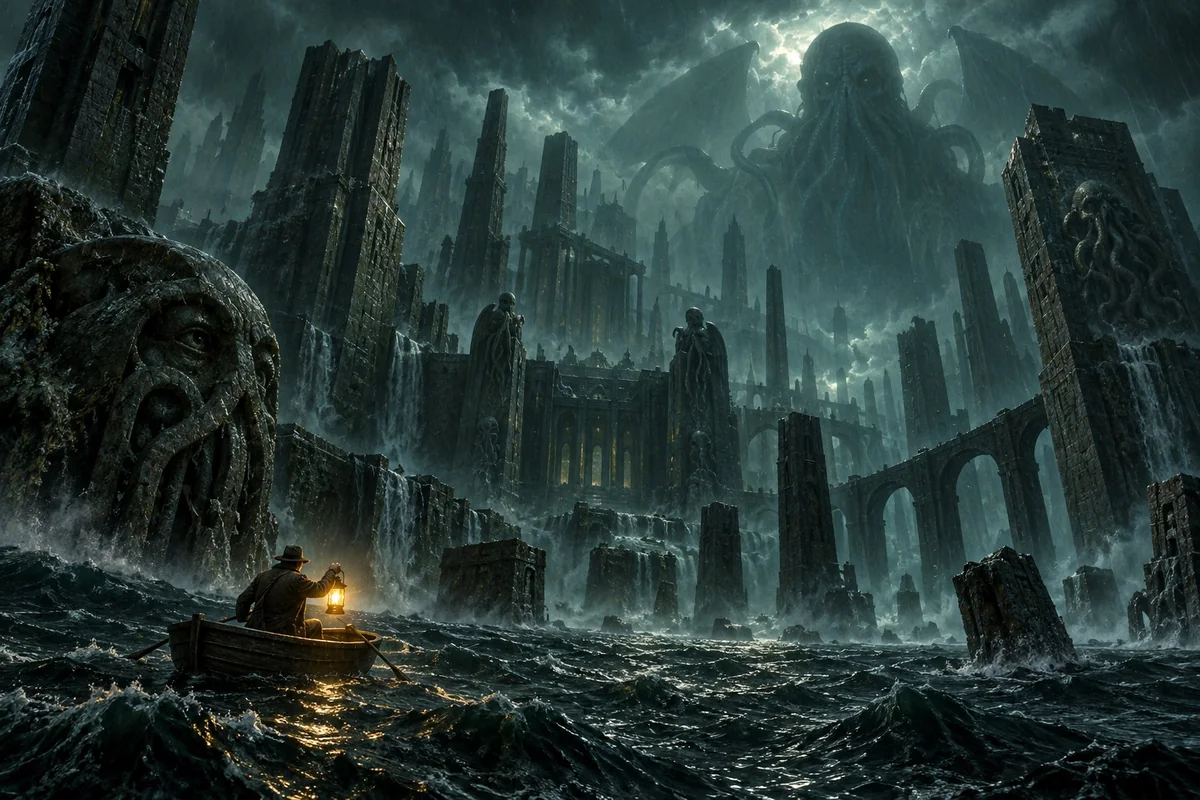
The current eventually ceases, and the submarine comes to rest in a valley containing an extensive ruined city. Streets, bridges, buildings and what appears to be an ancient river course suggest a landscape that once existed above the sea.
Karl identifies the place as Atlantis. That is his conclusion, not a label verified by an inscription or an external historian. The architecture reminds him of Greek forms while seeming to belong to a civilization older than the traditions he knows.
A particularly imposing temple stands near the submarine. It is cut into the rock and preserves a facade, entrances, windows and elaborate sculptural decoration. Scenes involving priests, priestesses and a radiant youthful divinity distinguish it from a merely anonymous ruin.
Nothing in the text identifies the site as R'lyeh. Its unnamed god should likewise not be assigned the name Cthulhu or Dagon simply because later readers associate Lovecraft's sea settings with those beings.
Sources: [1]
Exploration and the limits of equipment
Karl uses an articulated diving suit with its own air supply to investigate the city. He studies the streets and finds portable objects, including coins and sculpture. The absence of human remains attracts his attention without producing a secure explanation for the population's disappearance.
His first response to discovery includes anticipation of national prestige. Even isolated on the ocean floor, he imagines the archaeological achievement in terms of Germany and his own position within it.
The temple resists sustained examination. A shortage of replacements for his portable light limits a later visit, and he turns back after only a brief penetration of the darkness. The story therefore gives more information about the exterior and its decoration than about any inner sanctuary.
This distinction should survive a synopsis. Karl does not complete an archaeological survey or discover a readable theology explaining the city's history.
Sources: [1]
The recurring face
The youthful figure represented in the temple's decoration recalls the ivory head taken from the drowned sailor. Karl recognizes the resemblance even while trying to minimize its significance.
That repetition links events separated by weeks and by the submarine's long involuntary journey. It gives the object a narrative importance that its small size initially conceals.
The correspondence does not establish a complete causal mechanism. The text never supplies a verified rule that possession of the head steers ships, summons dolphins or transfers its owner's identity. Such claims would turn an ominous relationship into a system the story does not explain.
Sources: [1]
Light, sound and failing explanations
As his remaining electrical resources are exhausted, Karl experiences dreams and an increasingly strong desire to enter the temple. He hears music or chanting despite the submarine's isolation from the surrounding water and insists that these experiences must originate in his own disturbed perception.
Light then appears to issue from the temple's doors and windows. The surrounding city remains dark. Karl tests his perception in limited ways, but those efforts fail to restore a stable distinction between external event and hallucination.
His repeated insistence on rationality is not the same as reliable reasoning. He alternates observations that seem to contradict his explanation with assertions that preserve his preferred image of himself.
Sources: [1]
Where the narrative actually ends
Karl prepares to leave the submarine and enter the temple. He intends to release the manuscript in a bottle when he goes. The possibility of suffocation no longer restrains him as it should.
The final movement is a decision and a preparation, not an account of arrival inside the sanctuary. Readers are never shown what waits there, whether Karl dies immediately or what relationship the apparent god has to the drowned sailor.
That withheld destination is essential to the ending. A retelling that supplies an encounter with a named Mythos deity would replace the story's unresolved approach with a new event.
Sources: [1]
War, authority and cosmic displacement
The submarine begins as an instrument through which Karl exercises lethal control. It ends as a confined observation chamber carried toward something he cannot command. Technical competence, rank and national rhetoric offer progressively less protection.
The sequence permits a reading in which the deaths of civilians return as a haunting or judgment. It also leaves room for an external power whose motives are unknown. The narrative does not disclose a universal moral law governing the sea.
Karl's unreliability is therefore more specific than a simple claim that everything is imaginary. His account can preserve meaningful physical observations while distorting motives, responsibility and the significance of those observations. The horror develops through that combination.
Sources: [1]
Related music
The Dead But Dreaming is a dark folk metal song inspired by The Call of Cthulhu, evoking R’lyeh, forbidden worship and the ancient dream beneath the sea.
References
- The Temple — Unspeakable Tales ebook
The fictional narrative is evidence for what the story says, not proof of events in the real world.
At a glance
H. P. Lovecraft
1920
1925, September
Weird Tales, 6, No. 3
Fiction