

Dagon
Dagon is an early sea-horror story in which a wartime escapee finds himself stranded on an apparently risen ocean floor and encounters evidence of an intelligent undersea world. Written in July 1917 and first published in November 1919, it presents the experience through a desperate survivor whose recollection culminates in fear of an approaching presence.
6 min read · 1,219 words
Composition and first publication
Lovecraft wrote Dagon in July 1917. Its first appearance was in the November 1919 issue of The Vagrant. The title should be distinguished from later stories and films that use the same name while drawing on different material.
The narrative is framed as a final written account by an unnamed man in a garret. Poverty, dependence on morphine and recurring visions have brought him to a crisis. He asks the reader to understand the experience behind that condition before judging him.
The story then moves backward to his wartime voyage and returns to the room only at the end. The full synopsis below includes the final disturbance.
Capture and escape in the Pacific
The narrator serves as supercargo aboard a merchant vessel captured by a German raider near the beginning of the First World War. He describes the initial treatment of the prisoners as sufficiently lenient to make escape possible.
Five days after the capture he takes a small boat with food and water. His navigational knowledge is poor: he can only estimate that he is south of the equator and cannot determine his longitude. Days of drifting reveal neither land nor a rescuing ship.
This uncertainty prevents the later site from receiving a reliable location. The narrative supplies an oceanic region and the survivor’s impressions, rather than coordinates that can be converted into an exact map.
Sources: [3]
A sea floor exposed to the sky
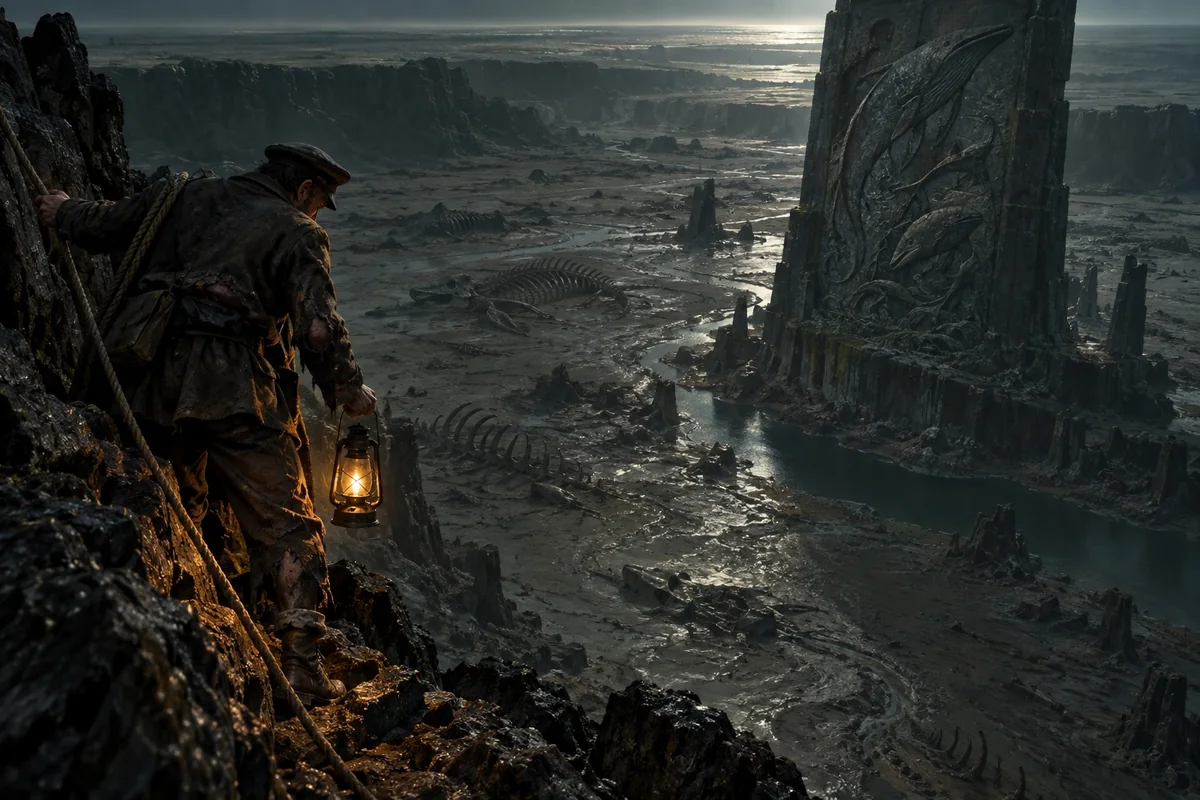
He wakes to find himself and the boat embedded in a vast field of black mud, surrounded by dead fish and unfamiliar marine remains. The sea is no longer visible or audible. He assumes that a volcanic upheaval has raised a large area of the ocean bed while he slept.
The explanation is his inference, not an event he witnesses. What he can describe directly is the exposed landscape, its stench, its silence and the absence of birds feeding on the carcasses.
He waits while the ground dries enough to cross. Taking provisions, he heads toward a distant rise that offers the only clear landmark. The apparent emptiness is frightening before any monument or creature appears: scale and stillness have already removed the reassuring conditions of an ordinary shore.
Sources: [3]
The hill and the hidden channel
After exhausting travel, he reaches the base of the rise and sleeps. Disturbing dreams wake him under a waning gibbous moon. Realizing that the night is cooler, he climbs the hill.
The far side drops into an immense canyon. As the moon rises, he discovers ledges that permit a descent. A dark channel of water runs along the bottom, and across it stands a huge pale stone.
At first the object might be a natural formation. Closer attention reveals deliberate shape, inscriptions and reliefs. The exposed bed of the sea thus becomes an archaeological site, implying a history of intelligent activity where he expected only geological material.
Sources: [3]
The monolith’s images
The inscriptions use marine forms, including familiar animals and others resembling the strange remains on the surrounding plain. The narrator cannot read them. Their aquatic subject matter is recognizable even though their language is not.
The reliefs show broadly humanlike beings swimming or worshipping beneath the sea. Their hands and feet are webbed, their mouths and eyes are disturbing to him, and their scale seems excessive. One image shows a being killing a whale not much larger than itself.
He initially explains these figures as imaginary gods rather than literal portraits. That attempt to contain the discovery within a familiar category lasts only until something moves in the channel.
Sources: [3]
The living visitor
An enormous being rises from the water and moves toward the monolith. It embraces the stone with scaly arms, bows its head and produces measured sounds.
The encounter is brief. The creature is not described chasing the narrator across the plain, and the text does not provide a conversation or translated ritual. Its behavior suggests a relationship to the monument, but the narrator flees before he can investigate further.
His return to the boat survives only in confused memories of frantic movement, singing, laughter and a later storm. This break in recollection also prevents a continuous account of what happens to the exposed land after the encounter.
Sources: [3]
Rescue and the search for an explanation
He regains awareness in a San Francisco hospital after an American ship finds his boat at sea. The rescuers know of no reported upheaval corresponding to his story, and his delirious statements have received little serious attention.
He later consults an ethnologist about Dagon, whom he describes through the fish-god interpretation familiar to him. The consultation does not establish the encountered being’s identity. The name enters through his attempt to connect an unexplained experience with something he has heard about ancient religion.
The creature at the monolith is consequently not explicitly introduced by its own name. Calling it Dagon is a conventional identification encouraged by the title, but the narrative itself leaves the relationship inferential.
Sources: [3]
The final room
The visions return, especially in association with the waning moon. Morphine offers only temporary relief and becomes another source of distress. The narrator considers whether the whole episode could have been a feverish experience during exposure in the boat, but the vividness of the recollection defeats that reassurance.
His fear expands from one encounter to the possibility of an undersea civilization rising against an exhausted humanity. That is a nightmare of a future catastrophe, not an event the story depicts as already occurring.
The closing lines report a noise at the door and an apparent hand, followed by his cry toward the window. The account ends during the crisis. It does not contain a subsequent investigation confirming who or what entered the room, or a completed report of the narrator’s death.
Sources: [3]
Connections and distinctions
Dagon anticipates later Lovecraftian concerns with submerged intelligence, a threatening marine past and humanity’s insecure position. The Call of Cthulhu and The Shadow over Innsmouth provide substantial comparisons, but their named beings, communities and histories should be read in their own texts.
The narrator’s discovery is not explicitly labeled R’lyeh. The reliefs and immense visitor are not called Deep Ones. The story offers motifs that later works develop, without itself supplying all the connections familiar from a combined Mythos reference system.
The 2001 film Dagon is chiefly connected with The Shadow over Innsmouth. A shared title is therefore insufficient evidence that a screen adaptation follows this early story’s plot.
Interpretation: the ocean as another inhabited world
The monolith changes the narrator’s problem from survival in an empty landscape to survival near a culture he does not understand. The being’s apparent act of reverence is unsettling partly because it suggests continuity: the monument still means something to a living inhabitant.
The perspective remains radically incomplete. The reader sees a fragment of an undersea world through someone who cannot read its writing, locate it accurately or remember his departure clearly. That limitation creates room for terror without requiring an encyclopedic explanation inside the story itself.
The wartime setting also gives the final vision of vulnerable humanity a specific emotional context. The narrator imagines a civilization already weakened by its own conflict facing powers that have existed outside its awareness. This is an interpretation of the story’s juxtaposition, not a prediction supplied as historical fact.
Sources: [3]
Related music
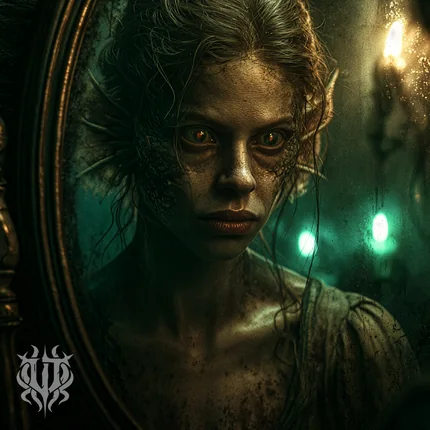
The Esoteric Order of Dagon is a dark metal descent into the world of Innsmouth, where ancient bloodlines, forgotten covenants and the call of the sea endure through countless generations.
References
- H. P. Lovecraft Archive — fiction in composition order
Composition dates; question marks and ranges retain the source uncertainty.
- H. P. Lovecraft Archive — fiction in publication order
First publication dates and venues; issue dates can differ from actual release dates.
- Dagon — Unspeakable Tales ebook
The fictional narrative is evidence for what the story says, not proof of events in the real world.
- The Call of Cthulhu — Unspeakable Tales ebook
The fictional narrative is evidence for what the story says, not proof of events in the real world.
- The Shadow over Innsmouth — Unspeakable Tales ebook
The fictional narrative is evidence for what the story says, not proof of events in the real world.
At a glance
H. P. Lovecraft
July 1917
1919, November
The Vagrant, No. 11
Fiction