

R’lyeh
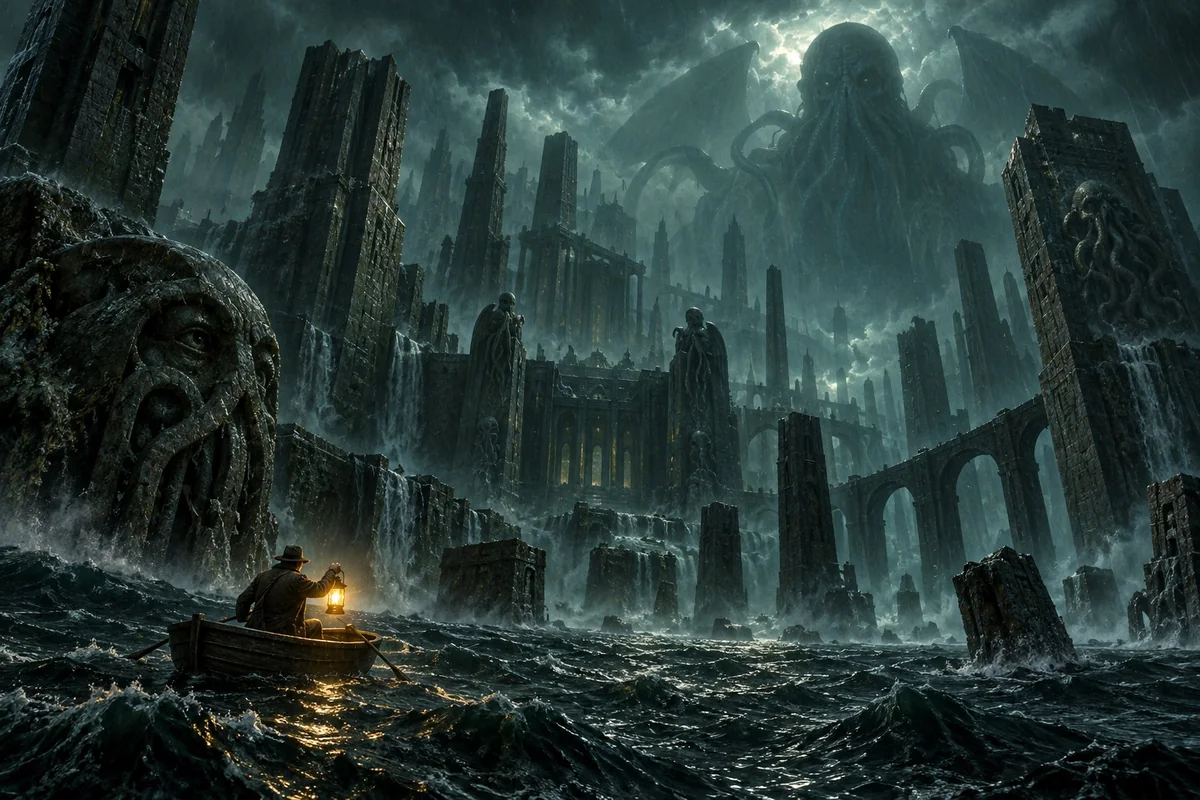
R’lyeh is the submerged Pacific city associated with Cthulhu and its waiting hosts. The Call of Cthulhu reveals it through dreams, cult testimony and a brief, disastrous landing on an exposed portion of its immense, disorienting architecture.
5 min read · 867 words
Name, testimony and the city beneath the sea
The name reaches the reader before the city becomes a directly visited location. Henry Anthony Wilcox repeats it during the dream disturbances recorded by Professor Angell. Cult testimony links it with Cthulhu’s continuing existence, and a later manuscript by the sailor Gustaf Johansen provides an account of a landing.
Sources: [1]
These sources create different kinds of access. A dream conveys images and sounds without a navigable route; cult doctrine offers an explanation of the city’s cosmic importance; the sailor records what his party encountered without initially knowing the larger tradition. Francis Wayland Thurston brings the materials together and identifies the correspondences.
The city’s role depends on that structure of partial knowledge. A familiar entry in a modern bestiary can make R’lyeh seem like a fully surveyed capital, but the original story gives only fragments of its appearance, history and inhabitants.
Location and the exposed acropolis
Johansen’s account places the encountered coast at 47° 9′ south latitude and 126° 43′ west longitude. Those coordinates belong to the fictional voyage. They should not be confused with the separate position given for the earlier confrontation with the yacht Alert.
The party sees mud, weed-covered masonry and an enormous pillar rising from the sea. Thurston believes that only the highest part of the city has emerged. This is an inference in his reconstruction, and it limits what can be said about the whole settlement. The men explore an exposed height; they do not walk every district or examine the full submerged extent.
R’lyeh is consequently not described as an ordinary island with a known coastline and settled hinterland. Its temporary visible surface is the upper portion of an architecture whose bulk and depth remain beyond the witnesses’ view.
Sources: [1]
Architecture and disturbed geometry
The exposed blocks are immense and slippery, covered with marine growth and carved signs. Their scale makes them unlike a human staircase. The travelers experience a visual environment in which surfaces seem to change relation: an apparent convexity may become a concavity when looked at again, and ordinary expectations about angles fail.
Wilcox’s dreams had already described abnormal geometry. Johansen’s physical encounter appears to confirm the same quality from another direction. The connection does not supply a mathematical specification or a working plan for impossible construction. The language communicates a breakdown in the observer’s ability to interpret space reliably.
The distortion becomes an active danger when a fleeing sailor appears to be swallowed by an angle that should not be capable of containing such an opening. Buildings are therefore more than a backdrop for Cthulhu’s appearance. The city itself frustrates the bodily assumptions by which a human being stands, climbs, looks and escapes.
Sources: [1]
The great door and Cthulhu’s emergence
The explorers reach a vast carved door. At first they cannot confidently determine its orientation; the architecture unsettles the distinction between a door and a surface opening beneath or before them. When it begins to move, an overwhelming darkness and odor precede the emergence of Cthulhu.
Members of the party die in the encounter and flight. Johansen and Briden reach the yacht, and Johansen later drives it into the pursuing being. The impact disrupts Cthulhu’s form, but the body begins to gather together again. The episode permits escape without establishing that either the creature or its city has been destroyed.
The scale of the event is therefore different from a conquest of R’lyeh. A small party accidentally reaches an exposed threshold, opens what it does not understand and suffers catastrophic losses. The survivor’s account is an escape narrative, not a successful archaeological survey or a military victory.
Sources: [1]
Submergence, dreams and cosmic timing
Cult testimony describes Cthulhu and the other beings as waiting through immense spans until conditions allow their return. The city’s submergence is associated with an interruption in the reach of their mental influence. The dream disturbance of 1925 suggests a temporary change in those conditions, which Thurston correlates with events at sea.
The later storm and the absence of the emerged land from subsequent observation support the conclusion that the exposed portion has sunk again. The story does not provide a reliable timetable for the next appearance. The frequently repeated idea of favorable stars belongs to the cult’s account of cosmic conditions; it is not an astronomical calendar supplied to the reader.
The uncertainty sustains the threat. Even if the immediate crisis has passed, the larger existence beneath the ocean remains. Thurston’s fear concerns not only what Johansen survived but the possibility that scattered traces of knowledge point toward a future event humans cannot control.
Sources: [1]
Relationship to other submerged places
The Shadow over Innsmouth names Y’ha-nthlei as the city of the Deep Ones associated with that town. It is a separate named location with a different narrative function. Dagon, the earlier short story, presents a raised sea floor, a carved monolith and an enormous marine being, but does not name that setting R’lyeh.
These works share the imaginative force of the ocean concealing ancient life and architecture. Their similarities support comparison; they do not erase the differences in names, witnesses and events. This encyclopedia therefore links the places through maritime horror while retaining their separate textual identities.
Related music
The Dead But Dreaming is a dark folk metal song inspired by The Call of Cthulhu, evoking R’lyeh, forbidden worship and the ancient dream beneath the sea.
References
- The Call of Cthulhu — Unspeakable Tales ebook
The fictional narrative is evidence for what the story says, not proof of events in the real world.
- The Shadow over Innsmouth — Unspeakable Tales ebook
The fictional narrative is evidence for what the story says, not proof of events in the real world.
- Dagon — Unspeakable Tales ebook
The fictional narrative is evidence for what the story says, not proof of events in the real world.
At a glance
Submerged Pacific city; partly exposed during the 1925 events
47° 9′ S, 126° 43′ W
Cthulhu
Gustaf Johansen
The Call of Cthulhu
An exposed upper portion, not a complete survey