

Winged Death
Winged Death follows a physician who uses his professional knowledge to murder a former friend, then finds himself pursued by an insect apparently carrying the victim’s consciousness. A journal records both the crime and the collapse of the killer’s confidence. The framing investigation in a South African hotel supplies evidence outside his own testimony, turning a story of calculated revenge into one of bodily and mental entrapment.
11 min read · 2,124 words
Authorship, publication and form
The story is credited to H. P. Lovecraft with Hazel Heald, with composition dated 1933. It appeared in the March 1934 Weird Tales, volume 23, number 3, on pages 299–315.
Its two numbered parts organize the journal of Dr. Thomas Slauenwite around a change in his purpose. He first records a murder so that his achievement will eventually be known. Later he writes to steady himself against an increasingly impossible threat.
A third-person frame introduces the hotel room in which he dies and returns to it after the journal ends. The sequence lets the reader experience his growing fear before learning what investigators independently find.
The room at the Orange Hotel
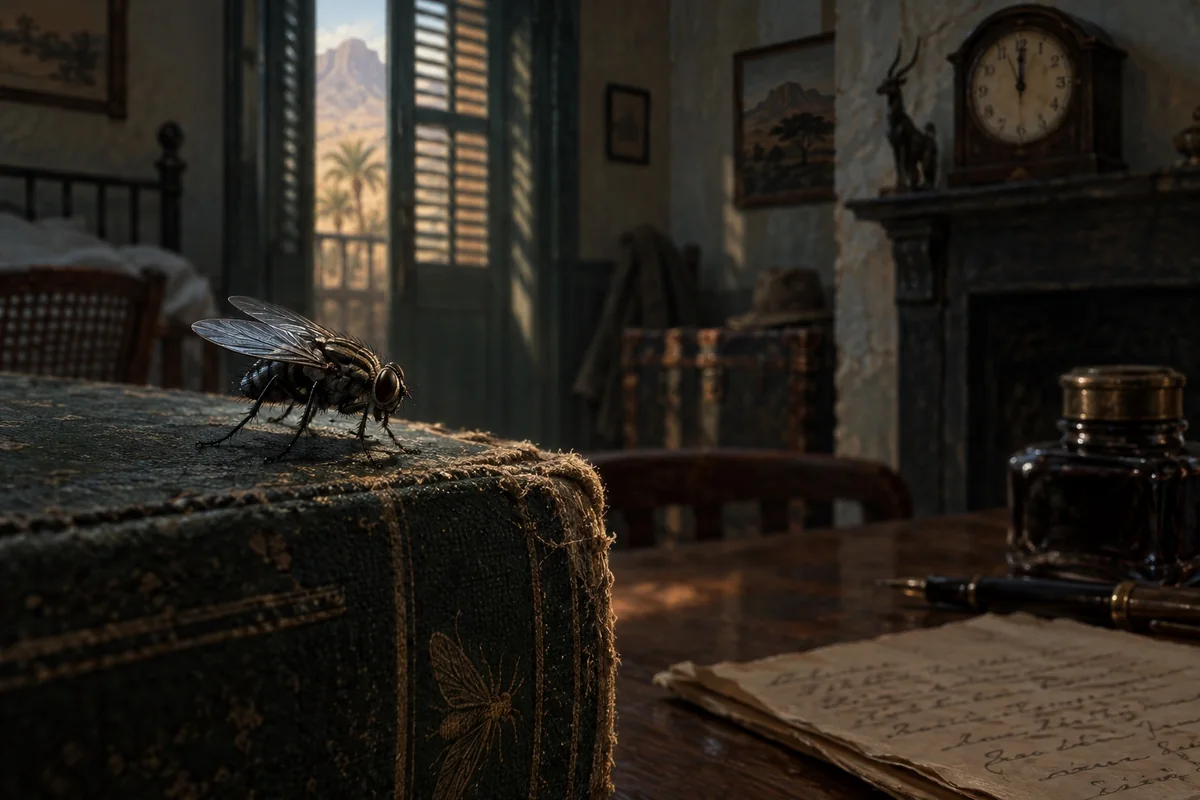
On 24 January 1932, officials and the proprietor of the Orange Hotel in Bloemfontein confront a dead guest, a peculiar fly and writing on the ceiling. The guest had registered under the identity Frederick N. Mason, a Canadian involved in mining properties.
The journal identifies him as Thomas Slauenwite, a physician known for work connected with Africa. Dr. Cornelius Van Keulen recognizes the professional name and discovers its association with the death of Henry Sargent Moore, a case already reported in the press.
The other men are proprietor George C. Titteridge, constable Ian De Witt and coroner Johannes Bogaert. Their collective presence is important: the final room is not described solely by the frightened man who occupied it.
The opening deliberately withholds the full significance of the fly and ceiling marks. They acquire meaning only after the written account has established a legend about the transfer of consciousness and a sequence of increasingly articulate insect behavior.
Sources: [1]
The grievance against Henry Moore
Slauenwite begins his record on 5 January 1929 with a settled intention to kill Moore. He presents himself as a talented physician whose research on African fevers had promised professional advancement and official recognition.
Moore, an old friend and fellow Columbia graduate, produced correspondence showing that the late Sir Norman Sloane had anticipated the central theory. Slauenwite admits that the letters establish the earlier work but resents the suggestion that he had used more of Sloane's papers than he acknowledged.
His expected rewards disappear, and he attributes the setback to jealousy. The journal does not independently settle the plagiarism question in his favor. Its secure revelation is his decision to convert a professional dispute into a premeditated killing.
He moves from Mombasa to the inland trading post of M'gonga and cultivates the grievance there. Moore's entomological book remains on his shelf, initially as an object of embittered condescension and later as a focus of the returning threat.
Sources: [1]
Mevana and the death-fly tradition
A sick man named Mevana is brought to the post after an insect bite. Through local informants, Slauenwite hears that a particular fly may cause wasting illness and then receive the victim's personality when that person dies, provided the insect is still alive.
He initially separates what he considers a usable medical observation from what he dismisses as superstition. The illness attracts his attention because it suggests a means of harming Moore, while the alleged transfer of consciousness seems irrelevant to his practical plan.
Mevana recovers with treatment and assistance from his wife Ugowe. Slauenwite then exploits the man's gratitude to obtain guidance into the region associated with the flies. His conduct corrupts the relationship between patient and physician before the main murder occurs.
On the journey, the party encounters ruins associated with beings called the Fishers from Outside and powers named Tsadogwa and Clulu. The episode gives the insects a surrounding occult geography without identifying their exact supernatural origin.
Sources: [1]
Research turned into abuse
Slauenwite's journal describes a prolonged effort to prepare insects that Moore will not readily recognize as dangerous. The narrative represents them as altered hybrids with conspicuous blue wings and connects the project with the physician's access to equipment and professional contacts.
The details serve a plot of concealment rather than a dependable account of entomology. Their literary role is to make the murder appear as a corrupted extension of ordinary scientific exchange: a specialist expects to receive interesting specimens from another specialist.
Before sending them abroad, Slauenwite deliberately exposes two men at the post, Batta and Gamba. He presents himself afterward as the helpful doctor attending their injuries. Gamba receives treatment and survives; Batta is allowed to decline while the physician observes him.
The journal's casual treatment of these men makes its moral character clear. Slauenwite values their lives according to his experiment, and his racist language attempts to make that exploitation seem ordinary. Their victimization is part of the crime, not a preliminary detail to be eclipsed by Moore's death.
Sources: [1]
Batta’s death and the first warning
When Batta dies in November 1929, the insect associated with his infection behaves unusually in its cage. Slauenwite observes frantic activity followed by an unsettling stillness in his presence. By the time he returns later, the fly is dead.
The coincidence recalls the local account of a human personality entering the insect. The physician notices the possible relationship but refuses to let it alter his plans.
This episode foreshadows the final outcome in two ways. It suggests that the personality transfer may occur, and it also raises the possibility that consciousness within such a body might seek or bring about its destruction.
The journal gives only the behavior Slauenwite sees. It does not provide a direct statement by Batta from inside the fly. The final room will supply a more explicit form of communication.
Sources: [1]
The attack on Moore and the investigation
Using the fictitious identity Nevil Wayland-Hall, Slauenwite arranges for the specimens to reach Moore as an apparently professional gift. The deception relies on the recipient's curiosity and trust in the accompanying account.
Moore is bitten on 19 June 1930. News of his illness reaches Slauenwite through mutual acquaintances, allowing the physician to follow its progress without openly requesting a report. His journal alternates satisfaction with anxiety that the circumstances may be traced back to him.
The anomalous specimens eventually attract suspicion, and attempts to locate the supposed sender fail. Moore forms theories about the attack before losing the ability to communicate. His death occurs on 20 September 1931, much later than Slauenwite had anticipated from his earlier victim's decline.
A reported incident on the night of Moore's death disturbs the killer: a blue-winged fly appears near their acquaintance Dyson before news of the death arrives. Slauenwite dismisses it as journalistic embellishment while preparing to disappear from his own career.
Sources: [1]
The assumed identity
Slauenwite establishes a financial and personal cover as Frederick Nasmyth Mason, a mining-properties broker from Toronto. After resigning his position, he travels toward South Africa and eventually settles in a Johannesburg hotel under that name.
He wants the journal to remain hidden during his lifetime and be read afterward as confirmation of the revenge. The document is therefore both an assertion of control over his story and a potentially fatal piece of evidence against him.
His claim that the physician Slauenwite is now effectively dead proves premature. A new identity can obstruct ordinary investigation, but the later pursuer appears to recognize him regardless of the name entered in a hotel register.
When he resumes writing in January 1932, the tone has changed. The author of the carefully planned crime now struggles to explain an event he cannot control: an insect matching the appearance of those he sent to Moore has entered his room.
Sources: [1]
The fly acquires a language
The visitor repeatedly evades attempts to kill it and circles Moore's book. That focus suggests recognition or intention beyond the random movement Slauenwite expects from an insect.
It then uses ink to trace a question mark on the ceiling. On a later visit it produces the numeral five and repeats patterns of five movements or impacts. A hotel worker sees the ceiling marks, weakening the explanation that they exist only in the physician's imagination.
As Slauenwite alters the room to exclude the insect, it changes tactics. Its apparent ability to avoid traps and find openings makes the pursuit feel adaptive rather than mechanical.
The most personal moment comes when he addresses it as Moore. Its movement seems to acknowledge the name. Slauenwite still phrases much of the account in terms of uncertain perception, but he increasingly acts as though the death-fly tradition is true.
Sources: [1]
The countdown
From 18 January onward, the insect presents a descending sequence: five, four, three, two and one. It communicates through written marks, repeated beats or patterned flight rather than ordinary speech.
On one occasion it touches the back of Slauenwite's neck around noon without biting him. The gesture recalls the location and time of Moore's original injury, making recognition part of the torment.
Slauenwite leaves Johannesburg for Bloemfontein, but the insect follows. At the Orange Hotel he seals his room and orders supplies so that he will not need to open it on the expected final day.
The plan fails when the fly emerges from among the delivered packages. Its presence reveals that his attempt to secure the room has included the threat within it. It moves to a clock, directing his attention from a count of days to the remaining minutes.
Sources: [1]
The interrupted last defense
Slauenwite prepares a hazardous chemical attempt to kill the insect while believing he can protect himself. The journal ends before he carries out the plan successfully. Its improvised chemistry is part of the character's desperate reasoning, not reliable practical advice.
His final entries explicitly consider what would happen if the fly carrying Moore's consciousness bit him. He fears not only illness but the possibility that his own mind might later replace Moore's in the insect.
Even then he refuses to regret the original murder. The story does not offer a last-minute moral conversion; it brings the logic of his chosen method back upon him.
The clock and the increasingly broken writing make the conclusion feel imminent, but the exact final sequence remains outside the journal. The room's investigators must reconstruct it from the body, the insect and the message overhead.
Sources: [1]
The body and the last message
The examination finds an insect bite on Slauenwite's neck and evidence of infection. The story nevertheless attributes the immediate death to fright-induced heart failure rather than the long course of the disease. He has died before the illness can repeat Moore's prolonged decline.
The fly is discovered in a bottle of liquid, apparently having entered the narrow opening deliberately. Its lower body bears ink stains, and the ceiling contains a coherent message in irregular letters that the investigators cannot explain by an ordinary human writing arrangement.
The message directs attention to the journal and describes the writer's death, subsequent awareness inside the insect and decision to end that remaining existence. Within the story's proposed mechanism, its author is Slauenwite after the transfer.
The ending does not say where Moore's consciousness goes when displaced. Its explicit emphasis is the killer's final recognition that the tradition he dismissed described his own fate. The written evidence survives him in a form he never intended.
Sources: [1]
Fictional biology and colonial knowledge
The story borrows the names of real insects and diseases, but that vocabulary does not make its biological assertions dependable. In particular, Slauenwite initially says that tsetse flies do not infect humans. The World Health Organization identifies infected tsetse flies as the vectors of human African trypanosomiasis, caused by protozoan parasites.
The soul-bearing fly, its extraordinary persistence and its capacity to travel, write and recognize a target belong to the supernatural fiction. The journal's imagined manipulation of insects and its old therapeutic claims should remain within that fictional frame.
There is also a deliberate reversal of authority. Slauenwite treats African testimony as ignorant while exploiting African people for his experiment. His final message acknowledges the account he had dismissed, but the broader narrative still repeatedly represents Africa through racial stereotypes and an undifferentiated atmosphere of hidden menace.
Reading those features together preserves the story's contradiction: it punishes one man's arrogance while continuing to use prejudicial language and assumptions in the world surrounding him.
Mythos links and the limits of explanation
The ruined site and its named powers provide a limited connection with the wider Mythos. They do not establish that Cthulhu, Tsathoggua or the Fishers from Outside directly command the returning fly.
The principal mechanism is the transfer of an individual consciousness after death. It can be compared with other Lovecraftian stories of identity surviving or moving between bodies, while retaining the particular conditions asserted here.
The hybrid's small size is crucial to the horror. It is easy to dismiss as a nuisance, difficult to exclude completely and eventually capable of turning a supposedly secure private room into a prison. The killer's expertise gives him many attempted explanations, but no successful escape.
Sources: [1]
Related music
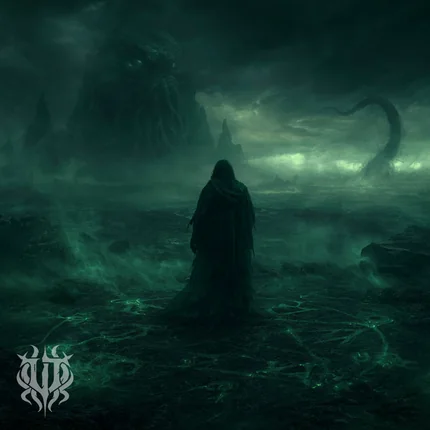
The Dead But Dreaming is a dark folk metal song inspired by The Call of Cthulhu, evoking R’lyeh, forbidden worship and the ancient dream beneath the sea.
References
- Winged Death — original text
The fictional narrative is evidence for what the story says, not proof of events in the real world.
- H. P. Lovecraft Archive — fiction in composition order
Composition dates; question marks and ranges retain the source uncertainty.
- Winged Death — publication data
- World Health Organization — Human African trypanosomiasis
Used only to distinguish the story’s fictionalized biology from the real disease; search-indexed WHO overview checked.
At a glance
H. P. Lovecraft; Hazel Heald
1933
1934, March
Weird Tales, 23, No. 3
Fiction