

Death-fly
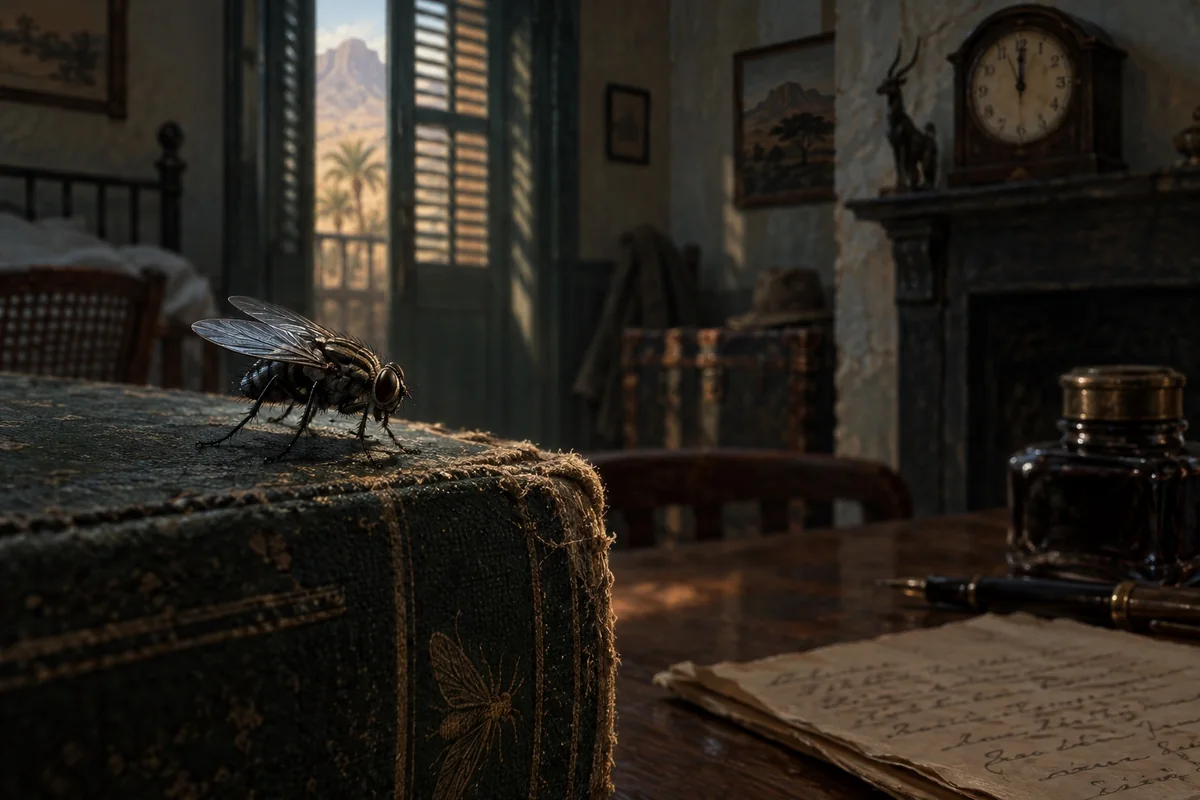
The death-fly in Winged Death is an insect associated with a fictional transfer of consciousness: a person it infects may enter its body after dying. The blue-winged specimen that pursues Thomas Slauenwite appears to carry Henry Moore’s identity before the final transfer reverses their relationship. Its behavior combines the small physical scale of an insect with memory, intention and the ability to communicate.
5 min read · 1,029 words
The tradition heard at M’gonga
In the story by H. P. Lovecraft and Hazel Heald, Slauenwite first hears of the insect through the illness of Mevana. Local accounts describe a wasting sickness followed by the victim's personality passing into the fly, if that insect is still living when the person dies.
Sources: [1]
The physician accepts the possibility of an unusual disease vector while dismissing the claim about consciousness. This division determines his early behavior: he seeks to exploit the dangerous bite without considering the other part of the testimony.
The term death-fly describes the story's creature and tradition. It is not a recognized scientific species name, and the extraordinary mental properties should not be transferred to real flies discussed in medical or entomological sources.
The blue-winged specimens
Slauenwite's fictional research produces specimens he describes as hybrids. Their blue wings are an artificial disguise, intended to prevent his chosen victim, entomologist Henry Sargent Moore, from recognizing their danger.
That appearance later becomes a means of recognition for Slauenwite himself. An insect matching the disguised specimens enters his hotel room after Moore's death. The feature he used to mislead someone else now identifies the apparent return of his crime.
The pursuing creature remains insect-sized. The story does not enlarge it into a physical monster or give it a human face. Its horror depends on what such a small body seems able to remember, plan and express.
Sources: [1]
The evidence from Batta
Before Moore's death, an unusual incident occurs around the fly associated with Batta, one of Slauenwite's earlier victims. As the man dies, the caged insect becomes frantic, then reacts strangely to the physician's presence.
It is later found dead. Slauenwite notices the correspondence with the reported tradition but continues to reject its explanation. No message identifies the consciousness within that particular insect.
The episode is therefore a warning and a parallel, not evidence that the later pursuing specimen is Batta's fly. The journal treats them as separate insects, and the first is already dead before the later pursuit.
Sources: [1]
The apparent return of Henry Moore
A report associates a blue-winged fly with the night of Moore's death. Months later, the insect that torments Slauenwite repeatedly approaches Moore's entomological book, giving its movements an increasingly personal significance.
Its behavior differs from the easy capture Slauenwite expects. It evades blows, avoids preparations he intends as traps and appears to understand the changing obstacles in his room.
When addressed as Moore, it makes a movement Slauenwite interprets as acknowledgment. The journal combines close observation with the observer's uncertainty and fear. The final investigation adds evidence beyond his isolated testimony, but it does not reconstruct the insect's entire journey.
In particular, Slauenwite's speculation about how it traveled from America to Africa remains an attempted explanation. The narrative does not follow the crossing from the insect's viewpoint.
Sources: [1]
Ink, numbers and a clock
The fly uses ink to mark the ceiling, first producing a question mark and then the number five. It also repeats beats and patterned movements corresponding to a decreasing count.
The sequence proceeds through four, three, two and one on successive days. A hotel worker confirms that some ceiling marks physically exist, although that witness does not independently explain their maker.
The insect briefly touches the back of Slauenwite's neck around noon, recalling the reported place and time of Moore's bite. Later it uses the hotel room's clock to focus attention on an approaching hour.
These acts make communication an instrument of torment. The apparent pursuer does not merely attack at the first opportunity; it allows the target to recognize a pattern and anticipate its completion.
Sources: [1]
Pursuit and confinement
Slauenwite changes hotels and cities, but the insect follows him from Johannesburg to Bloemfontein. Attempts to seal openings produce only temporary reassurance.
When he finally barricades himself with delivered supplies, the fly emerges from among the packages. His defensive arrangement has enclosed the pursuer with him.
The incident demonstrates adaptive access within the story, not limitless magical passage through any solid barrier. The narration repeatedly gives small physical routes and opportunities through which the insect can enter or escape.
Its intelligence is extraordinary; its body still occupies space and can carry ink, rest on a surface and be found after death. That combination makes it a physical agent whose behavior exceeds Slauenwite's model of what an insect can do.
Sources: [1]
The final transfer
After Slauenwite dies, investigators find a bite and evidence of infection. The story attributes his immediate death to overwhelming fright rather than the later progress of the illness. The transfer is consequently linked to death itself, not solely to the completion of a prolonged disease.
A coherent ceiling message describes the writer dying and discovering that he now occupies the insect. Its reference to the journal identifies this final consciousness as Slauenwite's. The message then announces the destruction of that remaining existence.
The fly is found dead in a bottle, with ink on its body. Its position and the message imply a deliberate act after the transfer. The narrative does not explain whether Moore's displaced consciousness has ceased, escaped or moved elsewhere.
That omission limits the mechanism. The story supports a particular succession of identities; it does not provide a complete theory of souls, an unlimited capacity to store several people or a general method of resurrection.
Sources: [1]
Mythos background and scientific boundary
The collecting expedition passes ruins associated with the Fishers from Outside and powers named Tsadogwa and Clulu. Local tradition links the site with the dangerous insects, but the exact causal relationship is not established.
The creature can be compared with other fictional means of moving consciousness between bodies. Its conditions differ from the Great Race's reciprocal exchanges and from possession practiced by human occultists. Similar themes do not prove a shared mechanism.
Real human African trypanosomiasis is a parasitic disease transmitted by infected tsetse flies, as the World Health Organization explains. The consciousness-bearing insect and the story's imagined biological operations remain inventions. Its entry belongs to an encyclopedia of fiction, not a zoological catalog.
Related music
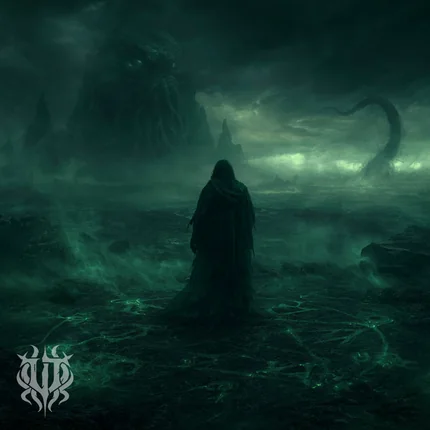
The Dead But Dreaming is a dark folk metal song inspired by The Call of Cthulhu, evoking R’lyeh, forbidden worship and the ancient dream beneath the sea.
References
- Winged Death — original text
The fictional narrative is evidence for what the story says, not proof of events in the real world.
- Winged Death — publication data
- World Health Organization — Human African trypanosomiasis
Used only to distinguish the story’s fictionalized biology from the real disease; search-indexed WHO overview checked.
At a glance
Winged Death
Weird Tales, March 1934
Artificially blue-winged fly
Henry Sargent Moore; later Thomas Slauenwite
Ink marks, patterned movements and a final written message
Supernatural fictional creature; not an identified species