

Charles Stross
Charles Stross combines cosmic horror, espionage, computing and institutional satire in the Laundry Files. His wider fiction includes science fiction and alternate-world narratives. The Laundry’s threatened civil servants, the civilians of the New Management books and the separate story A Colder War represent different ways of bringing Lovecraftian danger into modern political life.
7 min read · 1,303 words
A writer across speculative genres
Stross was born and raised in Leeds. His publisher identifies Edinburgh as his home and lists a bibliography that extends well beyond the Laundry: the Merchant Princes sequence, Accelerando, Glasshouse and Saturn's Children all belong to his broader career. His awards include a Hugo for the Laundry novella Equoid.
That breadth is relevant to his place in weird fiction. The same writer can work with technological speculation, alternative societies and cosmic horror without requiring every fictional setting to share its laws. The Laundry is one sustained imaginative project within that career, rather than a label for everything Stross has written.
The Atrocity Archive and its ingredients
Stross's account of the first Laundry novel describes an intentionally awkward combination: Lovecraftian threats, a secret organization, the atmosphere of Cold War espionage and a computer specialist poorly fitted to his new employment. Bob Howard becomes the point of contact between immense dangers and the mundane frustrations of working inside an institution.
The British thriller writer Len Deighton was a specific influence. Stross was rereading Deighton while the project developed, and the result draws on a world of compromised institutions rather than uncomplicated adventure heroics.
The initial novel appeared serially in Spectrum SF before its book publication. Stross recalls that the mixture of genres made it difficult to market at the beginning of his career. Its eventual success did not depend on removing those conflicting ingredients; their collision became a distinguishing feature.
Sources: Charles Stross — Crib Sheet: The Atrocity Archive(s), 2013
Why the title sometimes has a final s
The Atrocity Archive is the title of the original short novel. The Atrocity Archives is the expanded book containing that narrative and The Concrete Jungle, with introductory and concluding material. The difference is bibliographical, not a pair of unrelated adventures with almost identical names.
The Concrete Jungle won the 2005 Hugo Award for best novella. The book's subsequent editions and the omnibus On Her Majesty's Occult Service further complicate simple lists of titles: the latter combines The Atrocity Archives with The Jennifer Morgue rather than adding a new standalone novel.
For a reader building a collection, contents therefore matter as much as a cover title. A new edition, an omnibus and a new episode occupy different positions in the publication history even when they all appear as separate products in a catalog.
Sources: Charles Stross — The Charles Stross FAQ, historical version
A Colder War is a separate experiment
In a 2013 response to a reader, Stross distinguished A Colder War from the Laundry. He described it as a step in his development of Lovecraftian fiction, sharing some ideas but using a different setting and tone.
A shared interest in intelligence agencies or catastrophic knowledge does not establish that events in one story supply the hidden history of the other. Nor does the recurrence of Mythos vocabulary automatically make two narratives continuous.
The relationship is best understood as the development of an author's approach: political systems and organized power can provide routes into cosmic horror. The separate works explore that possibility under different narrative conditions.
Sources: Charles Stross — Deeply annoying realization, author reply of 16 July 2013
The Jennifer Morgue and the spy-fiction template
The success of the first book, including the recognition received by The Concrete Jungle, helped make a sequel possible. Stross's retrospective identifies the cinematic James Bond as its obvious new point of reference, while noting his own earlier reading of Ian Fleming.
The comic potential lay in placing Bob within expectations associated with Bond. A familiar adventure framework could become an uncomfortable role for a protagonist whose background and habits did not suit it.
This method also explains why the Laundry's humor is more than incidental jokes between monster encounters. Genre expectations become part of the pressure on the characters. The reader's recognition of a convention helps expose the distance between an elegant fantasy of secret service and the particular person trying to survive inside it.
Sources: Charles Stross — Crib Sheet: The Jennifer Morgue, 2013
Bob’s journals and Mo’s perspective
The Annihilation Score shifts attention to Dr. Dominique O'Brien, known as Mo, rather than simply continuing Bob's account. Stross's discussion of the book explains that the series had increasingly become a setting with several possible protagonists.
Bob's first-person narratives are framed as working journals preserved for whoever might inherit his duties. They contain information shaped by his changing knowledge and by his earlier assumptions. Stross acknowledges that inconsistencies helped lead him toward treating Bob as an unreliable narrator.
Mo's difficulties include a dangerous violin and the changes in her husband's powers. Giving her a viewpoint opens aspects of their lives that Bob's account cannot settle. The series consequently asks readers to distinguish the institution's workings, a character's explanation and the larger realities gradually disclosed around them.
Sources: Charles Stross — Crib Sheet: The Annihilation Score, 2016
The New Management and life after the rupture
Dead Lies Dreaming, published in October 2020, begins a successor sequence within the same world. Stross explicitly objected to its initial marketing as simply the tenth Laundry novel. The New Management shifts attention toward civilians living under a changed supernatural and political order.
The Black Pharaoh remains a central feature of that order, but the first books do not follow Bob and Mo on another routine assignment. Their absence is part of the design. The change permits a different social perspective on a world whose crisis cannot be contained inside a secret agency.
The distinction also separates publication order from fictional chronology. The successor sequence began reaching readers before Stross had published the conclusion to the earlier main arc. Reading the books by release date therefore does not produce an uninterrupted march through the setting's calendar.
Sources: Charles Stross — Crib Sheet: Dead Lies Dreaming, 2021
A Conventional Boy and the danger of games
A Conventional Boy appeared in January 2025. Its central figure, Derek Reilly, has spent his adult life confined at Camp Sunshine after the Laundry's response to his youthful involvement in Dungeons & Dragons. He has continued playing and developing a campaign under restrictive conditions.
The impending closure of the camp and the arrival of a nearby gaming convention give him a reason to use an escape plan he has long possessed. The premise joins the historical panic around roleplaying to a fictional world in which imaginative systems can have dangerous consequences.
Stross's later account identifies Derek as an exceptionally useful member of Forecasting Ops: a scenario designer whose gaming background connects with the agency's attempt to anticipate events. The novel was published late in the sequence but takes place earlier than the final main-arc books.
Sources: Charles Stross — A Conventional Boy, 3 January 2025, Charles Stross — Crib Sheet: A Conventional Boy, 2025
The Regicide Report and the completed main arc
The Regicide Report was published in January 2026. Its conflict brings Bob and Mo into a struggle involving Queen Elizabeth II, the Black Pharaoh and rival ambitions within the occult machinery of government. The publisher's account describes the monarch's accumulated supernatural power as a threat to the newly dominant god.
In his August 2026 retrospective, Stross identifies the book as the conclusion of the main Laundry story. He distinguishes that nine-novel arc from shorter works, A Conventional Boy and the New Management sequence. A publisher's larger series number counts a different grouping.
The novel's fictional events belong to 2015, not its real publication year. Its conclusion concerns the old organization and its protagonists; it does not erase the successor books already set in the same world. The later political order remains a separate stage of the setting's history.
Sources: The Regicide Report — Tor Books, Charles Stross — Crib sheet: The Regicide Report, August 2026
Routes into the series
Stross's reading guide offers several starting points: The Atrocity Archives, The Rhesus Chart, The Nightmare Stacks and Dead Lies Dreaming. These enter the world through different characters or phases. A Conventional Boy provides a shorter, largely self-contained alternative.
Starting with The Atrocity Archives preserves the gradual enlargement of Bob's understanding. Starting with Dead Lies Dreaming foregrounds life under the New Management. Those are different reading experiences, even though both lead into the same broader setting.
For this encyclopedia, Stross connects most directly with cosmic horror, science and forbidden knowledge, institutional secrecy, humor and roleplaying. His invented supernatural explanations belong to his own fiction. They should not be used to retroactively define how magic or mathematics must operate in Lovecraft's stories.
Sources: Charles Stross — The Laundry Files: an updated chronology
Related music
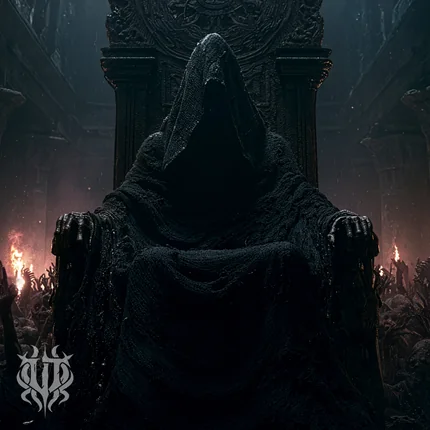
A Thousand Masks is a dark metal song inspired by Nyarlathotep, the Crawling Chaos who walks among humanity, hiding behind countless faces and whispered lies.
References
- Charles Stross — Macmillan author profile
- Charles Stross — Crib Sheet: The Atrocity Archive(s), 2013
- Charles Stross — The Charles Stross FAQ, historical version
Used for the distinction between the original novel and the expanded book, not its outdated forthcoming titles.
- Charles Stross — Deeply annoying realization, author reply of 16 July 2013
The cited clarification is Stross’s own response, not a reader’s comment.
- Charles Stross — Crib Sheet: The Jennifer Morgue, 2013
- Charles Stross — Crib Sheet: The Annihilation Score, 2016
- Charles Stross — Crib Sheet: Dead Lies Dreaming, 2021
- Charles Stross — A Conventional Boy, 3 January 2025
- Charles Stross — Crib Sheet: A Conventional Boy, 2025
- The Regicide Report — Tor Books
- Charles Stross — Crib sheet: The Regicide Report, August 2026
Used for the published conclusion and fictional chronology; unrelated historical and medical assertions are not adopted.
- Charles Stross — The Laundry Files: an updated chronology
Entry points are used; superseded predictions are not treated as publication evidence.
At a glance
Born 1964
Later Mythos
The Laundry Files
The New Management
The Regicide Report (January 2026)
A Colder War