

Games and the Mythos
Games adapt the Mythos by giving participants choices, procedures and possible outcomes. Tabletop roleplaying, cooperative board games, campaign card games and digital adventures do this in different ways. Their investigators, rules and scenarios form important later traditions, while remaining distinguishable from the events and descriptions in Lovecraft’s fiction.
5 min read · 939 words
From a discovered record to a playable situation
The Call of Cthulhu reconstructs its catastrophe through papers and reports. The reader follows the order established by the narrator, learning how apparently separate incidents connect. A game must also decide what happens when its participants pursue one lead before another or fail to interpret a discovery as expected.
That change creates a new kind of authorship. Designers establish situations and procedures; players contribute decisions within them. A session's events can therefore be meaningful without being a retelling of a published literary plot. The resulting story is one outcome of play, not an addition Lovecraft secretly left to be recovered.
Roleplaying systems make different promises
Call of Cthulhu and Trail of Cthulhu both support investigation, but their procedures should not be collapsed into one generic system. The linked articles explain their respective approaches to uncertainty, information and consequences.
A useful general distinction is between obtaining evidence and interpreting it. GUMSHOE design guidance separates clues from leads: some information explains a mystery, while other information points toward further investigation.
This is why automatic access to an essential clue does not necessarily eliminate suspense. It can provide the means to move into a more dangerous situation. Different games distribute the risks of ignorance, action and resource expenditure differently.
Delta Green and the cost of returning home
Delta Green presents a world of contemporary-seeming institutions, secrecy, conspiracy and cosmic horror. Its official introduction emphasizes agents whose efforts against the unnatural damage their ordinary relationships.
The Bonds system makes those connections part of the game's dramatic structure. A threatened marriage or lost friendship can matter alongside the immediate outcome of an operation. The horror extends beyond what an agent sees in a forbidden room to what that encounter makes of the life outside it.
This broad premise marks a distinct interpretation of Lovecraftian vulnerability. It does not require every scenario to repeat the period setting of a 1920s story. Nor should its organizations and operational history be imported into the original fiction as if Lovecraft had described them.
Arkham Horror as a cooperative board game
Arkham Horror Third Edition organizes its investigations around scenarios, a modular city and evolving narrative instructions. Its publisher describes archive cards entering a codex as events and decisions change the situation. The participants may discover their larger objective through play instead of beginning with a fully known route to victory.
The game supports one to six players. Individual investigators have distinct abilities and starting equipment, while the round structure divides opportunities to act from the movement of threats and the arrival of further events.
For comparison with literature, the important feature is that Arkham becomes a shared field of action. The city is not simply background for one narrator. Several characters can address different pressures at once, and the rules coordinate the consequences.
A card game that remembers earlier decisions
Arkham Horror: The Card Game is a cooperative Living Card Game for one to four investigators. Its defining emphasis is the campaign: choices and consequences can persist between scenarios instead of disappearing when an individual session ends.
Fantasy Flight's 2016 design account gives a concrete example. A decision about whether to burn a house in The Gathering affects the world encountered in The Midnight Masks. A campaign log records results, and experience can be used to develop an investigator's deck. Progress can coexist with lasting damage.
The design therefore gives continuity a material form in cards and written records. Success is not always reducible to one binary result. An investigator may learn more and acquire better tools while carrying an additional burden into the next encounter.
Sources: Fantasy Flight Games — Arkham Horror: The Card Game, Fantasy Flight Games — Uncovering the Truth, 7 September 2016
Eldritch Horror and the world map
Eldritch Horror expands cooperative investigation to a global scale, with support for one to eight players. The publisher describes travel, encounters and mysteries associated with a selected Ancient One. The map and transport-themed components make movement between distant places a central practical concern.
Different encounters can produce restrictions, injuries or obligations represented by Condition cards. The Mythos deck introduces further pressure as investigators try to solve the required mysteries. The narrative emerges through the interaction between an urgent objective and the consequences of the route taken toward it.
This is a game-specific model of world-spanning danger. Its victory conditions and assigned effects should be described as rules of Eldritch Horror, rather than as universal laws governing every literary appearance of the same named entity.
Cyanide’s Call of Cthulhu and a distinct digital story
Focus Entertainment's record identifies Cyanide Studio as developer of the Call of Cthulhu video game released on 30 October 2018. Its premise sends investigator Pierce to Darkwater Island in 1924 to investigate the deaths of the Hawkins family.
The publisher emphasizes investigation, choices and uncertainty about the protagonist's perceptions. This establishes the game's narrative premise and intended experience, without providing a complete walkthrough or evidence for every possible ending.
The shared title needs care in a reference work. Lovecraft's story, Chaosium's tabletop game and Cyanide's digital adventure are separate works with separate credits and plots. A link labeled only Call of Cthulhu should make clear which one a reader is about to open.
Why numerical lore needs a medium label
The examples above turn atmosphere into concrete decisions: preserving a relationship, choosing an action, spending a resource, following a lead or accepting a lasting consequence. Numbers and categories make those decisions manageable within a designed system.
That practical role does not make a statistic the final literary definition of a creature or book. A Mythos encyclopedia can record game interpretations alongside fiction while identifying the originating game and edition. The cross-reference then explains a relationship instead of quietly substituting one medium's assumptions for another's.
Sources: Delta Green Partnership — Delta Green, Fantasy Flight Games — Arkham Horror Third Edition, Fantasy Flight Games — Eldritch Horror
Related music
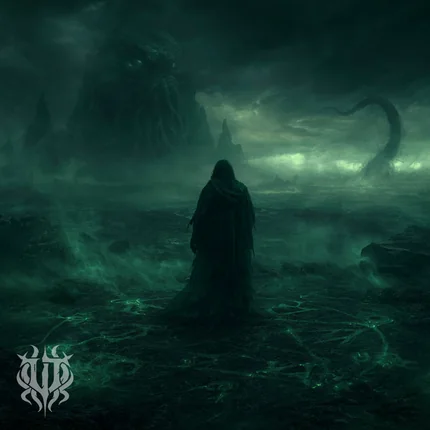
The Dead But Dreaming is a dark folk metal song inspired by The Call of Cthulhu, evoking R’lyeh, forbidden worship and the ancient dream beneath the sea.
References
- The Call of Cthulhu — Unspeakable Tales ebook
The fictional narrative is evidence for what the story says, not proof of events in the real world.
- Gareth Ryder-Hanrahan — Clues vs. Leads
- Delta Green Partnership — Delta Green
- Fantasy Flight Games — Arkham Horror Third Edition
- Fantasy Flight Games — Arkham Horror: The Card Game
- Fantasy Flight Games — Uncovering the Truth, 7 September 2016
- Fantasy Flight Games — Eldritch Horror
- Focus Entertainment — Call of Cthulhu
At a glance
Adaptation overview