

Cults and rituals
Cults and rituals in Lovecraftian fiction connect human communities with powers they understand only partly. Worship may preserve knowledge, organize coercion, negotiate material benefits or maintain contact with a dangerous presence. The individual stories give these activities different institutions and consequences, from the dispersed Cthulhu tradition to the local power of the Esoteric Order of Dagon.
5 min read · 949 words
Worship as a means of preserving a past
In The Call of Cthulhu, the cult's significance extends beyond the people encountered by Legrasse. The testimony of Castro describes a tradition that remembers powers and conditions older than ordinary historical records.
The idol and repeated chant allow investigators to connect episodes separated by place and time. Similarity becomes evidence of transmission, even though the exact routes by which the knowledge spread remain obscure.
The cult is therefore an archive as well as a group of worshippers. Its practices preserve a relationship to an ancient past, but the reader receives much of that relationship through testimony rather than direct access to every community that maintains it.
The limits of the Cthulhu cult’s visible organization
The Louisiana gathering is a concrete local event investigated by police. The wider organization is described through a mixture of captive testimony and reports brought together later by the narrator.
These levels should remain distinct. The existence of a dispersed tradition does not supply an independently verified list of all its leaders, a headquarters that controls every participant or a complete uniform ritual manual.
The story's power partly comes from what the investigators cannot delimit. They discover enough repetition to suspect continuity across immense distances, while lacking the evidence needed to map the whole network.
The Esoteric Order of Dagon
The Shadow over Innsmouth presents a more locally entrenched institution. Zadok Allen's account connects Obed Marsh's voyages and bargains with the town's altered prosperity, religious life and population.
Gold and abundant fishing give the relationship a material attraction. The obligations attached to those benefits extend into worship, oaths and reproduction. The Order occupies a recognizable place within the town's civic landscape rather than appearing only as a secret ceremony in remote woods.
The narrator initially encounters its influence indirectly, through the town's reputation, buildings and reluctant informants. Zadok's testimony then supplies a history of coercion and upheaval that helps explain the social order visible during the visit.
Sources: The Shadow over Innsmouth — Unspeakable Tales ebook
A bargain can reshape a community
Innsmouth makes the consequences of worship cumulative. A decision associated with Obed Marsh reaches later generations through institutions, family relationships and biological change.
The costs are unevenly distributed. Some inhabitants profit or belong; others are threatened, silenced or displaced. The narrator's own eventual discovery of kinship makes him part of a history he first regarded as external.
This distinguishes the town from a scene in which a temporary gathering merely summons a monster. The cultic relationship has become part of how the community reproduces itself and explains its future.
Sources: The Shadow over Innsmouth — Unspeakable Tales ebook
Starry Wisdom and the dangerous object
The Haunter of the Dark places the remains of the Starry Wisdom sect in an abandoned church. A collection of forbidden books, a marked notebook and the Shining Trapezohedron connect the building's past with Blake's investigation.
The object's use permits contact with a presence associated with the surrounding darkness. Light and the urban environment become practical conditions in the later emergency. Blake's curiosity reactivates a relationship whose earlier participants are no longer assembled in the building.
The episode shows that a cult can leave an operative infrastructure behind it. Its surviving artifacts and records can expose a later visitor without the visitor deliberately joining the former congregation.
Invocation, offering and exchange
Ritual action has several functions across the stories. A spoken formula can establish contact; an offering can maintain a relationship; a repeated rite can bind participants to a shared institution.
In The Door to Saturn, Eibon's offerings to Zhothaqquah are part of a durable association that brings information and assistance. In The Seven Geases, a human offered to Tsathoggua is refused because the deity has already eaten, then redirected to other inhabitants of the underworld.
These examples make divine response contingent. A ritual may reach its intended recipient without producing the exact outcome its human organizer expects. The other party has interests and circumstances of its own.
Sources: Clark Ashton Smith — The Door to Saturn (1932), Clark Ashton Smith — The Seven Geases (1934)
Religious authority can belong to the persecutor
Morghi's pursuit of Eibon reverses the easy assumption that the dangerous institution must always be the forbidden cult. The high priest of Yhoundeh possesses an apparatus capable of imprisoning and torturing a rival magician.
Eibon escapes through the aid of the disfavored deity. On Cykranosh, the two men encounter communities whose religious practices differ from those of their homeland. Morghi eventually finds a new priestly position but cannot establish an inquisition among the tolerant Ydheems.
Smith uses these contrasts to satirize institutional power. The presence of real gods in the fiction does not automatically justify the conduct of every priest who invokes them.
Records and witnesses
The cultic past frequently reaches the reader through an interested or damaged channel. Castro speaks as a captive believer, Zadok as a frightened survivor, and Blake works with documents he has only partly deciphered.
The reliability of a detail can therefore depend on its source within the narrative. A witness may accurately describe a building or an event while interpreting its cosmic significance through a belief that the reader cannot independently confirm.
Source-aware entries preserve these differences. They can state that an oath, sacrifice or bargain is reported without inventing its complete wording or claiming a level of certainty beyond the scene.
Sources: The Call of Cthulhu — Unspeakable Tales ebook, The Shadow over Innsmouth — Unspeakable Tales ebook, The Haunter of the Dark — Unspeakable Tales ebook
Literary cults and real communities
These groups are fictional institutions. The stories often place them beside prejudicial descriptions of actual ethnic, religious or rural populations. The invented supernatural events do not substantiate those descriptions as anthropology.
For this encyclopedia, the useful object of study is the narrative: who performs the rite, what is offered or demanded, how authority is maintained, and what evidence remains afterward. That approach allows detailed discussion of the mythology while keeping the authors' historical attitudes visible as attitudes.
Sources: The Call of Cthulhu — Unspeakable Tales ebook, The Shadow over Innsmouth — Unspeakable Tales ebook
Related music
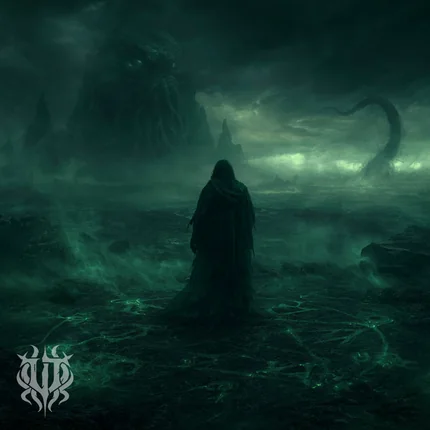
The Dead But Dreaming is a dark folk metal song inspired by The Call of Cthulhu, evoking R’lyeh, forbidden worship and the ancient dream beneath the sea.
References
- The Call of Cthulhu — Unspeakable Tales ebook
The fictional narrative is evidence for what the story says, not proof of events in the real world.
- The Shadow over Innsmouth — Unspeakable Tales ebook
The fictional narrative is evidence for what the story says, not proof of events in the real world.
- The Haunter of the Dark — Unspeakable Tales ebook
The fictional narrative is evidence for what the story says, not proof of events in the real world.
- Clark Ashton Smith — The Door to Saturn (1932)
Original story; the host identifies these texts as believed to be in the public domain.
- Clark Ashton Smith — The Seven Geases (1934)
Original story; the host identifies these texts as believed to be in the public domain.
At a glance
Comparison of fictional practices in primary sources
Contact; exchange; preservation; obligation; authority
Cthulhu cult; Esoteric Order of Dagon; Starry Wisdom
Scenes, testimony, surviving objects and documents