

Dagon
Dagon connects Lovecraft’s early nightmare of an exposed ocean floor with the later religion of Innsmouth. The name has a real ancient history, but the giant seen in the 1917 story, the figure Father Dagon and later visual interpretations should be distinguished rather than merged without qualification.
6 min read · 1,190 words
The early story and its publication
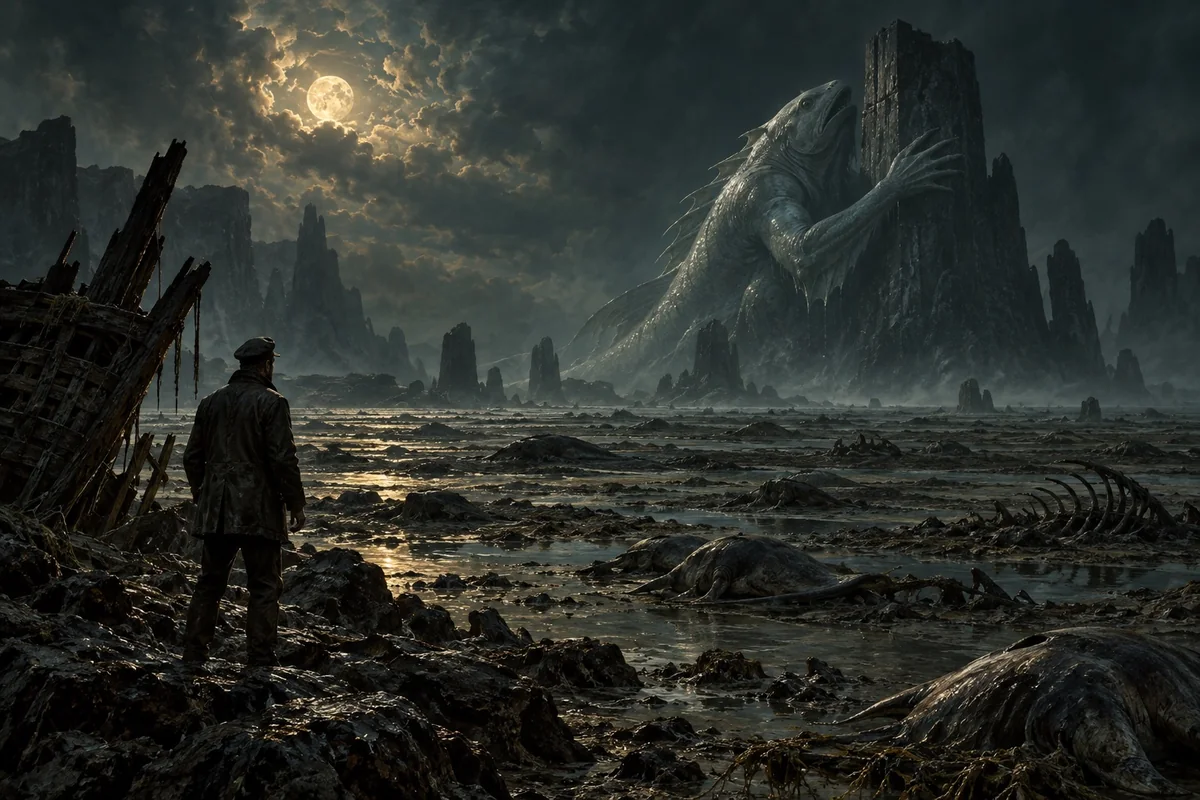
Lovecraft wrote Dagon in July 1917, and The Vagrant published it in November 1919. The story follows a sailor who escapes wartime captivity and drifts into an apparently impossible marine landscape. Its creature is encountered near a monumental stone structure on land that the narrator believes has recently risen from the sea.
The title supplies the name Dagon, and the narrator later asks an ethnologist about the ancient fish-god tradition. During the encounter itself, however, the creature does not identify itself and the sailor does not possess an inscription he can translate as its name. The association is part of his effort to interpret what he has seen. Calling the figure the Dagon creature is a practical reference convention; calling its exact identity a demonstrated fact goes farther than the narrative.
The exposed sea floor
The narrator awakens beside his grounded boat in an enormous expanse of black mud strewn with the remains of marine life. He concludes that an unprecedented upheaval has exposed part of the ocean bed. Silence, distance and the absence of familiar signs of rescue make the place threatening before any living monster appears.
After the surface dries enough to cross, he moves toward a distant rise and eventually discovers a deep channel beyond it. The scale defeats ordinary expectations: what seemed a modest landmark proves larger than it first appeared, and the newly visible terrain suggests an age and history far outside human settlement.
The landscape is not called R’lyeh in this story. It anticipates later uses of exposed submarine architecture, but the shared motif does not prove that the sailor and Johansen visit the same city. Its actual documented features are the mud plain, the height, the channel and the monolith.
Sources: [1]
The monolith and its carvings
Moonlight reveals a great worked stone on the opposite side of the channel. Its form and position persuade the narrator that it is a product of intelligence. Carved aquatic signs and large scenes imply a culture existing in the depths. Some represented sea life resembles the unfamiliar remains he has passed on the plain.
The depicted beings are broadly human-like in arrangement but have webbed hands and feet, wide mouths and bulging eyes. They swim or perform acts of homage around submerged structures. One figure appears in relation to a whale at a scale the narrator initially treats as artistic distortion. That attempt to explain the size prepares for the appearance of a living presence large enough to make the images newly plausible.
The monument therefore does two jobs. It offers evidence of a civilization and gives the observer an interpretation he can still try to keep at a safe historical distance. The encounter that follows breaks that distance: what he has considered a product of a vanished people’s imagination may belong to something still active.
Sources: [1]
The creature’s actions
A vast being rises from the channel and moves toward the monolith. It embraces the stone with immense scaly arms, bows its head and produces measured sounds. The behavior resembles an act of reverence or ritual. The sailor witnesses it rather than receiving a direct attack at this point.
That distinction matters for identity. A creature honoring a sacred structure might be a worshipper rather than the deity represented by the story’s title. The narrative leaves that possibility open. Its size, its relation to the carvings and its continued life beneath the sea are established more directly than its precise place within a religion.
The encounter destroys the narrator’s ability to maintain an orderly account of the return journey. He remembers flight, distress and a later storm, then recovers in a San Francisco hospital after rescue. No companion has seen the monolith with him, and the rescuers know nothing of the temporary land. His strongest experience remains difficult to corroborate.
Sources: [1]
The final fear and the possibility of a wider population
The narrator’s later suffering includes recurring visions, dependence on morphine and an announced intention to end his life. He considers whether fever and exposure could explain the experience, but cannot make that explanation displace its vividness. The story ends with a sound at the door and a final perception of a hand, leaving the immediate event within his collapsing account.
His terror extends beyond one creature. He imagines beings continuing to carve, worship and live beneath the ocean, and fears a reversal in which their world rises while the human world is overwhelmed. The threat is a change of planetary dominance rather than merely a monster entering one room.
These fears are narrated as fears. The story does not subsequently show the predicted global event taking place. The ending’s force depends on the mismatch between the small scale of the survivor’s remaining life and the immense possibility he believes he has glimpsed.
Sources: [1]
Father Dagon and the religion of Innsmouth
The Shadow over Innsmouth later uses Dagon in a more developed social setting. The Esoteric Order of Dagon occupies an important place in the town, and Zadok Allen’s account connects its oaths with the bargain made through Obed Marsh. Father Dagon and Mother Hydra appear in the religious language of the sea people and their human descendants.
The narrator eventually learns of an underwater future connected with Y’ha-nthlei. Here the marine world has family relationships, a long-lived population, material culture and an institution operating on land. That is more extensive evidence than the isolated sighting in the earlier tale.
The later story does not provide a direct statement that the 1917 narrator saw Father Dagon personally. Nor does it establish that Dagon and Cthulhu are identical. Their names can appear within the same religious complex while remaining distinct. The appropriate cross-link is a relationship of marine imagery and cultic development, with the source of each claim made explicit.
The historical name
Dagan or Dagon belongs to ancient Near Eastern religion independently of Lovecraft. Modern historical reference distinguishes that deity from the later fish-god interpretation: ORACC identifies the fish association as erroneous and discusses a possible connection of the name with grain. The simplified fish-god account available in older literature is therefore not a sufficient modern description of the ancient religion.
Lovecraft’s narrator explicitly invokes the fish-god tradition while searching for an explanation. That is evidence for the story’s imaginative background, not confirmation that the historical deity was an actual underwater being. Keeping the historical and fictional records separate makes the borrowed name more informative rather than less mysterious.
Adaptation and visual interpretation
A visual treatment of the early scene can emphasize a vast marine being, a worked monolith, moonlight and newly exposed oceanic terrain. Specific additional features should be marked as artistic interpretation. The source gives enough to construct a powerful scene without borrowing Cthulhu’s wings and tentacled face merely because the two names are often discussed together.
The film Dagon (2001) uses the name for an adaptation principally connected with The Shadow over Innsmouth. Its individual article distinguishes that relationship from a direct screen retelling of the solitary sailor’s story. A title can preserve the marine association while the plot, characters and setting come mainly from another work.
Related music
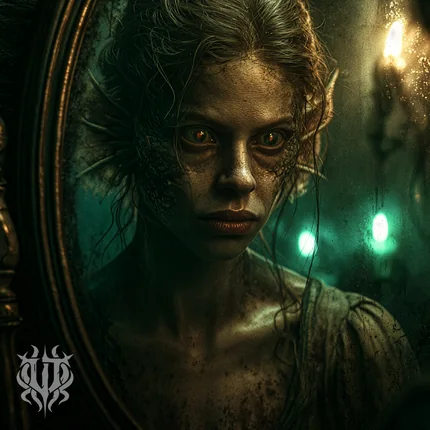
The Esoteric Order of Dagon is a dark metal descent into the world of Innsmouth, where ancient bloodlines, forgotten covenants and the call of the sea endure through countless generations.
References
- Dagon — Unspeakable Tales ebook
The fictional narrative is evidence for what the story says, not proof of events in the real world.
- H. P. Lovecraft Archive — fiction in publication order
First publication dates and venues; issue dates can differ from actual release dates.
- H. P. Lovecraft Archive — fiction in composition order
Composition dates; question marks and ranges retain the source uncertainty.
- The Shadow over Innsmouth — Unspeakable Tales ebook
The fictional narrative is evidence for what the story says, not proof of events in the real world.
- ORACC — Dagan in ancient Mesopotamian religion
Distinguishes the ancient deity from later fish-god interpretations and Lovecraft’s fiction.
- Dagon (2001) — credits, synopsis and release history
At a glance
H. P. Lovecraft; using an older divine name
July 1917
November 1919 · The Vagrant
Exposed ocean floor; channel; worked monolith
Father Dagon in The Shadow over Innsmouth
Esoteric Order of Dagon
The giant at the monolith is not explicitly named during the encounter