

Gugs
Gugs are gigantic, black-furred inhabitants of the underworld in The Dream-Quest of Unknown Kadath. Formerly dwellers in the enchanted wood, they were banished after an unspecified abomination offended the gods of Earth. Their city, cemetery, hunting grounds and guarded route to the surface form a dangerous obstacle in Randolph Carter’s journey. Their anatomy and behavior are described unusually concretely, while the offense that caused their exile remains concealed.
6 min read · 1,161 words
Banishment from the enchanted wood
Before their exile, the gugs built stone circles in the enchanted wood and sacrificed to the Other Gods and Nyarlathotep. One particularly dreadful act came to the attention of Earth’s gods, who drove them into the caverns below. The narrative never identifies the exact act. Its secrecy distinguishes the general account of their worship from the particular offense that brought punishment.
Sources: [1]
The gugs formerly ate mortal dreamers. Their descendants or surviving community retain legends of that food, but confinement has forced them to subsist on creatures available underground. Their history explains why Carter’s human identity would be especially dangerous if discovered.
This account also places them within the Dreamlands’ unequal divine order. Worship of the Other Gods does not prevent Earth’s gods from imposing a prohibition in this instance. The episode is a particular narrated punishment, not a complete statement of the powers of every deity.
Body and distinctive anatomy
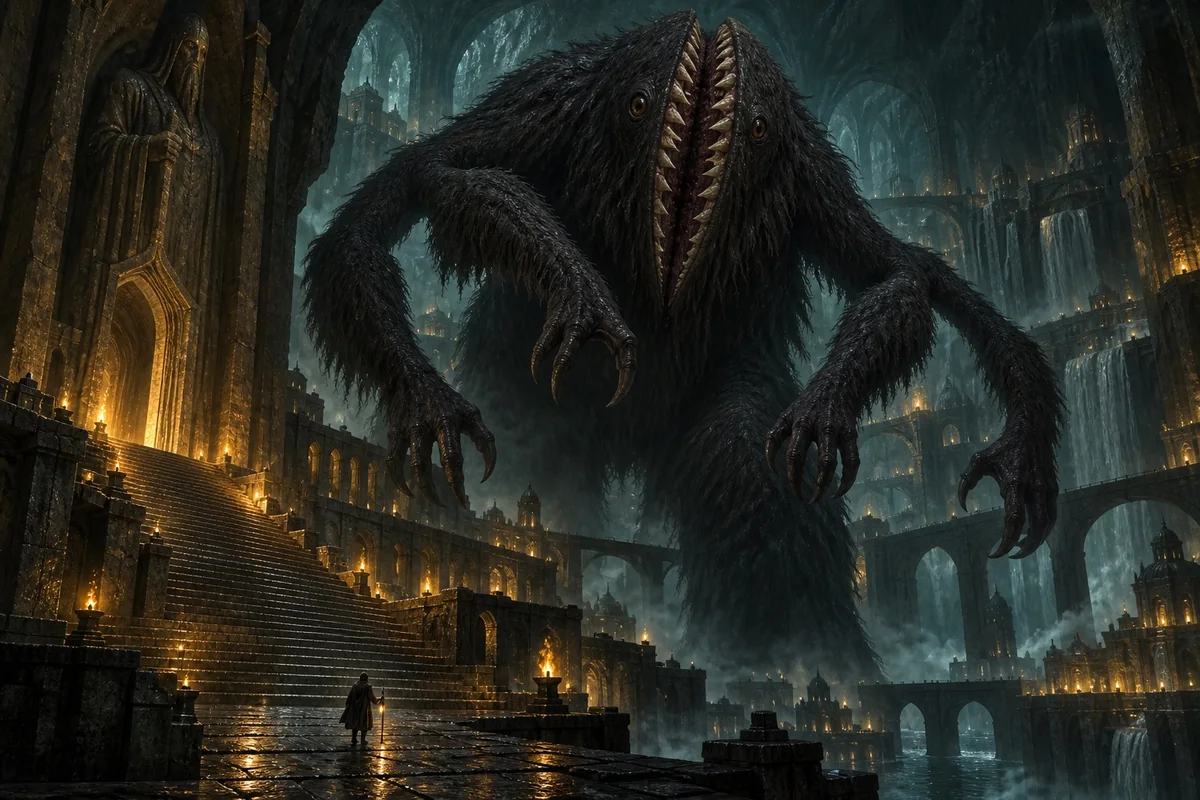
The sentry Carter observes would stand approximately twenty feet tall when fully upright. Its fur is black, and its huge head is compared in size to a barrel. The most striking feature is a mouth running vertically along the head, filled with large yellow fangs. The opening is not an ordinary horizontal jaw enlarged to monstrous proportions.
Each great arm divides into short forearms bearing separate taloned paws. The first paw emerging from the cavern is about two and a half feet across. The divided limbs supply the familiar four-handed appearance associated with gugs, but the arrangement differs from four unrelated arms attached separately to a torso.
Two pink eyes project from the sides of the head. Hair-covered bony structures partly shelter them. These lateral eyes and the vertical mouth make the head unlike a human or ape face despite the creature’s fur and broadly upright stature.
The measurements belong to the observed sentry. They provide a useful sense of scale without establishing that every gug has precisely identical dimensions.
Sources: [1]
Communication and senses
Gugs do not speak with a voice. Pickman’s ghoul guides explain that they communicate through facial expression. This fact initially reassures Carter when the sentry is attacked: it cannot simply shout an alarm to the sleeping city.
Voicelessness does not mean that a gug produces no sound at all. The narrative describes the sleeping inhabitants’ muffled snortings and later a panting presence beneath the trapdoor. Their bodies and movements remain audible under some conditions.
They possess acute hearing and are accustomed to seeing in darkness while hunting. Those capacities make the ascent of the Tower of Koth especially dangerous. Carter and his companions might be detected by small noises long before they can see a pursuer, while the giant steps favor the creatures for whom the tower was built.
Sources: [1]
The city and its cemetery
The gug kingdom is effectively coterminous with its immense city. Rounded stone towers rise into the twilight of the inner Earth, and doorways thirty feet high mark architecture built on a scale alien to Carter’s body. Even an urgent passage through its streets takes considerable time.
The cemetery stands among vast upright stones. Monoliths that appear monumental to a human are ordinary grave markers for the inhabitants. Carter’s experience of the place therefore depends on a continual adjustment of scale: graves, streets, doors and stairs all imply the bodies that use them.
Ghouls burrow into the cemetery to feed on dead gugs. A single buried giant can sustain a community for almost a year, making the danger worthwhile. This practice explains the enormous bones Carter has encountered farther below in the Vale of Pnath.
Sources: [1]
Hunting ghasts in the Vaults of Zin
The Vaults of Zin contain the ghasts that now form the gugs’ food supply. A sentry guards a narrow point, limiting their movement from the deeper darkness toward the city. The arrangement is imperfect because the guard can fall asleep.
Ghasts are not helpless livestock. They are dangerous hunters in their own right and seize opportunities to attack gugs. Their ability to tolerate the underworld’s gray twilight for hours allows them to leave the deeper vaults even though genuine daylight would kill them.
The relation is consequently a violent ecological contest. The larger creatures hunt the smaller ones, but numbers, confined space and the timing of an encounter can reverse the advantage.
Sources: [1]
The attack on the sentry
Carter and three ghoul escorts reach the cemetery while the city is asleep. A group of ghasts emerges from the cavern. The guides initially wonder whether the animals have fought the sentry, but their uninjured condition suggests that they slipped past it instead.
When the guard wakes and begins to crawl out, the ghasts attack before it can straighten to its full height. They bite and strike with pointed hooves, while its vertical mouth catches some of them in return. The fight moves back into the cavern as the sentry weakens.
That retreat keeps the noise from awakening the city and gives Carter’s party its chance. They pass through the streets under cover of the conflict. The escape depends on observing the inhabitants’ relationships and exploiting an accident, rather than on defeating the gugs in combat.
Sources: [1]
The Tower of Koth and the sealed exit
At the city’s center stands a tower larger than the rest, marked above its doorway with the sign of Koth. Inside, a long stairway rises toward the stone trapdoor in the enchanted wood. The steps are nearly a yard high, exhausting Carter and obliging the ghouls to assist him.
The divine curse prevents gugs from opening the final door and emerging into the upper world. It does not forbid entry into the tower or pursuit along the stairs. Escaped ghasts may be chased almost to the top, so approaching the exit offers no immediate safety.
Carter’s guides use a stolen human gravestone as a weapon against a ghast and then as a lever for the heavy door. A disturbance below forces all three to escape with him instead of returning through the city as originally planned. Once the stone closes, the prohibition protects them from the pursuer beneath.
Sources: [1]
Fear of ghouls and its practical limits
The gugs are said to fear ghouls and may leave their own cemetery when feeding parties appear. Pickman advises Carter to imitate a ghoul’s appearance and gait, hoping that disguise will make him less attractive as prey.
This advantage is conditional. On the narrow stairway, with darkness and long strides favoring a gug, the guides cannot rely on traditional fear to protect them. Their own behavior shows that they regard the pursuit as a mortal threat.
The episode makes the underworld more than a sequence of interchangeable monsters. Ghouls can be allies, gugs can be powerful yet afraid, and ghasts can endanger both. Carter survives by understanding those differences and accepting help from beings he still finds repellent.
Sources: [1]
References
- The Dream-Quest of Unknown Kadath — original text
The fictional narrative is evidence for what the story says, not proof of events in the real world.
At a glance
The Dream-Quest of Unknown Kadath
A subterranean city and the approaches to the Vaults of Zin
About twenty feet, for the sentry
Facial expression; no speaking voice
Mortal dreamers
Ghasts
The Great Ones’ curse prevents emergence through the trapdoor