

Dreamlands
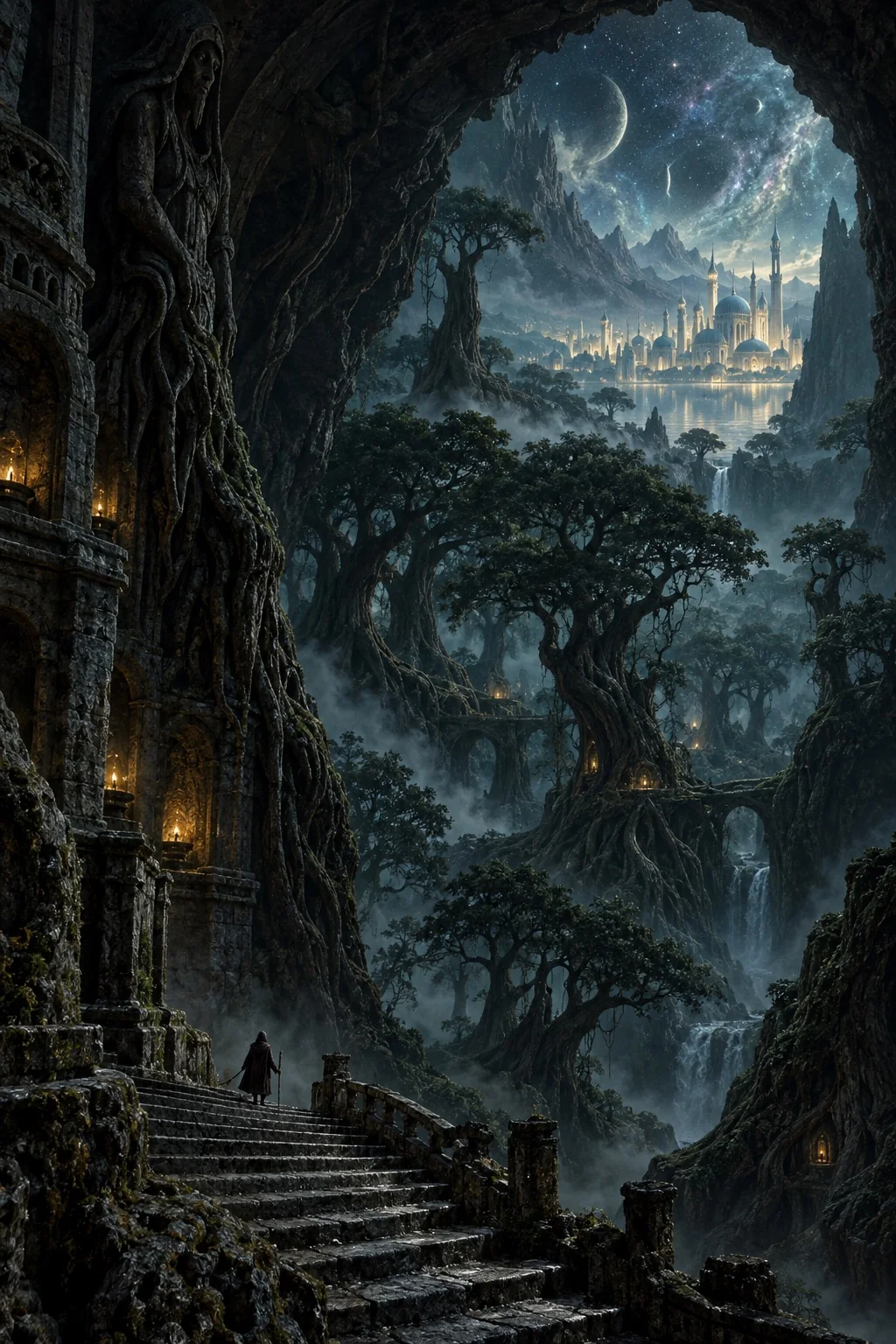
The Dreamlands are the interconnected dream regions most extensively explored in The Dream-Quest of Unknown Kadath. They include inhabited towns, agricultural country, seaports, divine mountains, underground territories and routes beyond the earth. Lovecraft presents both shared places known to many travelers and landscapes shaped by particular dreamers, leaving their relationship richer and less systematic than a single fixed fantasy map.
7 min read · 1,342 words
A shared world and individual visions
Carter's quest begins with a city that he has seen three times but cannot revisit. Other people know the ordinary geography through which he travels, yet cannot identify this particular vision. Atal considers whether it belongs to Carter's personal dream-world rather than the general region familiar to other dreamers.
The distinction is important. The story does not reduce every location to Carter's private invention, nor does it treat every dream as a journey through one universally mapped territory. Shared settlements coexist with places whose origin lies in an individual's memory and desire.
The priests Nasht and Kaman-Thah also contemplate dreamlands associated with other worlds. Their warning places the earth's dream region within a larger, dangerous possibility of travel, without supplying a complete cosmological atlas.
Entering deeper sleep
At the beginning of The Dream-Quest of Unknown Kadath, Carter descends seventy steps in light slumber to the cavern of flame. There he consults the two priests before continuing down seven hundred steps to the Gate of Deeper Slumber.
Beyond the gate lies the enchanted wood of the zoogs. This route establishes a sequence of thresholds in Carter's journey: consultation precedes entry, and greater depth of sleep corresponds to movement into a more extensive landscape.
The sequence belongs to this narrated journey. It should not be presented as a real technique for reaching another world or as the sole mechanism by which every character in Lovecraft's dream fiction enters a dream setting.
The enchanted wood and its borders
The zoogs inhabit burrows and hollow trees beneath enormous oaks. Carter can speak their language and has made agreements with them, allowing him to obtain information that would not be available to an unprepared traveler.
The wood touches the waking world at two locations that the narrative leaves undisclosed. The zoogs can cross in limited ways, providing a reason for some unexplained disappearances and rumors among waking people. The precise geography of those contacts remains concealed.
Older stone circles and a great slab with an iron ring suggest powers that predate the current inhabitants. The zoogs themselves avoid some of these places. Familiarity with a territory therefore does not mean its residents control everything below it.
Farms, towns and practical travel
Beyond the forest, Carter encounters farms, roads, hedges, bridges and ordinary hospitality. Nir and Ulthar stand in country linked by the river Skai. These inhabited places have local customs, occupations and histories rather than functioning only as spectacular scenery.
Ulthar's law protecting cats is particularly consequential because Carter's kindness and familiarity with the animals later bring aid. Knowledge of local relationships can be more useful than force. Priests, innkeepers, sailors, merchants and animals each contribute different parts of the traveler's route.
Travel also takes time. Carter joins a caravan, waits for ships and gathers directions from people whose expertise is limited to particular roads or coasts. The dream setting permits extraordinary movement without eliminating delays, uncertainty or the need for reliable guides.
Ports and connected economies
Dylath-Leen links the Skai country to the Southern Sea. Ulthar sends agricultural and textile goods toward the port; ships from Baharna bring resin, pottery and objects carved from Oriab's lava. The routes make distant settlements economically interdependent.
Trade also carries danger. The black galleys bring exceptional rubies while concealing their crews and participating in the purchase of enslaved people. The port's willingness to tolerate them reveals a moral compromise within the apparently ordinary business of exchange.
Carter's journey repeatedly depends on the difference between a trustworthy passage and a deceptive one. A vessel can be a means of exploration, a commercial link or an instrument of captivity, and its destination may lie beyond terrestrial waters.
Divine territories and unequal powers
Earth's gods inhabit Kadath but revisit mountains associated with their earlier life. Their withdrawal from accessible peaks gives the landscape a history of contact and avoidance. Hatheg-Kla and Ngranek retain particular signs of that history.
Atal distinguishes the relatively limited gods of earth from the greater Other Gods who protect them. Barzai's fate illustrates how confidence based on knowledge of the lesser powers can fail when the larger relationship becomes active.
Nyarlathotep operates as messenger and agent of the Other Gods and intervenes directly in Carter's quest. This arrangement should not be flattened into a list of equally powerful rulers, or into a universal hierarchy automatically governing every later Mythos work.
Sources: The Dream-Quest of Unknown Kadath — original text, The Other Gods — Unspeakable Tales ebook
The underworld and its inhabitants
Carter's descent below the surface brings him into regions associated with ghouls, gugs, ghasts and dholes. The Vale of Pnath, gug city, Vaults of Zin and Tower of Koth belong to a connected but hazardous underground route.
These populations have different habits and relations. Ghouls can communicate and guide; gugs hunt ghasts; ghasts exploit opportunities during the gugs' sleep. The underworld has its own patterns of predation and passage rather than being a single undifferentiated realm of monsters.
Pickman's presence connects the dream geography with another strand of Lovecraft's fiction. Carter's earlier acquaintance and his ability to cooperate with ghouls become practical resources. The encounter also challenges the assumption that outwardly horrifying beings must invariably be the traveler's enemies.
The moon and the edge of the sea
The Basalt Pillars of the West mark a route beyond the ordinary ocean. Carter's abductors take their galley over a vast cataract and into space, eventually reaching the hidden side of the moon. The voyage transforms a maritime passage into a cosmic one.
On the moon, the apparent human merchants are revealed within a larger system controlled by the toad-like beings often called moon-beasts. Carter sees labor, trade and captivity organized on terms that make his earlier observations in Dylath-Leen newly intelligible.
Earth's cats provide another means of crossing the same broad separation. Their rescue demonstrates that routes unavailable to a human traveler may be routine for another population. A map of coastlines alone cannot represent all the setting's connections.
Kuranes and the cost of a permanent refuge
Kuranes rules in Celephaïs and Serannian but longs for the English countryside of his childhood. Because his waking body is dead, he cannot simply return. Instead he recreates a local landscape of manor, village, church and familiar vegetation within his dream domain.
His dissatisfaction complicates the idea that unlimited imaginative power guarantees happiness. The recreated surroundings resemble home but cannot restore the relationships and time that gave home its meaning. Splendor becomes insufficient when detached from lived attachment.
His warning to Carter is therefore more than fear of the gods. He doubts whether possession of an imagined perfect city will satisfy the longing that produced it. Carter's eventual discovery of the source of his own city develops that question in a different direction.
Carter’s city and the return to Boston
Nyarlathotep identifies Carter's sunset city with the remembered beauty of New England, transformed by years of affection and dreaming. The revelation gives Carter a way to reinterpret the destination he has pursued across unfamiliar country.
The messenger also deceives him, sending him toward a catastrophic destination. Carter escapes by recognizing that he is dreaming and choosing to leap from the creature carrying him. He ultimately wakes in his Boston room, where familiar architecture and morning light answer the earlier vision.
The ending does not erase all dream geography as meaningless. The narration continues with Nyarlathotep and the gods after Carter's awakening. Personal memory explains the city he sought, while the story retains its larger imaginative world.
Mapping and comparing versions
A careful map can show routes, relative positions and named connections while acknowledging gaps. Travel times, uncertain reports, passages through sleep and nonhuman means of movement resist conversion into a perfectly scaled continent.
Names also recur across texts without always settling into one unambiguous location. The relation between dream regions and references to ancient or terrestrial places requires attention to the particular work making the claim.
This entry follows Lovecraft's fiction. Later games and writers often provide additional countries, borders, mechanics or political systems. Such developments can be documented in their own source layers without being retroactively treated as details explicitly supplied by Lovecraft.
Sources: The Dream-Quest of Unknown Kadath — original text, At the Mountains of Madness — original text
Related music
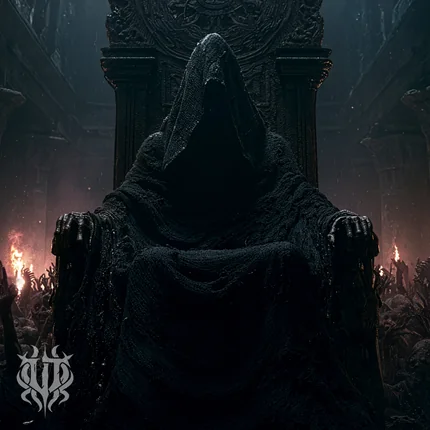
A Thousand Masks is a dark metal song inspired by Nyarlathotep, the Crawling Chaos who walks among humanity, hiding behind countless faces and whispered lies.
References
- The Dream-Quest of Unknown Kadath — original text
The fictional narrative is evidence for what the story says, not proof of events in the real world.
- The Other Gods — Unspeakable Tales ebook
The fictional narrative is evidence for what the story says, not proof of events in the real world.
- At the Mountains of Madness — original text
The fictional narrative is evidence for what the story says, not proof of events in the real world.
At a glance
The Dream-Quest of Unknown Kadath
Seventy steps; cavern of flame; seven hundred steps; Gate of Deeper Slumber
Randolph Carter
Earth’s dream regions and routes beyond them
Narrated connections with substantial uncertainty
Later additions require separate attribution