

The Horror at Red Hook
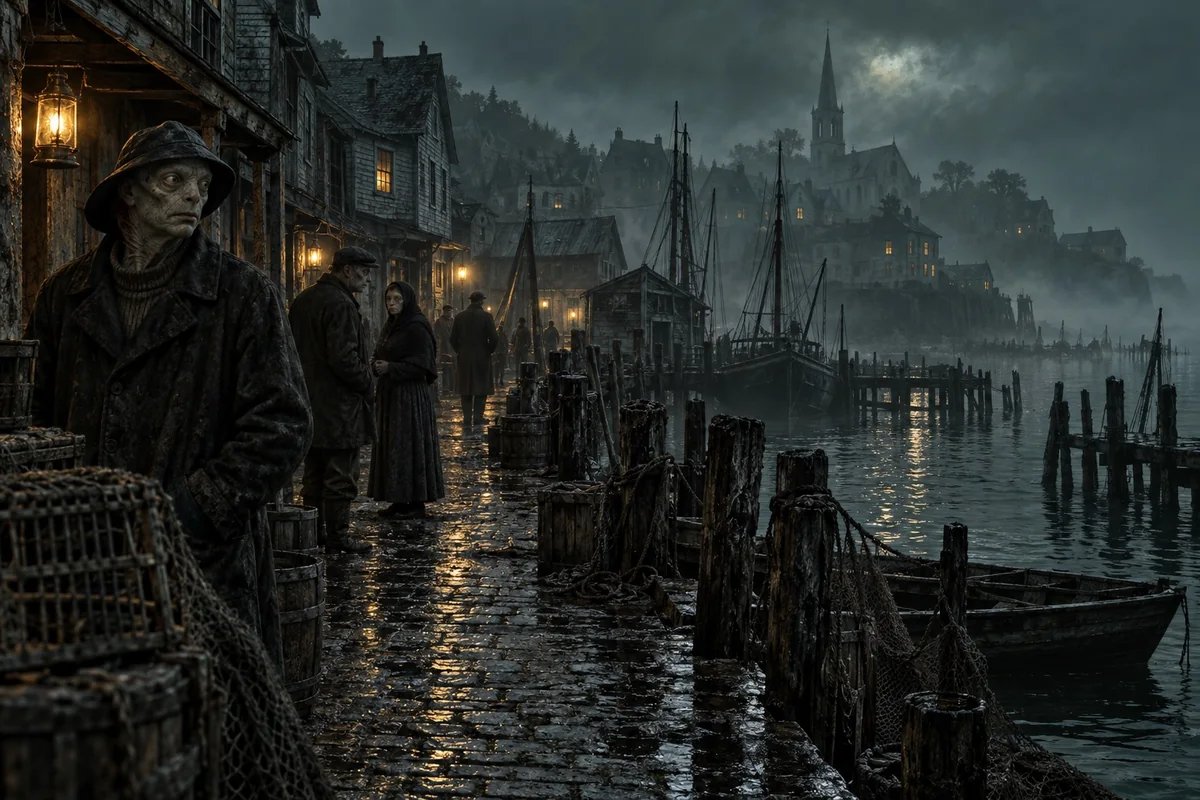
The Horror at Red Hook follows detective Thomas F. Malone into an occult investigation involving the scholar Robert Suydam, disappearances, waterfront passages and a subterranean ceremony. Its official account of a disastrous raid conflicts with Malone’s memories of what lay below the buildings. The story’s urban horror is inseparable from an aggressively racist portrayal of immigration and neighborhood life.
7 min read · 1,383 words
Composition and publication
Lovecraft wrote the story on 1–2 August 1925. It appeared in the January 1927 issue of Weird Tales. An epigraph from Arthur Machen introduces the idea of evil knowledge surviving near ordinary life, while the narrative develops that idea through a New York police case.
Sources: H. P. Lovecraft Archive — fiction in composition order, H. P. Lovecraft Archive — fiction in publication order, The Horror at Red Hook — Unspeakable Tales ebook
Malone after the disaster
The opening finds Malone on medical leave in rural Rhode Island. A walk into Pascoag brings him unexpectedly near brick buildings, provoking panic. His condition is publicly attributed to the collapse of buildings during a raid in Brooklyn.
Malone initially told his doctors more, but stopped when they rejected his account. He accepts the simpler explanation because it permits recovery outside an institution. The frame thus establishes a conflict between what a witness remembers and what others will accept as plausible.
His former interest in hidden meanings has survived as a form of vulnerability. Ordinary architecture can now recall the event with overwhelming force.
The detective and the neighborhood
Malone is an Irish-born, university-educated man whose earlier poetic interests have turned toward darker subjects. He enters police work with an unusual readiness to imagine supernatural patterns behind visible disorder.
Red Hook is described through buildings, alleys and waterfront routes, but also through sweeping hostility toward its inhabitants. The narration treats ethnic mixture, unfamiliar languages and poverty as signs of corruption. Malone's supposed insight repeatedly depends upon that hostile framing.
An accurate plot account must therefore distinguish the story's particular crimes and ceremonies from the much broader prejudices with which it describes an actual neighborhood.
Robert Suydam becomes a case
Suydam is an aging scholar from an old Dutch family, living in a deteriorating Flatbush house. Relatives seek a ruling on his sanity after changes in behavior, extravagant claims and increasing involvement with people in Red Hook.
He spends money on imported books and maintains a basement apartment used for nocturnal gatherings. At the hearing, however, he presents himself as a researcher studying traditions, songs and dances. His composed explanation secures his freedom.
The police investigation continues through a different route, linking his associates with criminal activity and clandestine arrivals by water. Malone suspects that Suydam's learning connects with something more organized than eccentric scholarship.
The hidden routes
Interviews suggest a maritime network using boats, a concealed canal and a pool beneath a house. Malone cannot initially establish the precise landing place. His sources provide fragments, and the investigation is interrupted by conflict between authorities.
Suydam meanwhile expands his Red Hook accommodation to several houses. A nearby stone church, also used as a dance hall, becomes another focus. Its sounds, painted panels and inscriptions trouble Malone, although an early search does not produce the missing child reportedly seen there.
The narrative builds its concealed city incrementally: reports of movement precede the discovery of passages that might make those movements possible.
Suydam’s apparent rejuvenation
As disappearances increase, Suydam becomes cleaner, more energetic and apparently younger. He renovates his Flatbush home, entertains relatives and resumes a socially acceptable public life. An inheritance is offered as the explanation for his improved circumstances.
He announces his engagement to Cornelia Gerritsen. The contrast between this respectable return and the continuing Red Hook activity raises the question of what his renewed vitality has cost.
A further raid finds occult designs, a small laboratory and marked gold ingots, but no directly usable evidence resolving the kidnapping cases. The investigation accumulates suggestive objects without achieving a comprehensive legal account.
The wedding voyage
After the wedding, Suydam and his bride leave aboard an ocean liner. A scream from their cabin brings the crew and physician to a scene of death. The doctor's later account includes a nonhuman-looking mark and a fleeting appearance of the name Lilith.
Men from a nearby vessel demand Suydam or his body. They produce an instruction signed by him, directing that he be surrendered in the event of sudden death or accident. Captain and doctor comply.
After the visitors leave, the physician discovers evidence that Cornelia's blood has been removed. The full meaning of the transfer will emerge only when the narrative returns to Malone's simultaneous investigation ashore.
The night raid
That evening in Red Hook, three more missing children and mounting public anger help bring about a larger raid. Malone enters Suydam's basement apartment and searches among books, instruments and bottles.
Breaking a cellar door exposes a force that draws him below. The account shifts from rooms that a police party could search to an immense subterranean experience whose dimensions cannot be reconciled so easily with the buildings above.
Malone later knows that others call it a dream. At the moment, its sensory intensity gives him no such distance.
The subterranean ceremony
Malone sees a vast interior of water, piers, arcades and monstrous figures. A luminous female presence occupies a golden pedestal. The narration associates the scene with Lilith and invokes a wide range of demonic and mythological names.
A boat brings a body wrapped in bedding, connecting the waterfront transfer with the underground setting. The body is Suydam's, now old and decayed. Bottles of blood are used in the rite, and a procession carries the corpse away toward an organ's sound.
The overlap between the two narrative strands gives Malone's otherwise unverified experience an unsettling relation to events at sea of which he had not yet been informed.
Suydam’s final act
After the ceremony, the animated corpse runs back toward the pedestal, pursued by the luminous presence and its followers. It expends its remaining force in pushing the object into the water.
The movement ends in bodily dissolution. At the same moment the scene vanishes from Malone's perception and a tremendous crash overwhelms him.
Suydam's act disrupts the ceremony, but the story does not provide a full explanation of his final motives. It should not be expanded into a confidently reconstructed moral conversion or an otherwise undocumented agreement with the powers below.
What the authorities actually find
The three houses have collapsed, killing many officers and prisoners. Malone is found unconscious beside an underground pool, near remains identified as Suydam's through dental work.
Searches reveal canals, a connecting crypt, an organ and imprisoned people. Human remains provide evidence for the disappearances, but the golden pedestal is never recovered. A depth beneath one canal is sealed when the site is rebuilt.
The public explanation emphasizes a criminal network and a violent cult. Malone considers it inadequate to the whole experience, while recognizing that his own account cannot be made legally conclusive.
An ending without secure containment
Suydam is buried beside his wife. His family hopes the scandal will fade, and the absence of a completed legal inquiry leaves room for a more respectable memory of him.
The neighborhood's ominous signs continue. Reports suggest that hidden passages may be returning, and an overheard invocation repeats the ritual language from the investigation. The story therefore refuses to make Suydam's death the end of the larger threat.
Malone seeks relief through time and distance rather than a new raid. His fear of architecture remains the visible residue of an experience whose boundaries he cannot establish.
Racism and the occult vocabulary
The narration repeatedly turns ethnic and religious difference into evidence of danger. Its hostile use of the Yazidi name, racial caricatures and language of contamination belong to its polemical construction of the setting. They should not be used as definitions of actual peoples or religions.
The story also assembles names from several traditions into a literary inferno. That accumulation creates an impression of vast inherited evil; it is not a consistent theological catalogue or a verified account of historical ritual.
Reading these features critically is essential to understanding how the story produces horror. They operate throughout its description and reasoning, rather than appearing only as isolated objectionable words.
Relation to the Mythos
The work's supernatural vocabulary differs from the later, more recognizable cluster around Cthulhu, Yog-Sothoth and the Necronomicon. Its importance to a broad Lovecraft encyclopedia includes urban space, forbidden scholarship, resurrection, testimony and the limits of investigation.
He, written later in the same month, provides a close comparison in its hidden New York architecture and hostile response to the city's inhabitants. Cool Air offers another city encounter with a very different relationship between the narrator and the keeper of an extraordinary secret.
Sources: The Horror at Red Hook — Unspeakable Tales ebook, He — Unspeakable Tales ebook, Cool Air — Unspeakable Tales ebook
References
- H. P. Lovecraft Archive — fiction in composition order
Composition dates; question marks and ranges retain the source uncertainty.
- H. P. Lovecraft Archive — fiction in publication order
First publication dates and venues; issue dates can differ from actual release dates.
- The Horror at Red Hook — Unspeakable Tales ebook
The fictional narrative is evidence for what the story says, not proof of events in the real world.
- He — Unspeakable Tales ebook
The fictional narrative is evidence for what the story says, not proof of events in the real world.
- Cool Air — Unspeakable Tales ebook
The fictional narrative is evidence for what the story says, not proof of events in the real world.
At a glance
H. P. Lovecraft
1–2 August 1925
1927, January
Weird Tales, 9, No. 1
Fiction