

He
He follows a disillusioned would-be poet through New York’s hidden courtyards to an old house whose occupant can reveal other periods of the city’s existence. A promised recovery of antique beauty exposes violence, temporal instability and the narrator’s own racial fears. The encounter ends with the host’s destruction and the visitor’s flight from the city.
5 min read · 1,040 words
Composition and publication
Lovecraft wrote He on 11 August 1925. It first appeared in the September 1926 issue of Weird Tales. Its first-person account is structured as a retrospective explanation of why the narrator abandoned a city that had once promised artistic inspiration.
The disappointed newcomer
The narrator initially sees New York as a place of extraordinary visual promise. Its towers at sunset suggest fabulous cities, while the old streets of Greenwich seem to preserve the architecture his imagination desires.
Daily life undermines those expectations. He finds himself isolated, unable to write the poetry he hoped to produce, and increasingly hostile toward the people around him. He begins walking at night, when darkness allows him to emphasize old buildings and suppress what disturbs him about the present.
His failure is therefore partly a crisis of perception. He cannot reconcile the city he wants with the inhabited city he encounters.
Sources: [3]
An apparently sympathetic guide
During an early-morning walk through hidden courts, an elderly stranger approaches. The man has noticed the narrator's interest and offers knowledge of antiquities unavailable to a newcomer.
His appearance mixes refinement with something unsettling. A cloak and broad-brimmed hat partly conceal him; his manner and voice seem out of place. The narrator registers these warnings but accepts the invitation because their shared interest promises relief from his loneliness.
The guide does not need to seize him. He gains compliance by offering precisely what the visitor most wants to find.
Sources: [3]
The route through the old city
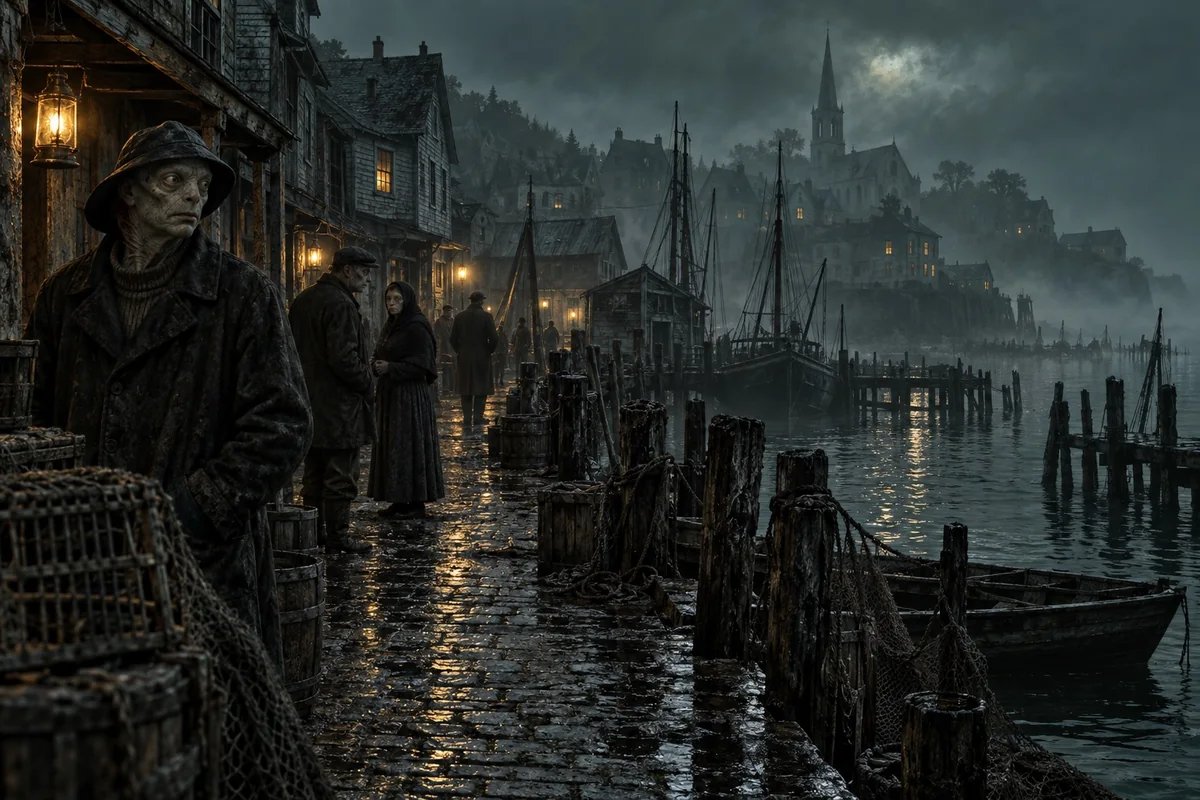
The pair move through passages, over walls and along a difficult succession of enclosed spaces. Their surroundings become increasingly archaic, including the forms of street lighting. The narrator loses his bearings.
Eventually they reach a steep approach to a walled estate, with a cupola visible above it. The host admits him through locked entrances and brings him to an upper library. Family portraits resemble the man now revealing his old-fashioned costume.
The house seems at first to vindicate the search for a surviving past. Its smell of decay and the host's insistence on silence complicate that apparent success.
Sources: [3]
The history of the secret
The host explains that an earlier squire learned rites associated with this particular ground from Indigenous visitors who sought access to it. The bargain gave the squire knowledge that they had preserved, partly through contact with an old Dutchman.
The account then turns evasive. After the exchange, the other possessors of the secret died following a supply of bad rum. The host speaks of the squire with increasing immediacy, blurring the distinction between an ancestor and himself.
His claim to refined antiquity is thus entangled with appropriation and a suspected killing. The desired past contains an unresolved act of violence.
Sources: [3]
The theory and the windows
The host describes a power of will over forces and dimensions beyond ordinary human control. His explanation is partly theatrical and partly qualified: the effects may not be completely material, but he can at least produce extraordinary spectacles.
He draws the visitor to a window. Successive flashes reveal a wooded landscape and then an older Greenwich, with fields and distant church steeples. These views move beyond architectural survival toward the apparent recovery of vanished time.
The narrator asks whether the power can reach farther. His own question helps carry the demonstration beyond the scenes that first attracted him.
Sources: [3]
The dreadful city
The next vision shows monumental terraces, pyramidal forms and strange movement in the sky. People gather on elevated structures amid a tumult of sound. The narrator experiences the scene as the concentrated fulfillment of everything he fears in New York.
His description is explicitly racialized. The people he sees are made horrifying through hostile stereotypes rather than through a neutral account of their actions. The passage should be read as part of the narrative's xenophobic imagination, not as an objective forecast of the city's population.
Overwhelmed, he screams, violating the host's demand for silence.
Sources: [3]
The return of the dead
The host's anger turns to fear as footsteps approach the locked door. He identifies the arrivals with the people implicated in the old story and protests that he did not poison them. His language makes the connection with the earlier squire increasingly difficult to dismiss.
The curtains fall, admitting moonlight. The room's apparent splendor gives way to decay, while the host blackens and shrivels until little remains beyond a head with furious eyes.
The door breaks. A dark mass containing many eyes flows in, surrounds what remains of the host and carries it away. It does not attack the narrator.
Sources: [3]
Collapse and escape
The building begins to fail around the surviving visitor. He drops through a floor, escapes through a broken window and struggles to climb the enclosing wall. A further fall leaves him badly injured.
He is found near a court off Perry Street, with a trail of blood indicating movement from elsewhere. Rain removes the trace, and the exact site of the house cannot be reconstructed from the surviving public account.
The narrator returns to New England and refuses any further exploration of the hidden route. His account ends in withdrawal, rather than a successful explanation of the powers he witnessed.
Sources: [3]
Nostalgia and its danger
The story makes longing for the past an active vulnerability. The narrator repeatedly accepts unease because the alternative seems to be an intolerable present. His host exploits that preference, while embodying an old world whose refinement does not imply innocence.
The final violence can be read as the return of a suppressed history against its beneficiary. That interpretation does not erase the story's own racist portrayal of both contemporary inhabitants and supernatural avengers. The text can expose the cruelty of the host while still using dehumanizing language to imagine those he wronged.
Sources: [3]
Place in the wider fiction
He uses temporal visions, a concealed residence and a survivor's difficult testimony without explicitly presenting a named Cthulhu Mythos deity. Its unnamed magician should not automatically be relabeled as Nyarlathotep.
For comparison, Pickman's Model also offers an unsettling guide through hidden urban spaces, while Cool Air places an apparently impossible survival inside a New York residence. Each story gives the visitor a different relationship with the person who holds the secret.
References
- H. P. Lovecraft Archive — fiction in composition order
Composition dates; question marks and ranges retain the source uncertainty.
- H. P. Lovecraft Archive — fiction in publication order
First publication dates and venues; issue dates can differ from actual release dates.
- He — Unspeakable Tales ebook
The fictional narrative is evidence for what the story says, not proof of events in the real world.
- Pickman's Model — Unspeakable Tales ebook
The fictional narrative is evidence for what the story says, not proof of events in the real world.
- Cool Air — Unspeakable Tales ebook
The fictional narrative is evidence for what the story says, not proof of events in the real world.
At a glance
H. P. Lovecraft
11 August 1925
1926, September
Weird Tales, 8, No. 3
Fiction