

N’kai
N’kai is the lightless subterranean realm beneath Yoth in The Mound. Ancient records describe it as the source of images of Tsathoggua, while a later expedition reports living, shapeless worshippers moving through its stone channels. The resulting disaster leads to a sealed passage, the destruction of the cult’s images in K’n-yan and centuries of uncertainty about whether the route can ever be found again.
5 min read · 845 words
Below the red-lit world
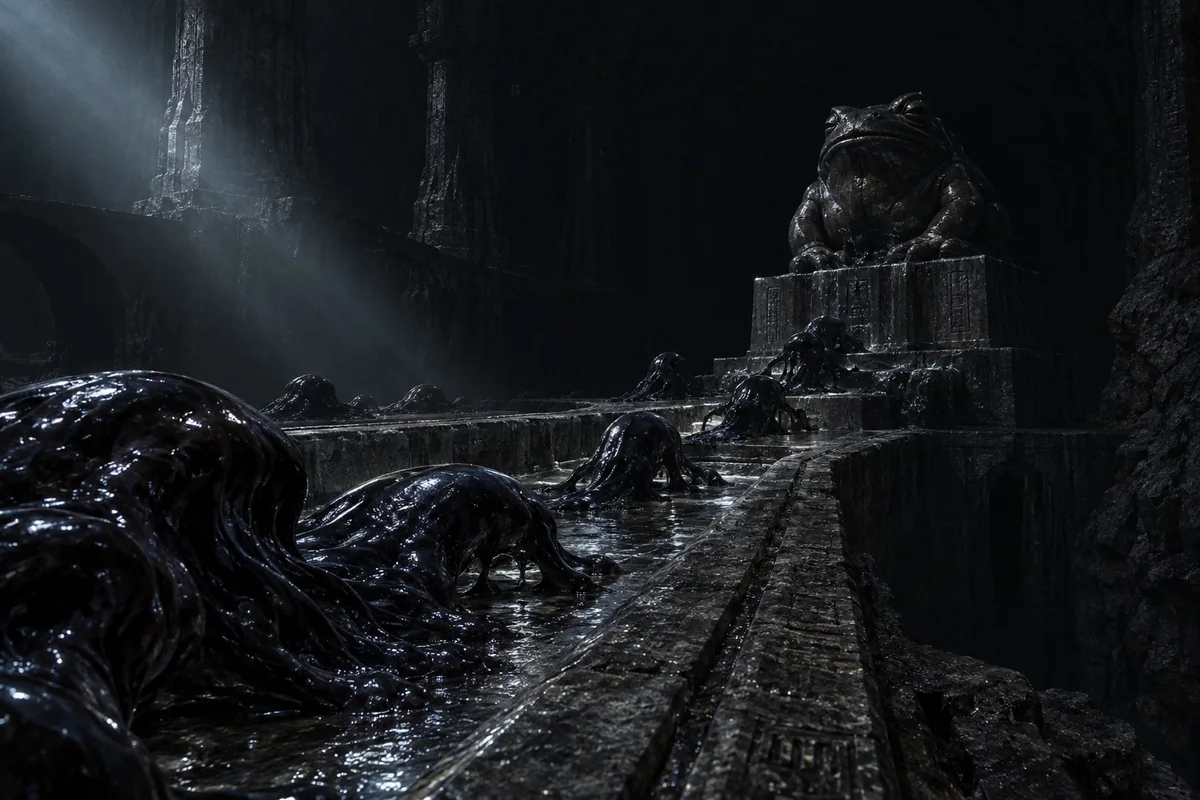
N’kai occupies the deepest of the three named regions in the story’s principal underground sequence. K’n-yan has blue illumination, Yoth has red illumination, and N’kai has none.
Sources: [1]
The lack of light is not presented as proof that nothing could live there. The older traditions describe beings with senses suited to conditions unlike those of the upper worlds.
Its darkness therefore marks a change in the assumptions an explorer can make. An environment that offers no natural visibility to the visitor may still be fully usable by its inhabitants.
What the Yothic records claim
The scholars of Yoth believed that N’kai had supported civilizations and gods before their own people existed. They explored it and found unusual stone troughs or burrows that prompted speculation about their makers.
Their records also associated the realm with the images of Tsathoggua found in Yoth. Those images were understood as possible representations of an extinct population.
At the time recorded by the surviving manuscripts, the explorers reported no continuing life. This is an observation attributed to a particular exploration, not an omniscient guarantee that every chamber had always been empty.
Sources: [1]
The expedition from K’n-yan
After discovering and studying Yoth, the people of K’n-yan eventually descend farther. They bring powerful artificial searchlights into the black region, replacing natural illumination with their own technical means.
The expedition encounters living things that the earlier documents had not prepared them to expect. The survivors do not remain to conduct a careful biological survey.
This limitation is central to the report. The text establishes that the encounter was terrifying and that some explorers escaped, but it does not supply a full census, a complete account of casualties or a detailed map of the inhabited chambers.
Sources: [1]
The shapeless worshippers
The beings are described as masses of dark, viscous material that assume temporary forms as needed. They move along stone channels and worship onyx and basalt images of Tsathoggua.
Their appearance differs from the toadlike figure of the god’s images. The distinction prevents a common confusion: the active organisms encountered in the darkness are worshippers, not automatically Tsathoggua himself.
The Mound does not give them a complete species history or an exhaustive list of abilities. Later terminology may classify related beings as formless spawn, but the original scene should remain grounded in the behavior and material qualities actually described.
Sources: [1]
Why the accounts disagree
The discovery of life conflicts with the Yothic account of an empty realm. The narration considers the possibility that an earthquake opened chambers the earlier explorers could not reach, or that some still less comprehensible change occurred between the two expeditions.
Those suggestions remain hypotheses. The story does not choose a single cause or demonstrate that the beings arrived from another planet during a particular period.
The uncertainty also leaves open the relationship between N’kai’s surviving population and the collapse of Yoth. A possible connection is suggestive, but it is not a narrated war with a securely established outcome and chronology.
Sources: [1]
Sealing the route and abolishing the cult
The survivors close the passage from Yoth into N’kai. In K’n-yan, images of Tsathoggua are destroyed through the civilization’s disintegrating technology, and the cult loses its accepted place.
The response transforms an exploratory disaster into a religious and cultural break. A deity adopted through ancient objects becomes associated with a danger considered too severe to preserve its images.
Some architectural traces remain, including empty or repurposed temples. Tsath also retains the name associated with the former cult. Suppression removes the active worship without perfectly erasing its historical effects.
Sources: [1]
The missing gate
In a later period, confidence and scientific curiosity replace the earlier fear. A properly equipped party returns to Yoth intending to locate the sealed descent and investigate what remains below.
It cannot find the gate. Subsequent searches also fail, and the existence of the abyss itself becomes a matter of debate among people who no longer have direct access to it.
The older Yothic manuscripts and the less secure middle records of K’n-yan carry different degrees of authority for scholars. The story therefore includes disagreement about sources inside its own fictional world, rather than giving every tradition the same evidentiary weight.
Sources: [1]
N’kai and the scale of the unknown
N’kai is important because it unsettles a civilization that already seems almost impossibly advanced to the human visitor. Longevity, telepathy and mastery of matter do not make K’n-yan immune to fear or error.
The deeper realm also reverses the usual direction of explanation. The discovery of an older world might promise to clarify the origins of a cult, yet the actual encounter makes the cult more alarming and less comprehensible.
Its remaining mystery should not be replaced by an invented catalog of rooms, rulers or secret routes. The source gives a dark environment, a chain of archaeological testimony, a disastrous encounter and a lost entrance. Those limits are part of N’kai’s specific role in the tale.
Sources: [1]
References
- The Mound — original text
The fictional narrative is evidence for what the story says, not proof of events in the real world.
At a glance
The Mound
Beneath Yoth
None
Shapeless, dark, viscous worshippers of Tsathoggua
Passage sealed; later searchers fail to locate it
Yothic manuscripts and K’n-yan’s later exploratory tradition