

K’n-yan
K’n-yan is the blue-lit subterranean world described in The Mound, written by Lovecraft for Zealia Bishop. Its principal city, Tsath, contains an ancient civilization that has conquered aging, developed telepathy and learned to alter the material state of bodies. The apparent abundance of this society conceals an economy of enslavement and a system that welcomes knowledgeable visitors while forbidding them to leave.
7 min read · 1,317 words
Name and position
The Spanish manuscript embedded in the story records the name as Xinaián. The modern narrator presents K’n-yan as a rendering better suited to the sounds implied by the manuscript’s supplementary marks and explanations.
Sources: [1]
It is the uppermost of the three named subterranean regions central to the account. Beneath its blue illumination lies red-lit Yoth, and beneath Yoth is the lightless realm called N’kai.
This order is explicit, but it is not a complete geological map. The story gives routes, ruined settlements and important thresholds without providing a measurable survey of the entire underground system.
How the account reaches the surface
Most of the information comes from Pánfilo de Zamacona, a fictional Spanish adventurer who leaves Coronado’s expedition in 1541. Guided to an entrance by Charging Buffalo, he travels through descending passages and eventually reaches the blue-lit landscape.
Centuries later, the frame narrator discovers his manuscript in a metal cylinder beneath an Oklahoma mound. Reading the document changes the apparent local haunting into evidence of a guarded route to the underground civilization.
The modern investigator does not personally tour Tsath. His direct experience is confined to the mound and its entrance passages. The distinction between the Spanish account and the later corroborating encounter is fundamental to the story’s presentation of evidence.
Sources: [1]
Light, weather and landscape
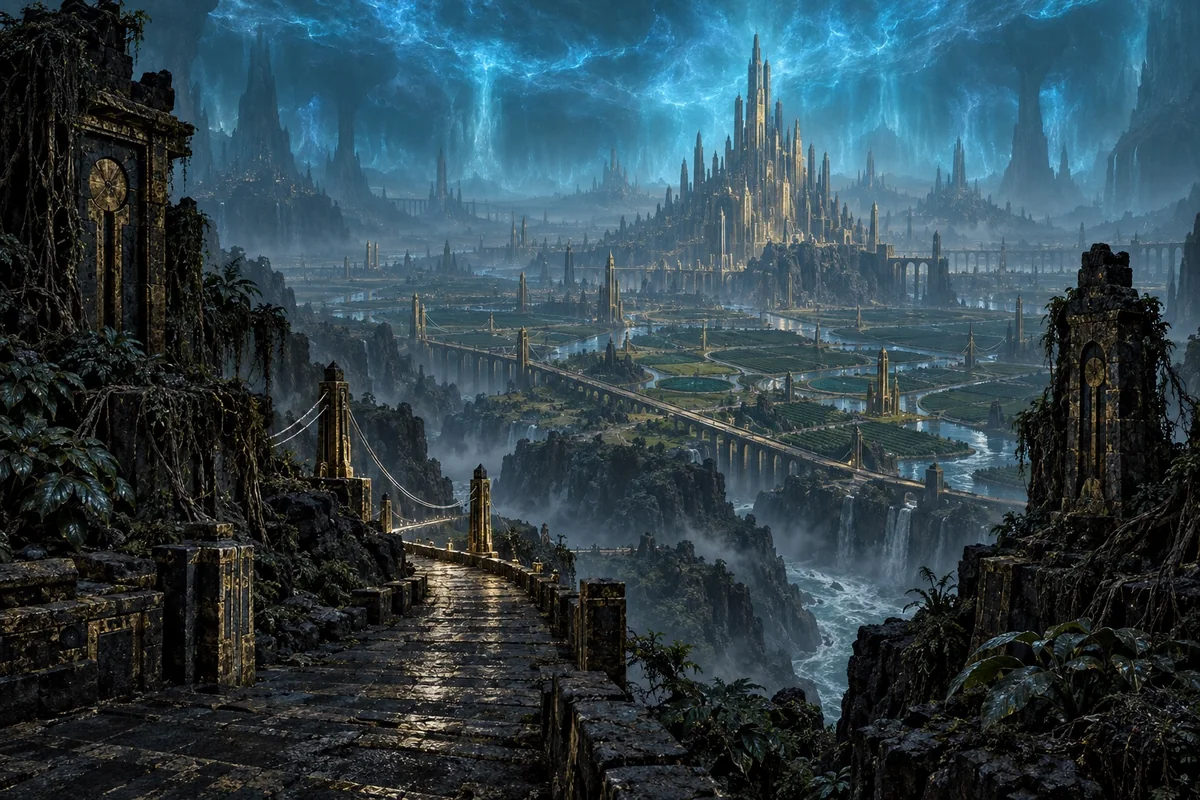
K’n-yan’s overhead atmosphere shines with a diffuse blue radiance compared with electrical or auroral effects. It does not depend on a visible sun. Zamacona encounters mountains, plains, rivers, vegetation and extensive settlements beneath this illumination.
Mist gathers in lower areas, and occasional condensation produces rain without extinguishing the light above. The temperature appears comparatively stable, allowing a landscape that differs sharply from the narrow dark passages through which the visitor arrives.
The region should not be illustrated as a small cave containing a few buildings. Its apparent horizon, mountains and broad plains create the experience of an entire interior world, even though it remains physically connected with passages in the Earth.
Sources: [1]
The abandoned plain
Zamacona first crosses an area of deserted settlements and old temples. Gold has been used extensively in architecture and decoration, making the place seem like a fulfillment of the expeditionary fantasies that drew Europeans into the continent.
B’graa is one of the older cities shown to him. Its narrow, winding streets and tall, elaborate buildings differ from the more regular planning of later settlements. Ruined walls recall the period when Tsath conquered competing populations.
The emptiness of this first landscape does not mean the civilization has vanished. Population has concentrated elsewhere, leaving former centers as antiquarian and religious sites. The visitor reaches the living metropolis only after passing through this older layer.
Sources: [1]
Tsath and its surrounding economy
The city of Tsath rises so high above the plain that Zamacona initially mistakes its outline for a mountain covered with buildings. Its towers, terraces and dense streets are approached through irrigated fields and carefully laid roads.
Some of the tallest structures are no longer fully occupied, and newer low dwellings spread outside the old center. The city preserves the scale of an earlier population and a greater appetite for construction than its current residents require.
Agriculture, transport and domestic service continue through a large coerced labor system. The comfort of the free population is therefore not evidence that labor or violence has disappeared; it is evidence that both have been transferred to people and organisms denied the same standing.
Sources: [1]
Telepathy and the survival of language
The inhabitants ordinarily communicate by directing thought. Zamacona first understands them through concentrated attention to their gaze and gradually learns to respond in the same way.
Spoken language has not vanished. It survives in writing, ceremonial use and emotional expression. The manuscript consequently contains attempts to render unfamiliar names and sounds, even though much of the information has supposedly been conveyed without ordinary speech.
This combination gives the civilization both immediacy and historical depth. Telepathy is a developed practice of its present life, while books, names and ritual utterances preserve older forms of communication.
Sources: [1]
Longevity and material transformation
The free inhabitants can regulate aging and avoid ordinary death. Some choose to experience age or eventually to die, but these choices occur within a society that treats longevity as a technical achievement rather than a miraculous exception.
They can also dematerialize and rematerialize themselves or other objects through trained mental control. The process requires effort and skill; it is not portrayed as something every person performs flawlessly at every moment.
Zamacona learns only imperfectly. His eventual hope of escape depends on maintaining an unstable acquired ability, which makes the difference between a native expert and an outsider practically decisive.
Sources: [1]
The gyaa-yothn and the y’m-bhi
The gyaa-yothn are horned, partly anthropoid beasts used for riding, carrying loads and other work. Their ancestry is associated with organisms found in Yoth and with later breeding by the inhabitants of K’n-yan. Their intelligence is sufficient for one of them to report the fugitives’ departure.
The y’m-bhi are reanimated dead bodies used as laborers or guards. They are controlled through the civilization’s technical and mental procedures, and some bear the consequences of punishment or public entertainments.
These are distinct categories. A riding beast is not simply another name for a reanimated corpse, and neither category should be treated as synonymous with the ordinary free inhabitants of Tsath.
Sources: [1]
Religion and inherited forms
Yig and Tulu occupy major places in the religious landscape. Their cults preserve accounts of life, origins and cosmic history, but many inhabitants participate for aesthetic and emotional stimulation rather than literal belief.
The story also mentions temples associated with Nug, Yeb, Shub-Niggurath and the Not-to-Be-Named One. It does not describe all their rites equally. Zamacona’s selective reporting and religious aversion leave deliberate gaps.
The sacred Tulu-metal has a particularly persistent authority. Used for ritual objects and manuscript containers, it remains a focus of reverence even as attitudes toward inherited religion change.
Sources: [1]
The abandoned cult of Tsathoggua
K’n-yan adopted Tsathoggua’s images and cult after discovering the older world of Yoth. For a time the worship became prominent enough to influence the name of Tsath itself.
A disastrous exploration of N’kai then produced reports of shapeless living beings worshipping the same images. The survivors sealed the route, and the images in K’n-yan were destroyed. Some former temples stood empty or were assigned to other worship.
Later attempts to locate the sealed descent failed, making the original disaster a subject of dispute. K’n-yan thus contains its own uncertain archaeology: an advanced civilization arguing over evidence from worlds older and less accessible than itself.
Sources: [1]
Hospitality without freedom to depart
Zamacona receives comfortable accommodation, access to libraries, instruction and companions. His knowledge of the surface is valuable, and the inhabitants want to learn about the expanding European presence above them.
The price is permanent residence. They fear that an returning traveler could expose their wealth and entrances to invasion. Courtesy and intellectual curiosity therefore coexist with a prohibition enforced by punishment.
T’la-yub helps Zamacona attempt escape through a passage preserved in her family’s traditions. Their capture exposes the inequality hidden beneath the welcome: the useful foreign informant is temporarily spared, while the woman who helped him receives a devastating sentence.
Sources: [1]
Social criticism and the narrator’s prejudices
The society’s technical accomplishments do not prevent boredom, cruelty or political stagnation. Its search for new sensations makes the suffering of enslaved beings part of ordinary entertainment. The narrative can be read as a satire of abundance severed from restraint or sympathy.
At the same time, the text’s account is saturated with racial hierarchy, eugenic assumptions and colonial self-congratulation. Those judgments belong to the story’s historical language and narrators; they are not reliable anthropology or principles adopted by this encyclopedia.
K’n-yan is a fictional invention using real geographical and historical references. Its imagined ancestry, skull classifications and supernatural traditions should not be presented as factual descriptions of Indigenous American peoples.
Sources: [1]
Related music
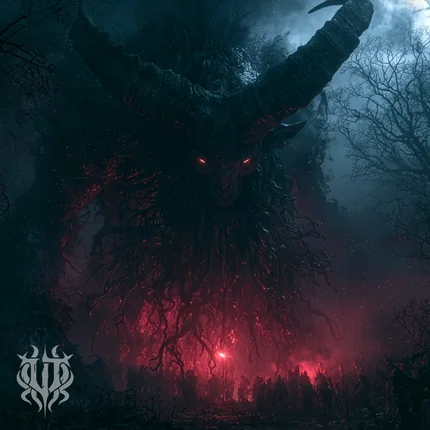
The Black Goat of The Woods is a dark metal tribute to Shub-Niggurath, the ancient woodland deity whose forgotten cults gather beneath twisted trees and indifferent stars.
References
- The Mound — original text
The fictional narrative is evidence for what the story says, not proof of events in the real world.
At a glance
The Mound
Xinaián
Diffuse blue radiance
Tsath
Yoth; then N’kai
Telepathy, longevity, dematerialization and reanimation
Pánfilo de Zamacona
Departure prohibited