

Yoth
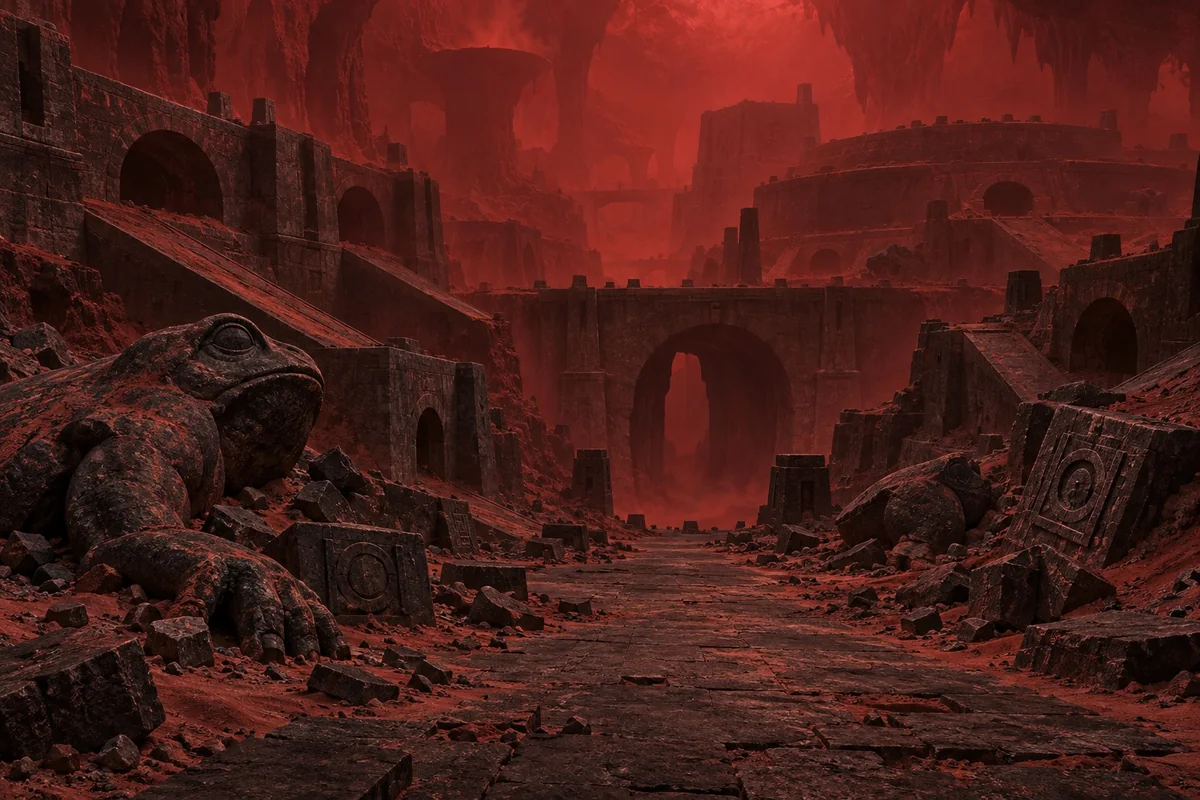
Yoth is the red-lit subterranean region beneath K’n-yan in The Mound. Its ruined cities and surviving records belong to a civilization older than the people who later study it. Yoth provides both the archaeological evidence for an earlier reptilian society and the route by which the cult of Tsathoggua enters K’n-yan from the still deeper darkness of N’kai.
4 min read · 824 words
The middle region
The narrative places Yoth below the blue-lit world inhabited by the people of Tsath and above the lightless realm of N’kai. Its red illumination gives it a clear sensory distinction from both neighboring regions.
Sources: [1]
The three names are therefore not interchangeable descriptions of a single cavern. They designate different environments with different histories and degrees of accessibility.
No comprehensive dimensions or modern coordinates are supplied for Yoth. Its position is established through the underground civilization’s accounts of exploration, rather than through a surface survey that could be plotted with precision.
The vanished builders
Archaeologists from K’n-yan find remains of an older nonhuman civilization in Yoth. Surviving manuscripts and carvings indicate that its inhabitants were quadrupedal and had reptilian affinities.
The text does not provide a complete anatomical description of every member of this civilization. Nor does it establish that the ruins were built by the same people who now occupy Tsath.
This separation matters when connecting Yoth with later Mythos material. The story’s particular evidence should come before a generalized assumption that every ancient reptilian society belongs to one universally consistent species.
Sources: [1]
The records beneath the ruins
A small body of documents and carvings survives in the vaults of Zin beneath Yoth’s largest ruined city. These remains provide information about the builders’ bodies, their technical achievements and their knowledge of N’kai.
The name Zin also occurs in Lovecraft’s Dreamlands writing. The Mound does not supply a detailed route proving that the two appearances refer to a single continuously mapped location.
For this account, the relevant vaults are the archaeological repository described beneath a city in Yoth. That local context is more secure than an invented diagram joining every use of the name across separate stories.
Sources: [1]
Artificial life and uncertain descendants
The earlier civilization could create living organisms for work, transport and amusement. Its records describe the making and destruction of several kinds of designed life.
When later explorers encounter beasts in Yoth, they cannot confidently decide whether those animals descend from the vanished inhabitants or from their artificial creations. The shared fact of four-legged movement does not settle the question.
The gyaa-yothn used in K’n-yan are associated with these Yothic animals and with subsequent crossing and alteration. Their history is consequently composite. Calling them unchanged survivors of Yoth’s original ruling population would erase an uncertainty the text explicitly preserves.
Sources: [1]
The images of Tsathoggua
Yoth contains numerous images of Tsathoggua, described as a toadlike deity. Its manuscripts say that the images came from N’kai, a deeper realm whose civilization and gods were older still.
The scholars of Yoth had explored that darkness and speculated about unusual stone channels or burrows. They believed that no living population remained there. Their interpretation of the images as representations of an extinct race was therefore an archaeological hypothesis.
The later explorers from K’n-yan inherit both the images and the hypothesis. The subsequent encounter in N’kai demonstrates the danger of treating an older survey as a permanent statement about what can exist below.
Sources: [1]
A route of religious transmission
After studying Yoth’s records, the people of K’n-yan bring the Tsathoggua images upward and build shrines using basalt quarried in the red-lit world. An archaeological discovery becomes the basis of a living cult.
This sequence gives Yoth an active historical role despite the loss of its builders. Objects and documents continue to affect later societies, shaping architecture, worship and the names of places.
The transmission is not a direct eyewitness appearance of Tsathoggua. It is the movement of images and traditions through several civilizations, each interpreting remains left by an earlier one.
Sources: [1]
The sealed descent into N’kai
The explorers from K’n-yan pass through Yoth on their way into N’kai. What they find below frightens the survivors into sealing the passage and prompts the suppression of the cult above.
Much later, another expedition tries to rediscover that gate and cannot find it. Yoth remains known while the exact access to the deeper region becomes uncertain or lost.
The story suggests possible explanations for the discrepancy between old reports of a lifeless N’kai and the later living horrors, including changes that might have opened previously inaccessible chambers. It does not confirm one explanation or establish the precise cause of Yoth’s own decline.
Sources: [1]
Yoth’s place in the narrative
Yoth extends the story’s historical depth beyond K’n-yan. Even the seemingly immeasurable civilization of Tsath turns out to be a late interpreter of older ruins.
Its strongest connections are archaeological: records, designed organisms, imported images and a missing gate. These details make it more than a colored layer on a fantasy map.
The modern frame narrator never personally visits it. Readers know Yoth through Zamacona’s account of what he learns below, so a source-conscious description preserves both the concrete reported features and the successive layers of testimony through which they arrive.
Sources: [1]
References
- The Mound — original text
The fictional narrative is evidence for what the story says, not proof of events in the real world.
At a glance
The Mound
Red
Below K’n-yan and above N’kai
A vanished quadrupedal civilization with reptilian affinities
Cities, the vaults of Zin, manuscripts and Tsathoggua images
Relationship between the original inhabitants and later animals